

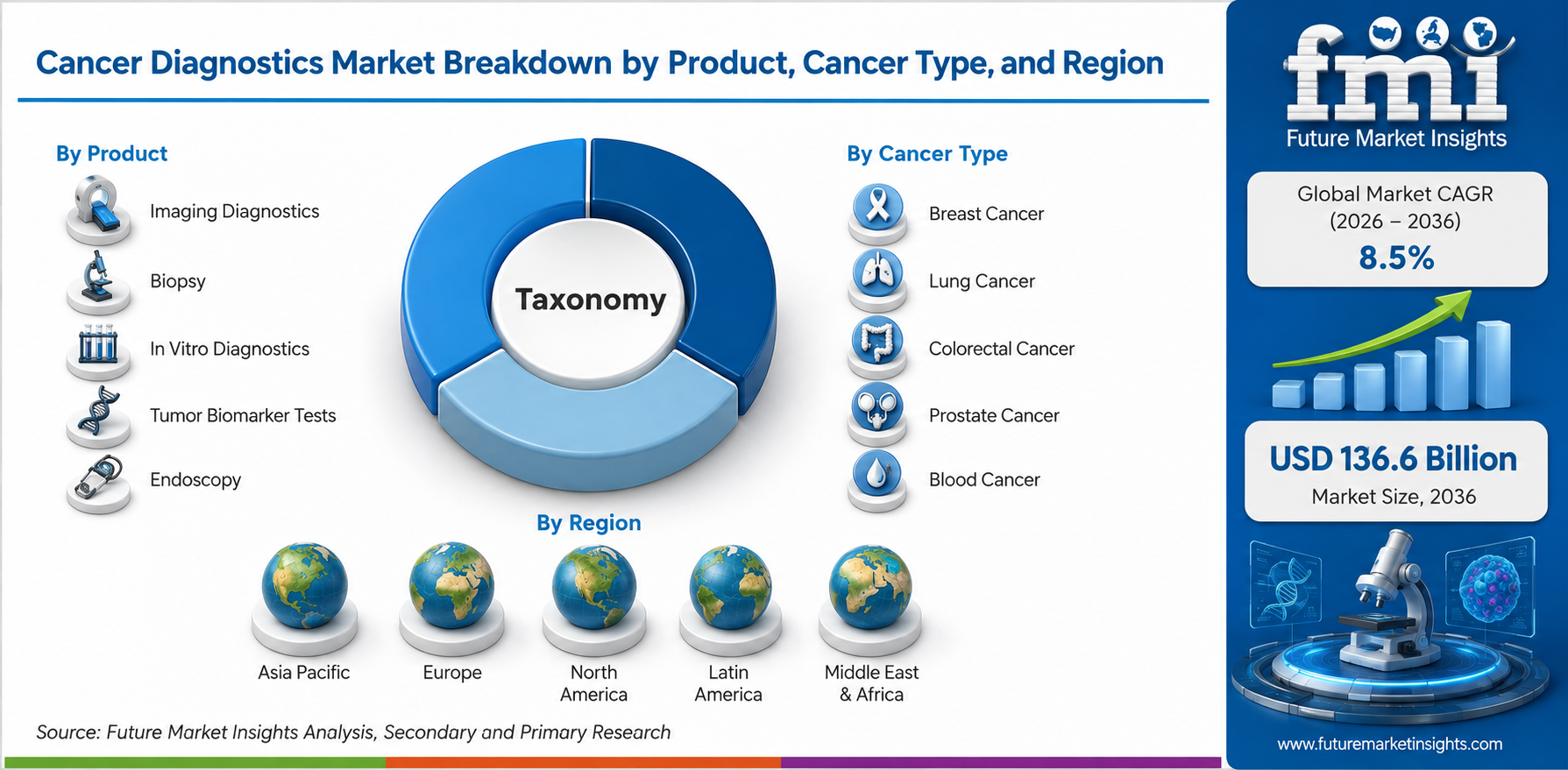
NEWARK, Del., Aug. 4, 2026 — The global Cancer Diagnostics Market is witnessing strong momentum as precision medicine, companion diagnostics, and advanced molecular testing continue transforming cancer detection and treatment decisions. According to Future Market Insights (FMI), the market is projected to grow from USD 60.4 billion in 2026 to USD 136.6 billion by 2036, registering a 8.5% CAGR during the forecast period. Rising cancer prevalence, expanding screening programs, increasing adoption of biomarker-based diagnostics, and continuous regulatory approvals for companion diagnostic assays are supporting sustained market expansion.
A recent milestone highlighting this momentum is F. Hoffmann-La Roche Ltd.‘s FDA approval of the VENTANA PD-L1 (SP263) Assay, designed to identify patients with metastatic or locally advanced urothelial carcinoma who may benefit from IMFINZI™ (durvalumab) therapy. The approval reinforces the growing role of companion diagnostics in personalized oncology, enabling clinicians to make more informed treatment decisions based on tumor biomarker expression.
👉 Get Detailed Market Forecasts, Competitive Benchmarking, and Pricing Trends
The market is expected to create an absolute dollar opportunity of USD 76.2 billion between 2026 and 2036. Market growth continues to be supported by expanding precision oncology initiatives, increasing hospital investments in diagnostic infrastructure, growing adoption of molecular testing technologies, and rising demand for early cancer detection solutions.
Key Cancer Diagnostics Market Highlights at a Glance
- Market Size (2026): USD 60.4 Billion
- Forecast Market Size (2036): USD 136.6 Billion
- Forecast Period: 2026–2036
- CAGR (2026–2036): 8.5%
- Absolute Dollar Opportunity: USD 76.2 Billion
- Leading End User: Hospitals (48.0% Market Share in 2026)
- Leading Sample Type: Blood Samples (41.0% Market Share in 2026)
- Fastest-growing Markets: India and South Korea
- Key Segments Covered: Product Type, Sample Type, End User, Region
Analyst Viewpoint
“The cancer diagnostics market is rapidly evolving from conventional disease detection toward precision oncology platforms that guide individualized treatment decisions. Regulatory approvals of companion diagnostic assays, such as Roche’s VENTANA PD-L1 (SP263) Assay, demonstrate how biomarker testing is becoming an essential component of cancer care. AI-enabled pathology, molecular diagnostics, liquid biopsy, and real-world clinical data will continue shaping the future of oncology diagnostics while improving patient outcomes and healthcare efficiency.” Anurag Sharma, Principal Analyst at Future Market Insights
Why Is the Cancer Diagnostics Market Growing?
Growing global cancer incidence, increasing demand for personalized medicine, and wider adoption of biomarker-based testing continue fueling market expansion.
Key Growth Drivers
- Rising global cancer prevalence.
- Expansion of national cancer screening programs.
- Increasing adoption of precision oncology.
- Growing regulatory approvals for companion diagnostics.
- Rising demand for molecular and genetic testing.
- Increasing investments in hospital diagnostic infrastructure.
- Growing integration of artificial intelligence in pathology and imaging.
As healthcare providers increasingly focus on earlier diagnosis and personalized treatment selection, cancer diagnostics continue becoming a cornerstone of modern oncology care.
Which End User Leads the Cancer Diagnostics Market?
Hospitals dominate the market, accounting for 48.0% of total revenue in 2026.
Growing oncology patient volumes, expanding diagnostic laboratories, integrated pathology services, and increasing adoption of advanced imaging and molecular testing continue supporting hospital leadership across the global market.
End User Segment Highlights
- Hospitals remain the leading diagnostic providers.
- Oncology centers continue expanding molecular testing capabilities.
- Precision medicine initiatives increase diagnostic investments.
- Companion diagnostic adoption strengthens hospital demand.
Why Do Blood Samples Dominate Cancer Diagnostics?
Blood Samples account for 41.0% of the market in 2026, reflecting growing demand for minimally invasive diagnostic procedures.
Liquid biopsy technologies continue gaining clinical acceptance by enabling easier disease monitoring, treatment response evaluation, and recurrence detection while reducing patient burden.
Sample Type Highlights
- Blood samples remain the leading specimen type.
- Liquid biopsy adoption continues expanding.
- Repeat testing improves patient monitoring.
- Precision oncology increases biomarker testing demand.
How Are Companion Diagnostics Expanding Market Adoption?
Companion diagnostics continue reshaping oncology by helping physicians identify patients most likely to benefit from targeted therapies.
The FDA approval of Roche’s VENTANA PD-L1 (SP263) Assay represents an important advancement in personalized medicine. The assay evaluates PD-L1 protein expression within tumor and immune cells, providing clinicians with valuable information for selecting patients who may respond to IMFINZI™ (durvalumab) immunotherapy in metastatic or locally advanced urothelial carcinoma.
As pharmaceutical companies increasingly develop biomarker-driven therapies, demand for validated companion diagnostics is expected to accelerate across multiple cancer indications.
Companion Diagnostic Highlights
- FDA approvals strengthen precision oncology adoption.
- Biomarker-guided therapies improve treatment selection.
- Companion diagnostics support personalized medicine.
- Molecular pathology expands across oncology care.
Market Dynamics
Market Drivers
Growing cancer incidence, expanding precision medicine programs, increasing molecular diagnostics adoption, rising investments in companion diagnostics, technological innovation in pathology, and wider implementation of AI-enabled diagnostic platforms continue driving global market growth.
Market Restraints
High diagnostic equipment costs, reimbursement limitations, shortage of trained pathology professionals, regulatory complexities, and unequal access to advanced diagnostic technologies remain key challenges for market expansion.
Market Trends
Innovation continues transforming cancer diagnostics worldwide.
Major trends include:
- AI-assisted digital pathology.
- Liquid biopsy expansion.
- Companion diagnostic approvals.
- Precision oncology integration.
- Next-generation sequencing adoption.
- Multi-cancer early detection testing.
- Cloud-based diagnostic workflows.
Regional and Country Outlook
India and South Korea continue demonstrating strong market readiness as healthcare infrastructure expands and cancer screening programs improve patient access to early diagnosis.
China remains one of the largest cancer diagnostics markets due to high patient volumes, expanding oncology care capacity, and increasing investments in molecular testing technologies.
North America continues leading innovation through strong regulatory support, significant oncology R&D investments, and rapid commercialization of companion diagnostics, while Europe continues strengthening adoption through precision medicine initiatives and expanding cancer screening programs.
Competitive Landscape
Competition remains centered on technological innovation, molecular diagnostics, companion diagnostic development, AI-powered pathology, regulatory approvals, and strategic collaborations between pharmaceutical and diagnostic companies.
Leading companies continue investing in next-generation sequencing, liquid biopsy, digital pathology, and integrated oncology testing platforms to strengthen their global market position.
Key Companies
- F. Hoffmann-La Roche Ltd.
- Thermo Fisher Scientific Inc.
- Abbott Laboratories
- Illumina Inc.
- bioMérieux SA
- Siemens Healthineers
- GE HealthCare
- Hologic Inc.
- Agilent Technologies Inc.
- BD
- Myriad Genetics Inc.
- QIAGEN
Frequently Asked Questions
- What is the projected size of the Cancer Diagnostics Market by 2036?
The global Cancer Diagnostics Market is projected to reach USD 136.6 billion by 2036, growing from USD 60.4 billion in 2026. - What is the expected CAGR of the Cancer Diagnostics Market?
The market is forecast to expand at an 8.5% CAGR between 2026 and 2036. - Which end user dominates the Cancer Diagnostics Market?
Hospitals lead the market, accounting for 48.0% of total demand in 2026. - Which sample type holds the largest market share?
Blood samples remain the leading segment, representing 41.0% of the global market in 2026. - What factors are driving market growth?
Growing cancer incidence, increasing precision oncology adoption, expanding screening programs, rising companion diagnostic approvals, molecular diagnostics innovation, AI-enabled pathology, and increasing hospital investments continue driving the global Cancer Diagnostics Market.
Related Reports:
- https://www.openpr.com/news/4594133/human-ipsc-biobanking-for-drug-discovery-market-projected
- https://www.openpr.com/news/4594146/multi-organ-transplant-monitoring-market-to-achieve-usd
- https://www.openpr.com/news/4594154/new-approach-methodologies-drug-development-market-expected
- https://www.openpr.com/news/4594161/fampridine-market-to-reach-usd-11-7-million-by-2036-as-growing
- https://www.openpr.com/news/4594168/neuro-restoration-spinal-cord-injury-market-forecast-to-reach
About Future Market Insights (FMI)
Future Market Insights (FMI) is a global market intelligence and consulting firm providing comprehensive market research, competitive intelligence, and strategic business insights across industries. The firm delivers detailed forecasts, technology analysis, and data-driven recommendations that support informed decision-making for manufacturers, investors, distributors, and policymakers worldwide.
For Press & Corporate Inquiries
Rahul Singh
AVP – Marketing and Growth Strategy
Future Market Insights, Inc.
+91 8600020075
For Sales – sales@futuremarketinsights.com
For Media – Rahul.singh@futuremarketinsights.com
For Web – https://www.futuremarketinsights.com