

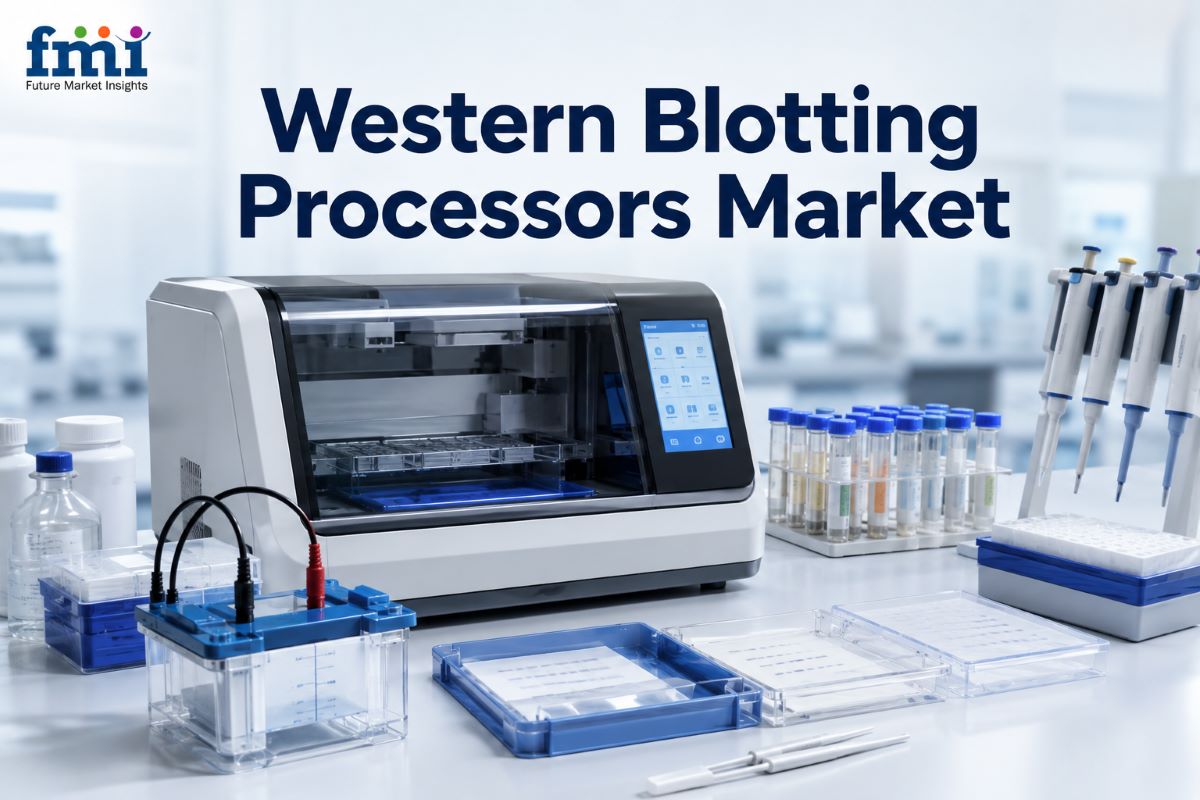
The global western blot processors market is witnessing steady growth as laboratories, research institutes, and diagnostic centers increasingly adopt automated protein analysis technologies. Western blotting, also known as immunoblotting, remains one of the most reliable analytical techniques for detecting specific proteins in complex biological samples. Its high sensitivity, specificity, and reproducibility make it an essential tool across molecular biology, proteomics, disease diagnosis, and pharmaceutical research.
The growing shift toward laboratory automation is further supporting market expansion. Manual western blotting is labor-intensive and time-consuming, prompting laboratories to adopt fully automated and semi-automated processors that improve workflow efficiency while minimizing human error. As a result, demand for advanced western blot processors continues to increase across both research and clinical applications.
Market Outlook
The western blot processors market is expected to expand steadily through 2036, supported by rising investments in life science research, increasing adoption of automated laboratory equipment, and growing applications in disease diagnosis. Pharmaceutical and biotechnology companies continue to increase research spending, creating favorable conditions for advanced protein analysis technologies.
Demand remains strong across academic research institutes, pharmaceutical companies, biotechnology firms, clinical laboratories, diagnostic centers, and contract research organizations (CROs). Consequently, manufacturers are introducing faster, more user-friendly systems capable of processing multiple samples simultaneously while improving result consistency.
Growing Prevalence of Infectious Diseases Drives Market Growth
The increasing incidence of infectious diseases such as HIV/AIDS, hepatitis B, and Lyme disease continues to support demand for western blot processors. Western blotting remains an important confirmatory diagnostic technique for several infectious diseases due to its high analytical accuracy.
In addition, expanding research into cancer biomarkers, neurological disorders, autoimmune diseases, and genetic conditions is driving wider adoption of protein analysis technologies. Governments and healthcare organizations are also investing in disease surveillance and laboratory modernization, further strengthening market demand.
Automation Continues to Transform Laboratory Workflows
Automated western blot processors are becoming the preferred choice for modern laboratories due to their ability to streamline complex analytical procedures. These systems automate membrane washing, antibody incubation, reagent dispensing, and imaging, significantly reducing manual intervention.
Researchers are increasingly adopting digital western blot processors that deliver improved reproducibility, faster turnaround times, and higher laboratory throughput. Moreover, automation minimizes operator-dependent variability, making protein detection more reliable for both clinical diagnostics and research applications.
Technological Innovation Accelerates Market Development
Technology continues to reshape the western blot processors market. Manufacturers are developing fully automated systems capable of handling multiple membranes simultaneously while reducing reagent consumption and operational costs.
Digital imaging technologies are also improving protein detection sensitivity and data accuracy. Furthermore, advanced software platforms simplify data analysis, image interpretation, and laboratory reporting. Artificial intelligence and automated image processing are expected to further improve workflow efficiency while reducing analytical errors.
Diagnostic Centers Strengthen Market Demand
Diagnostic laboratories remain among the largest end users of western blot processors. These facilities rely on automated protein detection systems to improve testing accuracy and laboratory productivity.
Hospitals, clinical laboratories, and research institutions are also increasing investments in automated diagnostic platforms to meet growing testing volumes. In developing countries, however, manual western blotting systems continue to remain widely used due to lower equipment costs and limited laboratory infrastructure.
Regional Developments
Several regions continue to strengthen their laboratory capabilities through investments in healthcare infrastructure and research innovation.
North America remains the leading regional market due to high healthcare spending, widespread adoption of laboratory automation, and strong pharmaceutical research activities. The United States continues to dominate regional demand owing to increasing testing for HIV, hepatitis B, and other infectious diseases, along with significant investments in biotechnology research.
Western Europe represents the second-largest market, supported by expanding healthcare investments, favorable reimbursement policies for disease diagnosis, and strong government support for biomedical research. The presence of several leading laboratory equipment manufacturers further contributes to regional growth.
Meanwhile, Asia Pacific is expected to witness significant expansion as healthcare infrastructure improves, pharmaceutical manufacturing grows, and governments invest heavily in life science research and diagnostic modernization.
Emerging Growth Opportunities
The market is gradually shifting toward intelligent laboratory automation and integrated diagnostic workflows. Consequently, manufacturers are focusing on solutions that improve efficiency while reducing operational complexity.
Key growth opportunities include fully automated western blot processors, AI-assisted image analysis software, digital imaging systems, multiplex protein detection technologies, laboratory workflow automation platforms, cloud-connected diagnostic systems, and high-throughput protein analysis solutions.
Market Challenges
Despite favorable growth prospects, several challenges continue to affect market expansion. Automated western blot processors require substantial capital investment, limiting adoption among smaller laboratories and research facilities.
Additionally, false-positive or inconclusive results may occasionally require supplementary confirmatory testing. Variations in laboratory protocols and the need for skilled personnel can also affect testing consistency. Nevertheless, ongoing technological advancements are expected to improve automation, affordability, and analytical accuracy over the coming years.
Competitive Landscape and Future Outlook
Competition within the western blot processors market is increasingly focused on automation, digitalization, and laboratory efficiency. Manufacturers continue investing in automated membrane processing systems, enhanced imaging technologies, and intelligent software platforms that simplify laboratory workflows.
Future market leaders are expected to emphasize high-throughput processing, AI-supported analysis, digital laboratory integration, and user-friendly automation. Companies offering reliable, cost-effective, and highly reproducible protein analysis solutions are likely to strengthen their market position throughout the forecast period.
Conclusion
The western blot processors market is evolving from conventional manual laboratory procedures toward fully automated, digitally connected protein analysis systems.
Western blotting will continue to serve as a gold-standard protein detection technique across research and clinical diagnostics. However, laboratory automation, artificial intelligence, and digital imaging technologies will increasingly shape the future of protein analysis. Ultimately, organizations that combine technological innovation, operational efficiency, and diagnostic accuracy will be well positioned for sustained long-term growth.
Explore More Related Studies Published by FMI Research:
Unresectable Hepatocellular Carcinoma Market
FMI Custom Research: Strategic Intelligence for Confident Decision-Making
In today’s rapidly evolving business environment, leadership teams need more than market data—they need clear, actionable intelligence tailored to their strategic objectives. FMI’s Custom Research solutions are designed around the specific business questions organizations need answered, enabling executives to evaluate growth opportunities, validate investments, assess competitive dynamics, and reduce uncertainty before making critical decisions. By combining deep industry expertise, primary research, and proprietary market intelligence, FMI delivers insights that help organizations move from assumptions to evidence-based strategies with greater speed and confidence.
Key Executive Benefits
- Decision-Ready Insights: Research tailored to your specific business challenges, growth plans, and investment priorities.
- Reduced Strategic Risk: Validate market opportunities, customer demand, and competitive positioning before committing resources.
- Market Entry Confidence: Assess opportunity size, regulatory barriers, channel dynamics, and competitive landscapes with precision.
- Competitive Advantage: Gain proprietary intelligence unavailable through syndicated reports or internal datasets.
- Faster Growth Decisions: Accelerate expansion, product development, portfolio optimization, and investment planning.
- Primary Market Validation: Access real-world customer, buyer, and stakeholder insights that support high-confidence decision-making.
- Global Industry Expertise: Powered by 100+ analysts, 20,000+ published reports, and 1.6 million+ hours of research experience.
- Proven Track Record: Over 7,000 market-entry engagements completed across six regions and 14 industry sectors with strong client retention.
Business Impact
FMI helps organizations transform market complexity into strategic clarity, enabling leadership teams to identify growth opportunities faster, optimize resource allocation, strengthen competitive positioning, and make high-stakes business decisions with confidence.
To explore how FMI Custom Research can support your strategic priorities, please connect with our team at – sales@futuremarketinsights.com
About Future Market Insights (FMI)
Future Market Insights is a leading provider of market intelligence, consulting services, and syndicated research reports. FMI delivers actionable insights across food and beverage, healthcare, consumer goods, biotechnology, chemicals, industrial products, and emerging technologies, helping organizations identify growth opportunities and make informed strategic decisions in evolving global markets.
Contact Us:
Future Market Insights Inc.
Christiana Corporate, 200 Continental Drive,
Suite 401, Newark, Delaware – 19713, USA
T: +1-347-918-3531
Why FMI: https://www.futuremarketinsights.com/why-fmi
For Sales Enquiries: sales@futuremarketinsights.com
Website: https://www.futuremarketinsights.com