

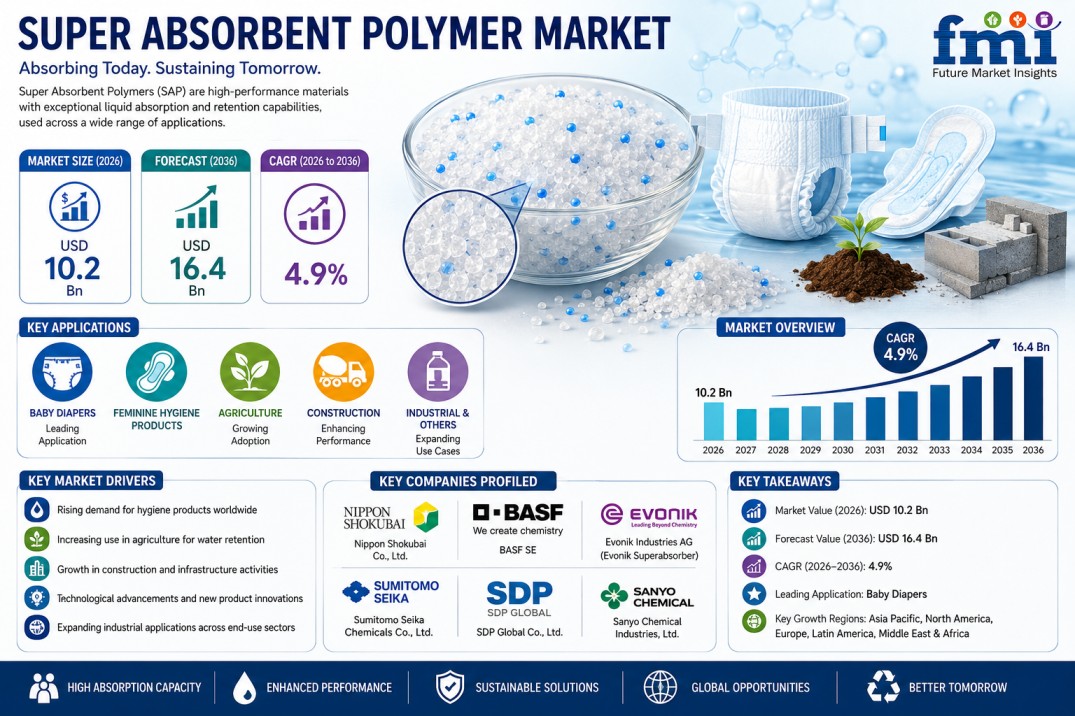
NEWARK, Del., July 23, 2026 — The Super Absorbent Polymer (SAP) Market is expected to witness steady growth as the global Chemicals & Materials industry experiences increasing demand for high-performance absorbent materials across personal hygiene, agriculture, healthcare, and industrial applications. According to Future Market Insights (FMI), the market is projected to grow from USD 10.2 billion in 2026 to USD 16.4 billion by 2036, registering a 4.9% CAGR during the forecast period. Rising diaper penetration, expanding adult incontinence product consumption, growing awareness of female hygiene, and increasing investments in sustainable bio-based absorbent materials are expected to support long-term market expansion.
👉 Get Detailed Market Forecasts, Competitive Benchmarking, and Pricing Trends
The market is anticipated to generate an absolute dollar opportunity of USD 6.2 billion between 2026 and 2036. Continuous innovation in ultra-thin hygiene products, increasing agricultural water conservation initiatives, and the emergence of low-carbon bio-based SAP technologies continue to strengthen global market demand.
Key Super Absorbent Polymer Market Highlights at a Glance
- Market Size (2026): USD 10.2 Billion
- Forecast Market Size (2036): USD 16.4 Billion
- Forecast Period: 2026–2036
- CAGR (2026–2036): 4.9%
- Absolute Dollar Opportunity: USD 6.2 Billion
- Leading Product Type: Sodium Polyacrylate (65.0% Market Share in 2026)
- Leading Feedstock Origin: Petro-Based SAP (90.0% Market Share in 2026)
- Fastest Growth Highlight: India driven by increasing diaper penetration and hygiene awareness
- Key Segments Covered: Type, Application, Feedstock/Origin, Region
- Report Pages: 307
- Last Updated: February 20, 2026
- Reviewed By: Nikhil Kaitwade
Why Is the Super Absorbent Polymer Market Growing?
The market continues expanding as manufacturers increasingly adopt high-performance absorbent polymers capable of delivering superior fluid retention, improved product comfort, and thinner product designs across hygiene applications.
Growing awareness regarding infant hygiene, rising aging populations requiring adult incontinence products, and increasing agricultural demand for water-retention materials are creating sustained opportunities for SAP manufacturers worldwide.
Key Growth Drivers
- Rising global demand for baby diapers and feminine hygiene products.
- Growing aging population driving adult incontinence product consumption.
- Increasing agricultural adoption for soil moisture retention.
- Rising investments in bio-based and sustainable SAP production.
- Growing healthcare expenditure supporting medical absorbent products.
- Expanding disposable incomes in emerging economies.
- Continuous innovation in ultra-thin hygiene product technology.
- Increasing awareness regarding personal hygiene worldwide.
The market also benefits from continuous advances in polymer chemistry, enabling manufacturers to develop absorbent materials with higher efficiency, lower environmental impact, and improved product performance.
According to Nikhil Kaitwade, Principal Consultant for Chemicals and Materials at Future Market Insights, “The super absorbent polymer market is moving toward performance-grade materials and lower footprint production. Producers with ultra-thin diaper-grade SAP and reliable acrylic acid access may gain advantage as hygiene brands focus on absorption efficiency and sustainability targets.”
Which Product Type Leads the Super Absorbent Polymer Market?
Sodium Polyacrylate remains the dominant product category, accounting for 65.0% of global market demand in 2026.
Its exceptional absorption capacity, cost efficiency, and widespread compatibility with baby diapers, adult incontinence products, and feminine hygiene products continue supporting strong commercial adoption.
Product Type Highlights
- Sodium polyacrylate dominates global SAP demand.
- Superior water absorption improves hygiene product performance.
- Cost-effective production supports large-scale manufacturing.
- High compatibility with disposable hygiene applications.
Why Does Petro-Based SAP Continue to Dominate?
Petro-based SAP is projected to account for 90.0% of feedstock demand in 2026, supported by mature acrylic acid supply chains, established manufacturing infrastructure, and consistent product quality.
Although bio-based SAP technologies are gaining momentum, petro-based materials continue offering strong commercial scalability and competitive production economics.
Feedstock Highlights
- Petro-based SAP dominates commercial manufacturing.
- Reliable acrylic acid supply supports production stability.
- Mature production technologies improve operational efficiency.
- Bio-based alternatives continue gaining industry attention.
How Are Hygiene Applications Driving Market Expansion?
Personal hygiene continues to represent the largest application area for super absorbent polymers, driven primarily by increasing consumption of baby diapers, feminine hygiene products, and adult incontinence solutions.
Demand is further supported by growing consumer preference for thinner, lighter, and higher-performing hygiene products that deliver improved comfort and absorption.
Application Highlights
- Baby diapers remain the largest end-use application.
- Adult incontinence products support sustained market growth.
- Feminine hygiene product adoption continues increasing globally.
- Medical absorbent products create additional growth opportunities.
- Agriculture expands SAP demand through water conservation applications.
Market Dynamics
Market Drivers
Growing infant and elderly populations, expanding personal hygiene awareness, increasing demand for high-performance disposable hygiene products, rising agricultural water conservation initiatives, and continuous advances in polymer technology continue driving global market growth.
Market Restraints
Volatility in acrylic acid prices, environmental concerns surrounding petrochemical feedstocks, stringent environmental regulations, disposal challenges, and pricing pressures remain key market constraints.
Market Trends
Innovation continues reshaping the global SAP industry.
Major trends include:
- Growing adoption of bio-based super absorbent polymers.
- Development of ultra-thin diaper-grade SAP materials.
- Increased focus on sustainable manufacturing.
- Expansion of agricultural moisture-retention applications.
- Rising investment in low-carbon polymer technologies.
- Continuous improvement in absorption efficiency.
Regional and Country Outlook
India is expected to witness strong growth throughout the forecast period, supported by rising diaper penetration, expanding healthcare access, improving hygiene awareness, and increasing disposable incomes.
South Asia continues emerging as a major growth region due to rapid urbanization and rising consumer awareness.
Europe is witnessing growing adoption of low-carbon and sustainable SAP materials, while East Asia remains a critical manufacturing hub backed by integrated chemical production, strong R&D capabilities, and established supply chains.
Competitive Landscape
Competition remains focused on product innovation, manufacturing efficiency, sustainability initiatives, and reliable raw material sourcing, with leading companies investing heavily in advanced absorbent polymer technologies and environmentally sustainable production processes.
Key Companies
- Nippon Shokubai Co., Ltd.
- BASF SE
- Evonik Industries AG (Evonik Superabsorber)
- Sumitomo Seika Chemicals Co., Ltd.
- SDP Global Co., Ltd.
- Sanyo Chemical Industries, Ltd.
- LG Chem Ltd.
- Formosa Plastics Corporation
- Wanhua Chemical Group Co., Ltd.
- Yixing Danson Technology
- Zhejiang Weilong Polymer Material Co., Ltd.
Frequently Asked Questions
- What is the projected size of the Super Absorbent Polymer Market by 2036?
The global Super Absorbent Polymer Market is projected to reach USD 16.4 billion by 2036, growing from USD 10.2 billion in 2026.
- What is the expected CAGR of the Super Absorbent Polymer Market?
The market is expected to expand at a 4.9% CAGR during the 2026–2036 forecast period.
- Which product type dominates the market?
Sodium Polyacrylate leads the market with a 65.0% share in 2026.
- Which feedstock dominates SAP production?
Petro-Based SAP remains the leading feedstock, accounting for 90.0% of market demand in 2026.
- What factors are driving market growth?
Growth is driven by rising demand for baby diapers, increasing adult incontinence products, expanding feminine hygiene awareness, growing agricultural water conservation applications, and continuous innovation in high-performance and sustainable absorbent polymer technologies.
Report Scope
- The polymer emulsion market is estimated at USD 30.2 billion in 2026 and is forecast to reach USD 54.7 billion by 2036 at a 6.1% CAGR.
- The polymer modified bitumen market is forecast to be valued at USD 22.8 billion BY 2036 and projected to expand at 4.4% CAGR during 2026 to 2036.
- The polymeric adsorbents market is projected to grow from USD 106.7 billion in 2025 to USD 169.0 billion by 2035, at a CAGR of 4.7%.
About Future Market Insights (FMI)
Future Market Insights, Inc. (ESOMAR certified, recipient of the Stevie® Award, and a member of the Greater New York Chamber of Commerce) provides deep insights into governing factors elevating demand in global markets.
FMI delivers market intelligence, consulting services, and syndicated research reports across chemicals, materials, food ingredients, pharmaceuticals, industrial manufacturing, sustainability, advanced materials, and infrastructure sectors.
With global expertise and industry-focused research capabilities, FMI provides actionable insights that help organizations understand market dynamics and identify emerging opportunities.
Contact
Future Market Insights Inc.
Christiana Corporate, 200 Continental Drive, Suite 401, Newark, Delaware 19713, USA
Rahul Singh
AVP – Marketing and Growth Strategy
Future Market Insights, Inc.
Phone: +91 8600020075
For Media: Rahul.Singh@futuremarketinsights.com
Email: sales@futuremarketinsights.com
Website: www.futuremarketinsights.com