

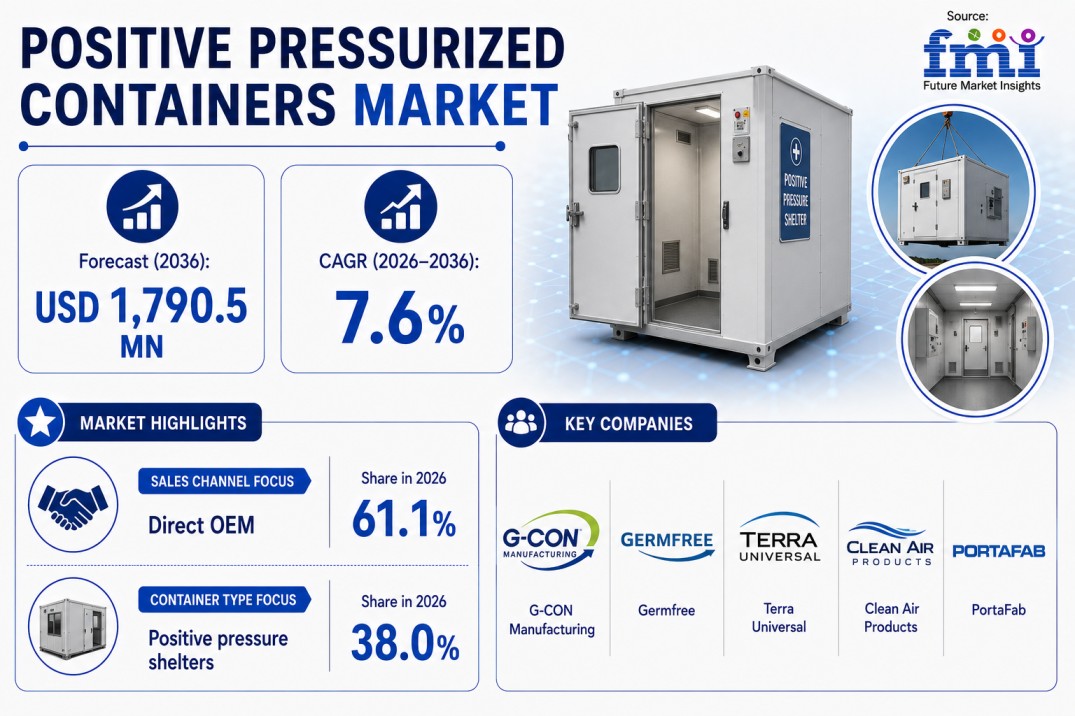
The global Positive Pressurized Containers Market is expected to witness steady expansion over the next decade as industries continue investing in contamination-controlled environments and safer operating conditions. The market is projected to grow from USD 860.7 million in 2026 to USD 1,790.5 million by 2036, registering a CAGR of 7.6% during the forecast period.
Growth is being driven by rising workplace safety regulations, increasing deployment of modular cleanroom infrastructure, and expanding demand from oil & gas, mining, pharmaceutical, and semiconductor industries. Positive pressurized containers are becoming an essential solution for protecting personnel, equipment, and sensitive operations from airborne contaminants, hazardous dust, and chemical vapors.
Positive Pressurized Containers Market Overview
Industrial facilities are increasingly adopting positive pressurized containers to comply with stricter occupational health and safety standards while minimizing production interruptions. These containers create a controlled internal environment by maintaining higher air pressure than the surrounding atmosphere, preventing dust, fumes, and contaminants from entering enclosed spaces.
Mining operations, pharmaceutical manufacturing plants, semiconductor fabrication facilities, and oil & gas processing sites are among the primary users of these systems. Growing investments in modular industrial infrastructure and temporary cleanroom facilities are further supporting market expansion. The implementation of stricter dust exposure regulations, particularly those governing respirable crystalline silica, has accelerated adoption across mining and heavy industrial sectors. Companies are increasingly investing in engineered enclosure solutions that improve workplace safety while protecting critical control systems and sensitive equipment.
Rising Industrial Safety Requirements Driving Market Growth
One of the primary factors supporting market growth is the increasing focus on industrial safety and contamination control. Manufacturing facilities are operating under increasingly stringent environmental and occupational regulations, requiring better protection for workers and equipment operating in hazardous conditions.
Positive pressurized containers help maintain clean air environments by continuously filtering incoming air while maintaining internal positive pressure. This significantly reduces contamination risks and ensures uninterrupted operation of electronic equipment, control rooms, and monitoring systems. Industries are also prioritizing solutions that reduce downtime associated with contamination-related shutdowns, making these systems valuable investments despite higher initial costs.
Growing Adoption Across Pharmaceutical and Semiconductor Industries
Rapid expansion of pharmaceutical manufacturing and semiconductor fabrication is creating substantial opportunities for positive pressurized container manufacturers.
Pharmaceutical companies frequently require temporary clean environments during facility upgrades, equipment installation, and production expansion projects. Containerized cleanrooms provide flexible deployment while reducing construction time and validation requirements. Similarly, semiconductor manufacturing demands extremely clean environments where even microscopic airborne particles can affect production quality. Positive pressurized containers provide cost-effective solutions for temporary clean workspaces, equipment protection, and controlled maintenance operations.
Oil & Gas Sector Remains the Largest End User
The oil & gas industry is expected to remain the largest consumer of positive pressurized containers throughout the forecast period.
Remote drilling locations, refineries, petrochemical facilities, and offshore platforms require protected control rooms and analyzer shelters capable of operating safely in harsh outdoor environments. Positive pressure systems prevent the ingress of hazardous gases, dust, and corrosive particles, improving equipment reliability while ensuring operator safety. By 2026, the oil & gas segment is projected to account for approximately 38.0% of total market demand.
Direct OEM Sales Continue to Dominate
Direct Original Equipment Manufacturer (OEM) sales remain the preferred procurement channel as industrial buyers increasingly seek integrated engineering, installation, and maintenance support from a single supplier.
Direct OEM sales are projected to account for 61.1% of the market in 2026 due to advantages such as:
- Comprehensive engineering support
- Faster installation and commissioning
- Better warranty management
- Simplified maintenance documentation
- Improved lifecycle service support
Industrial buyers increasingly value suppliers capable of delivering complete project accountability from design through commissioning.
Positive Pressure Shelters Lead Product Demand
Among container types, Positive Pressure Shelters are expected to maintain market leadership with approximately 38.0% market share in 2026.
These shelters are widely deployed across mining sites, construction projects, oil refineries, chemical plants, and industrial processing facilities where airborne contamination poses significant operational risks. Growing adoption is supported by increasing regulatory focus on worker safety and stricter industrial hygiene standards across developed and emerging economies.
Asia Pacific Emerges as the Fastest Growing Regional Market
Asia Pacific is projected to remain the fastest-growing regional market during the forecast period, supported by rapid industrialization, pharmaceutical manufacturing expansion, electronics production, and infrastructure investment.
India is forecast to register the highest growth rate globally with a CAGR of 9.85%, driven by expanding pharmaceutical manufacturing, modular cleanroom projects, and increasing investments in industrial automation.
China follows closely with an expected CAGR of 8.85%, supported by large-scale semiconductor investments, electronics manufacturing, and industrial modernization initiatives.
South Korea also presents significant opportunities owing to continued expansion of semiconductor fabrication facilities and electronics production.
Competitive Landscape
The positive pressurized containers market remains moderately consolidated, with leading manufacturers competing through technological innovation, modular cleanroom expertise, engineering capabilities, and global service networks.
Major companies are investing heavily in modular cleanroom technologies, integrated pressure monitoring systems, advanced filtration solutions, and customized enclosure designs to meet evolving customer requirements.
Key companies operating in the market include:
- G-CON Manufacturing
- Germfree
- Terra Universal
- AES Clean Technology
- PortaFab
- Mecart Cleanrooms
- Panel Built
- Clean Air Products
- Klinge Corporation
Manufacturers are increasingly differentiating themselves through rapid deployment capabilities, engineering documentation, pressure validation systems, and comprehensive after-sales service programs.
Market Outlook
The outlook for the Positive Pressurized Containers Market remains highly favorable through 2036. Increasing workplace safety regulations, growing contamination-control requirements, expansion of pharmaceutical manufacturing, semiconductor investments, and modernization of industrial infrastructure will continue to drive demand worldwide.
As industries place greater emphasis on operational reliability, worker safety, and regulatory compliance, positive pressurized containers are expected to become an integral component of industrial facilities requiring controlled environments. Continuous advancements in modular engineering, filtration technologies, and smart monitoring systems will further strengthen market growth, positioning the industry for sustained expansion over the coming decade.
Related Research Reports
Steel Containers Market: is set to reach USD 13.3 billion by 2026-end and grow at a CAGR of 3.0% between 2026-2036 to reach USD 17.8 billion by 2036.
Foldable Steel Containers Market: The Foldable Steel Containers Market is segmented by collapsible, bulk, and volume-reducible container types from 2025 to 2035.
Metal Containers Market: The metal containers market is set to reach USD 146.8 billion by 2026-end and grow at a CAGR of 4.6% between 2026-2036 to reach USD 230.1 billion by 2036.
About Future Market Insights (FMI)
Future Market Insights is a leading provider of market intelligence, consulting services, and syndicated research reports. FMI delivers actionable insights across packaging, logistics, industrial manufacturing, food and beverage, healthcare, chemicals, and emerging technologies, helping organizations identify growth opportunities and make informed strategic decisions in rapidly evolving markets.
Economics
Contact
Future Market Insights Inc.
Christiana Corporate
200 Continental Drive, Suite 401
Newark, Delaware 19713, USA
Email: sales@futuremarketinsights.com
Website: www.futuremarketinsights.com