

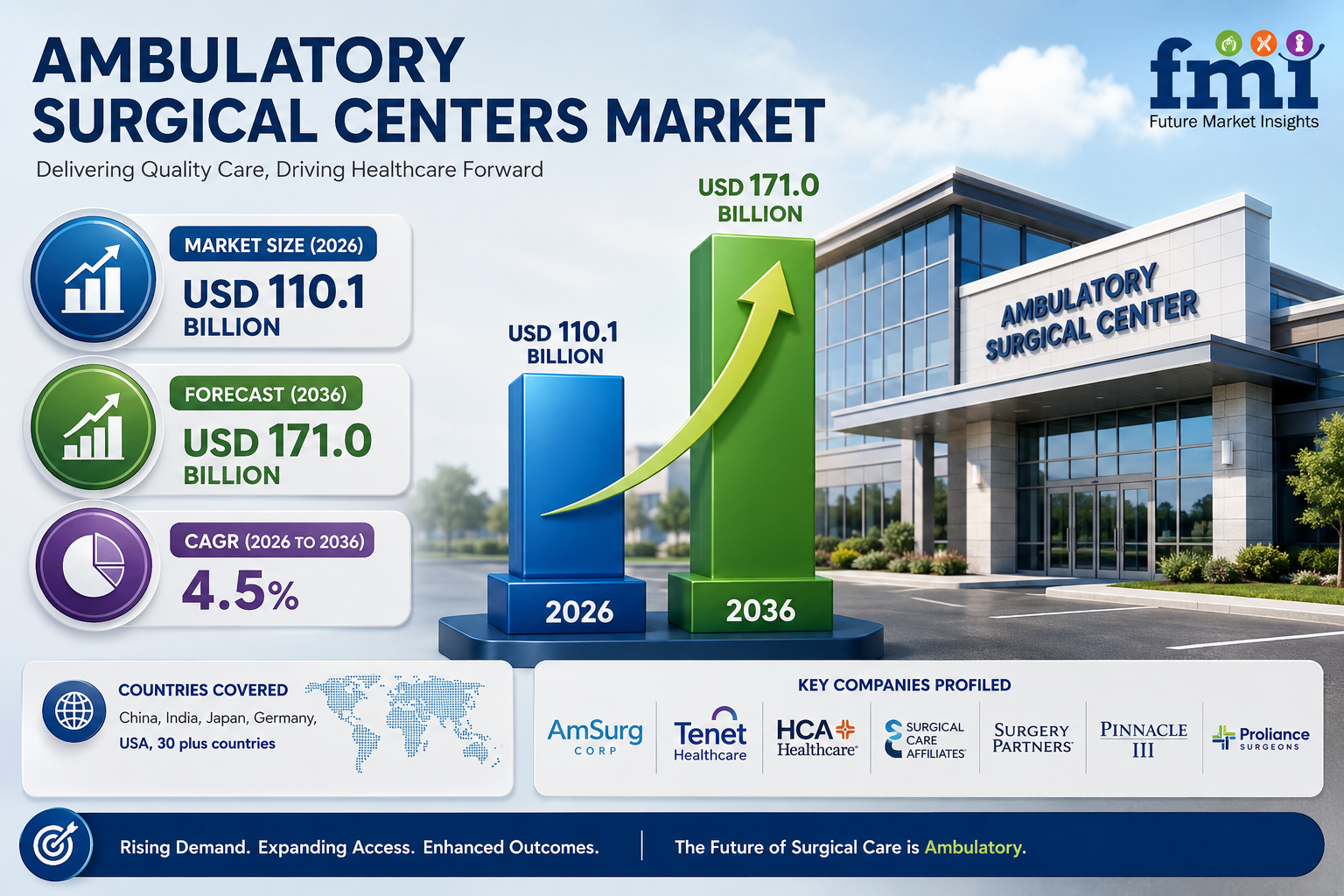
The global ambulatory surgical centers market is expected to grow from USD 110.1 billion in 2026 to USD 171.0 billion by 2036, registering a compound annual growth rate (CAGR) of 4.5% during the forecast period. This expansion reflects the accelerating shift toward outpatient care, driven by healthcare systems seeking lower-cost, high-efficiency treatment settings without compromising clinical quality.
Ambulatory surgical centers (ASCs) are becoming central to healthcare delivery as providers increasingly transition away from traditional inpatient procedures. The market is benefiting from rising adoption of minimally invasive surgeries, growing pressure to reduce healthcare expenditure, and increasing demand for efficient, patient-centric surgical pathways. At the same time, a broader shift toward value-based care models is fundamentally changing how ASCs evaluate and procure medical technologies.
Unlike traditional fee-for-service systems, value-based reimbursement rewards improved outcomes, reduced complications, operational efficiency, and patient satisfaction. This has significantly altered device demand, pricing structures, and vendor relationships across the ASC ecosystem. Procurement decisions now prioritize technologies that improve procedural precision, reduce recovery times, and deliver measurable economic value over the long term.
As reimbursement increasingly aligns with quality metrics rather than procedural volume, both ASC operators and medical device manufacturers are being pushed to demonstrate measurable clinical and financial performance.
Market Overview
The global ambulatory surgical centers market continues to expand as outpatient surgery becomes a strategic priority across healthcare systems. ASCs provide same-day surgical care, offering a cost-efficient alternative to hospital-based procedures while improving convenience for patients and reducing pressure on inpatient facilities.
The market is projected to create an absolute dollar opportunity of USD 60.91 billion between 2026 and 2036, reflecting strong structural demand for outpatient care models. This growth is closely tied to the increasing complexity of procedures that can now be safely performed outside hospitals due to advancements in surgical equipment, anesthesia, imaging systems, and digital monitoring tools.
Healthcare systems globally are increasingly focused on reducing unnecessary hospital admissions, improving procedural throughput, and optimizing resource allocation. This macro trend continues to favor ASC expansion, especially in high-volume specialties such as orthopedics, ophthalmology, gastroenterology, and pain management.
Key Growth Drivers
One of the most significant growth drivers in the ambulatory surgical centers market is the global migration toward value-based healthcare delivery. This transition is redefining reimbursement frameworks and influencing purchasing behavior across provider networks.
Historically, fee-for-service reimbursement incentivized procedural volume. Device selection often depended on physician preference and product performance alone. Today, reimbursement models increasingly reward measurable outcomes including reduced readmissions, fewer complications, faster recovery, and stronger patient satisfaction.
This shift is driving ASC demand for technologies that improve both clinical and economic performance.
Another major growth catalyst is the rise of minimally invasive procedures. Smaller incisions, reduced blood loss, lower infection risk, and shorter recovery periods make minimally invasive techniques ideal for outpatient settings. Robotic-assisted procedures, image-guided interventions, and precision navigation tools are enabling ASCs to expand into more advanced surgical categories.
Cost awareness is also playing a critical role. Payers, providers, and patients alike are increasingly seeking lower-cost care environments. ASCs often deliver procedures at significantly lower cost than hospitals while maintaining comparable outcomes, making them attractive under cost-containment initiatives.
Technology & Innovation Trends
Technology is becoming a defining competitive differentiator in the ASC ecosystem. Device manufacturers are no longer competing solely on product specifications; instead, they are expected to demonstrate measurable contributions to efficiency and outcomes.
In orthopedics, ASCs performing joint replacements are investing in advanced implants, navigation platforms, and precision surgical instruments that improve alignment accuracy and reduce complications. Though capital-intensive upfront, these technologies improve long-term procedural value by reducing revision surgeries and recovery times.
In ophthalmology, advanced imaging systems and high-precision surgical platforms are improving consistency in visual outcomes. As patient satisfaction increasingly affects reimbursement, predictable surgical performance becomes financially important.
The cardiovascular segment is also seeing major transformation as more procedures shift to outpatient settings. ASCs are adopting minimally invasive intervention platforms, advanced imaging tools, and patient monitoring systems to safely support complex procedures.
Data analytics is another major innovation trend. ASCs are increasingly deploying digital systems to track:
- Clinical outcomes
- Resource utilization
- Patient satisfaction
- Procedure efficiency
These insights support operational optimization, regulatory reporting, and reimbursement negotiations.
Integration capabilities are equally important. Technologies compatible with electronic health records, scheduling systems, billing infrastructure, and workflow software are increasingly favored because they reduce administrative burden and improve operational efficiency.
Market Challenges & Restraints
Despite strong growth potential, the ambulatory surgical centers market faces several structural challenges.
One of the most pressing concerns is rising operational cost pressure. ASC operators continue to face increasing expenses related to labor shortages, regulatory compliance, training, and infrastructure upgrades. These pressures make capital expenditure decisions increasingly scrutinized.
Another challenge lies in the evolving procurement model. Purchasing teams now evaluate total cost of ownership rather than acquisition price alone. Factors such as equipment uptime, maintenance costs, consumable usage, training requirements, and workflow impact are central to investment decisions.
This creates pressure on medical device manufacturers to provide stronger evidence of economic value.
The industry also faces complexity in pricing negotiations. Traditional pricing models based on product specifications are gradually being replaced by outcome-based agreements, where reimbursement may partially depend on measurable performance indicators. While promising, these arrangements remain operationally complex and difficult to standardize.
Segment Analysis
The ambulatory surgical centers market is segmented by Centers Type, Modality, Services, and Region.
By center type, Single Specialty Centers dominate the market and are expected to retain leadership throughout the forecast period. This segment accounted for 65.0% market share in 2026, reflecting strong demand for highly specialized outpatient facilities. Single-specialty centers benefit from streamlined workflows, optimized staffing, and procedural standardization, enabling high throughput and cost efficiency.
Multi Specialty Centers are also growing as providers seek to diversify revenue streams and expand procedural capabilities under one operational framework.
By modality, the market includes:
- Hospital-Based Ambulatory Surgical Centers
- Freestanding Ambulatory Surgical Centers
Hospital-based ASCs benefit from access to broader clinical infrastructure and emergency support systems. However, freestanding centers are increasingly favored for their lower overhead, faster patient flow, and greater operational flexibility.
By services, the market is divided into:
- Diagnostic Services
- Surgical Services
Surgical services account for the larger revenue share due to higher procedure volumes and increasing migration of surgeries into outpatient settings. Diagnostic services continue expanding as early detection and procedural planning become increasingly integrated with outpatient care delivery.
Regional Analysis
Regional growth patterns vary significantly based on reimbursement models, healthcare infrastructure, and regulatory maturity.
North America remains a major revenue contributor due to advanced ASC penetration, mature reimbursement systems, and widespread adoption of value-based payment models. The region has seen strong growth in outpatient orthopedic, ophthalmic, and gastrointestinal procedures.
Europe continues to benefit from healthcare modernization initiatives and growing acceptance of outpatient surgery, especially in cost-constrained public healthcare systems.
Asia-Pacific is expected to deliver the most dynamic expansion, led by China, which is projected to be the fastest-growing country with a CAGR of 6.2% through 2036. Rapid healthcare infrastructure expansion, growing middle-class demand, and rising surgical volumes are accelerating ASC adoption across China.
Emerging economies across Asia and Latin America are also investing heavily in cost-efficient surgical delivery models to improve healthcare access.
Competitive Landscape
Competition in the ambulatory surgical centers market is becoming increasingly sophisticated. Success is no longer defined solely by procedural capacity or pricing competitiveness.
ASC operators now seek strategic vendor partnerships that provide:
- Clinical training
- Implementation support
- Software integration
- Performance analytics
- Long-term optimization services
This has transformed the competitive landscape for device manufacturers. Suppliers that can provide comprehensive value propositions are better positioned to secure long-term contracts.
The rise of performance-based contracting further reflects this shift. Manufacturers are increasingly experimenting with pricing models tied to measurable operational or clinical outcomes.
Leading Companies Analysis
Leading market participants include ASC operators, healthcare service providers, and medical device manufacturers supporting outpatient surgical ecosystems.
Competitive advantage increasingly depends on the ability to deliver integrated solutions rather than standalone devices. Companies investing in AI-driven analytics, workflow automation, remote monitoring, and precision surgical systems are likely to strengthen market positioning.
Manufacturers with robust clinical datasets, real-world evidence, and health economics capabilities are becoming preferred partners in value-based procurement environments.
Investment & Strategic Developments
Investment in the ASC sector is accelerating as private equity firms, hospital systems, and strategic healthcare investors recognize long-term outpatient growth potential.
Capital allocation is increasingly focused on:
- Digital transformation
- Surgical robotics
- Imaging innovation
- Workflow automation
- Data analytics platforms
Mergers, acquisitions, and strategic partnerships are expected to intensify as companies seek scale and operational efficiency.
A major strategic trend is investment in technologies that improve measurable ROI. Procurement decisions increasingly require evidence linking technology investments to improved reimbursement outcomes and reduced cost of care.
Future Outlook
The future of the ambulatory surgical centers market will be shaped by the growing correlation between reimbursement policy and technology adoption.
As healthcare systems continue emphasizing value over volume, ASCs will increasingly prioritize technologies that improve procedural consistency, reduce complications, and enhance patient experience. Device makers that demonstrate measurable contributions to cost control and quality improvement will gain significant competitive advantage.
Outcome-based contracting, AI-powered analytics, and integrated digital workflows are expected to become more common over the next decade.
Conclusion
The ambulatory surgical centers market is entering a transformative phase as outpatient care becomes central to global healthcare delivery. Expected to reach USD 171.0 billion by 2036, the sector is benefiting from rising demand for efficient, cost-effective, and patient-centric surgical care.
The shift toward value-based healthcare is fundamentally changing how ASCs source technology, allocate capital, and measure success. Clinical effectiveness alone is no longer sufficient—providers now demand operational efficiency, measurable outcomes, and long-term economic value.
Organizations that successfully align technology, reimbursement strategy, and patient outcomes will define the next generation of growth in the ambulatory surgical ecosystem.
Explore More Related Studies Published by FMI Research
- The cardiac ambulatory monitoring market is projected to grow from USD 15.9 billion in 2025 to USD 24.6 billion by 2035, at a CAGR of 4.5%.
- The ambulatory polysomnography systems market is expected to expand from USD 324.48 million in 2025 to USD 543.84 million by 2035 and is anticipated to register a 5.3% CAGR during the forecast period.
- The digital pathology market is expected to expand from USD 11,817.9 million in 2026 to USD 38,036.8 million by 2036 and is likely to register a 12.4% CAGR during the forecast period.
FMI Custom Research: Strategic Intelligence for Confident Decision-Making
In today’s rapidly evolving business environment, leadership teams need more than market data—they need clear, actionable intelligence tailored to their strategic objectives. FMI’s Custom Research solutions are designed around the specific business questions organizations need answered, enabling executives to evaluate growth opportunities, validate investments, assess competitive dynamics, and reduce uncertainty before making critical decisions. By combining deep industry expertise, primary research, and proprietary market intelligence, FMI delivers insights that help organizations move from assumptions to evidence-based strategies with greater speed and confidence.
Key Executive Benefits
- Decision-Ready Insights: Research tailored to your specific business challenges, growth plans, and investment priorities.
- Reduced Strategic Risk: Validate market opportunities, customer demand, and competitive positioning before committing resources.
- Market Entry Confidence: Assess opportunity size, regulatory barriers, channel dynamics, and competitive landscapes with precision.
- Competitive Advantage: Gain proprietary intelligence unavailable through syndicated reports or internal datasets.
- Faster Growth Decisions: Accelerate expansion, product development, portfolio optimization, and investment planning.
- Primary Market Validation: Access real-world customer, buyer, and stakeholder insights that support high-confidence decision-making.
- Global Industry Expertise: Powered by 100+ analysts, 20,000+ published reports, and 1.6 million+ hours of research experience.
- Proven Track Record: Over 7,000 market-entry engagements completed across six regions and 14 industry sectors with strong client retention.
Business Impact
FMI helps organizations transform market complexity into strategic clarity, enabling leadership teams to identify growth opportunities faster, optimize resource allocation, strengthen competitive positioning, and make high-stakes business decisions with confidence.
To explore how FMI Custom Research can support your strategic priorities, please connect with our team at – sales@futuremarketinsights.com
Contact Us
Future Market Insights Inc.
Christiana Corporate, 200 Continental Drive,
Suite 401, Newark, Delaware – 19713, USA
T: +1-347-918-3531
Why FMI: Future Market Insights – Why FMI
Website: Future Market Insights