

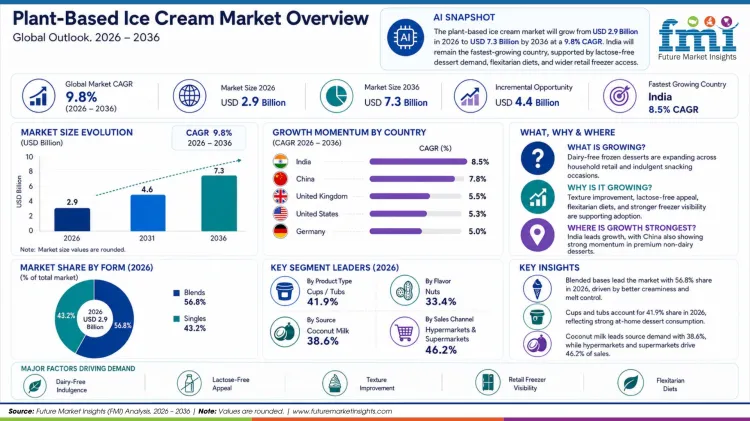
According to the latest insights by Future Market Insights, the global Plant-Based Ice Cream market is experiencing a significant competitive shift as retailer-owned brands increasingly gain influence across frozen food aisles. Channel control, pricing strategies, product similarity, and consumer acceptance are changing how value is captured between national brands and private label manufacturers.
In 2026, private label competition in plant-based ice cream is being driven by retailers’ growing control over shelf placement, promotional activity, price architecture, and consumer purchasing decisions.
Industry analysts highlight that private label threats are no longer limited to traditional dairy categories. As plant-based ice cream moves from trial purchases into repeat household consumption, retailer brands are becoming increasingly competitive in standardized formats where consumers prioritize affordability and acceptable taste over brand loyalty.
Established national brands continue to benefit from innovation, emotional branding, and premium positioning, while weaker brands face increasing pressure where products appear interchangeable with retailer alternatives.
Private Label Economics Create Pressure on Plant-Based Ice Cream Brands
The plant-based ice cream market operates under a unique competitive structure compared with traditional premium dessert categories.
National brands typically compete through:
- Brand recognition
• Product innovation
• Consumer trust
• Premium flavor development
• Sustainability positioning
However, private label brands compete through:
- Lower pricing
• Retailer shelf control
• Efficient sourcing
• Faster product adaptation
• Promotional flexibility
The growing acceptance of plant-based products has reduced one of the biggest barriers for private label adoption.
Previously, consumers viewed vegan and dairy-free products as highly specialized categories requiring trusted brands. Today, many shoppers evaluate products based on:
- Taste performance
• Price difference
• Availability
• Format convenience
• Ingredient expectations
This creates opportunities for retailers to capture repeat purchases with lower-priced alternatives.
Frozen Department Dynamics Strengthen Retailer Brand Influence
The strongest private label advantage comes from the structure of the frozen category.
Retailers already have significant influence over frozen product purchasing decisions because they control:
- Freezer placement
• Promotional calendars
• Shelf visibility
• Price comparisons
• Category organization
Plant-based ice cream benefits from strong supermarket penetration, making it highly exposed to retailer strategies.
When consumers repeatedly purchase take-home frozen desserts, private label does not need to outperform every national brand.
It only needs to provide:
- Comparable taste
• Similar product formats
• Competitive pricing
• Reliable availability
This creates the greatest risk for brands positioned in mainstream segments.
Cups and Tubs Become the Biggest Private Label Opportunity
Cups and tubs represent the most vulnerable segment for national brands.
These formats create easy comparison points through:
- Pack size
• Price per unit
• Flavor selection
• Promotional discounts
A retailer-owned vanilla or chocolate tub does not need to replicate the complete identity of premium brands.
It only needs to satisfy household dessert occasions at a lower cost.
Basic flavors such as:
- Vanilla
• Chocolate
• Coconut-based options
• Standard blended-base products
are particularly exposed because consumers often view them as functional purchases rather than emotional brand experiences.
Blended Bases Increase Retailer Flexibility
Blended-base formulations are becoming an important competitive area in plant-based ice cream.
These formulations allow manufacturers to balance:
- Texture improvement
• Cost management
• Ingredient flexibility
• Product consistency
For private label producers, blended bases create additional advantages because retailers can develop products around mainstream consumer expectations rather than relying on a single signature ingredient.
This flexibility supports:
• Faster product development
• Lower ingredient risk
• Broader consumer appeal
As a result, blended-base products may face stronger retailer competition compared with highly differentiated formulations.
Premium Indulgence Protects National Brands
Not all plant-based ice cream products face equal private label pressure.
Premium indulgence products remain more protected because consumers purchase them for experience rather than simply avoiding dairy.
Brands with strong differentiation compete through:
• Rich flavor profiles
• Premium inclusions
• Dessert-style experiences
• Unique formulations
• Brand identity
Products featuring:
- Brownie pieces
• Cookie dough
• Caramel swirls
• Premium nut flavors
• Specialty combinations
are harder for retailers to replicate convincingly.
The more a product represents a complete experience, the less vulnerable it becomes to price-based competition.
The Middle Market Faces the Highest Replaceability Risk
The greatest pressure is concentrated among brands positioned between premium and value segments.
These brands often face a structural challenge:
They are too expensive to compete directly with private label.
They are not differentiated enough to justify premium pricing.
If the only message is:
• Plant-based
• Dairy-free
• Vegan
retailers can often reproduce those claims.
If product quality is average and flavor positioning is generic, private label alternatives can gain share through stronger price-value perception.
Retailer Control Determines Competitive Advantage
The plant-based ice cream value chain includes multiple stages where competitive power is created.
Stage 1: Product Development
Brands manage:
- Recipe formulation
• Ingredient selection
• Consumer positioning
• Innovation strategy
Stage 2: Manufacturing and Supply
Companies manage:
- Ingredient sourcing
• Production efficiency
• Quality consistency
• Cost control
Stage 3: Retail Distribution
Retailers influence:
- Shelf allocation
• Promotional visibility
• Pricing strategy
• Consumer access
As organized retail becomes the dominant channel, control over distribution increasingly determines market success.
Three Competitive Layers Shape Plant-Based Ice Cream Economics
The market operates through three major competitive layers.
Product Value Layer
Driven by:
- Taste quality
• Texture performance
• Ingredient profile
• Product experience
Products with stronger differentiation maintain greater pricing power.
Cost Efficiency Layer
Influenced by:
- Manufacturing scale
• Supply chain management
• Retail partnerships
• Production optimization
Private label benefits from retailer scale and purchasing advantages.
Brand Equity Layer
Determined by:
- Consumer loyalty
• Emotional connection
• Innovation reputation
• Market positioning
Strong brands can defend pricing when consumers associate them with unique experiences.
Why Smaller and Mid-Sized Brands Face Structural Challenges
Smaller brands face pressure across several areas:
- Limited manufacturing scale
• Higher ingredient costs
• Reduced retailer influence
• Lower promotional power
• Difficulty competing on price
Large retailers often negotiate stronger terms, creating cost advantages for store brands.
Mid-sized national brands face the biggest challenge because they compete against premium brands above and retailer brands below.
Future Outlook
The future of the Plant-Based Ice Cream market will depend on the balance between retailer power, brand differentiation, and consumer expectations.
Manufacturers are expected to focus on:
- Premium flavor innovation
• Better texture technologies
• Unique ingredient positioning
• Sustainable sourcing
• Stronger brand experiences
• Retail partnership strategies
Private label growth will continue where products become standardized and comparison-driven.
National brands will remain stronger in areas where consumers seek:
- Indulgence
• Discovery
• Premium quality
• Brand trust
As competition increases, success will depend on whether brands create meaningful differentiation beyond the basic plant-based claim.
FMI Custom Research: Strategic Intelligence for Confident Decision-Making
In today’s rapidly evolving business environment, leadership teams need more than market data—they need clear, actionable intelligence tailored to their strategic objectives.
FMI’s Custom Research solutions are designed around the specific business questions organizations need answered, enabling executives to evaluate growth opportunities, validate investments, assess competitive dynamics, and reduce uncertainty before making critical decisions.
By combining deep industry expertise, primary research, and proprietary market intelligence, FMI delivers insights that help organizations move from assumptions to evidence-based strategies with greater speed and confidence.
Key Executive Benefits
- Decision-Ready Insights: Research tailored to specific business challenges, expansion plans, and investment priorities.
• Reduced Strategic Risk: Validate market opportunities, supply risks, and competitive positioning before allocating resources.
• Market Entry Confidence: Assess market size, regulations, supply structures, and competitive landscapes.
• Competitive Advantage: Gain proprietary intelligence beyond traditional syndicated research.
• Faster Growth Decisions: Support product development, geographic expansion, and strategic planning.
• Primary Market Validation: Access real-world buyer and stakeholder insights.
• Global Industry Expertise: Powered by 100+ analysts, 20,000+ published reports, and 1.6 million+ hours of research experience.
• Proven Track Record: Over 7,000 market-entry engagements completed across six regions and 14 industry sectors.
Business Impact
FMI helps organizations transform market complexity into strategic clarity, enabling leadership teams to identify growth opportunities faster, optimize resources, strengthen competitive positioning, and make high-impact business decisions with confidence.
To explore how FMI Custom Research can support your strategic priorities, connect with our team at: sales@futuremarketinsights.com
Explore More Related Studies Published by FMI Research:
The Vegan Omega-3 Capsules Market is segmented by Source Type (Algal Oil Capsules, Fermented Microalgae Oil Capsules, Yeast-based Omega-3 Capsules, Encapsulated ALA Conversion Support Blends, Mixed Plant and Algae Capsules), Active Composition, Capsule Format, End User, Sales Channel, Certification and Label Positioning, and Region. Forecast for 2026 to 2036.
The Plant-Based Deli Slices Market is segmented by Product Type, Source Protein, Format, Sales Channel, End-use Buyer, and Region. Forecast for 2026 to 2036.
Dairy-free Evaporated Milk Market is segmented by Product (Coconut Based Evaporated Milk, Oat Based Evaporated Milk, Soy Based Evaporated Milk, Almond Based Evaporated Milk), Application (Food And Beverage, Household Consumption, Foodservice), End Use (Household Consumers, Food And Beverage Manufacturers, Foodservice Operators), and Region. Forecast for 2026 to 2036.
About Future Market Insights (FMI)
Future Market Insights, Inc. (FMI) is an ESOMAR-certified, ISO 9001:2015 market research and consulting organization, trusted by Fortune 500 clients and global enterprises.
With operations in the U.S., UK, India, and Dubai, FMI provides data-backed insights and strategic intelligence across 30+ industries and 1200 markets worldwide.
Contact Us:
Future Market Insights Inc.
Christiana Corporate, 200 Continental Drive,
Suite 401, Newark, Delaware – 19713, USA
T: +1-347-918-3531
Why FMI: https://www.futuremarketinsights.com/why-fmi
Website: https://www.futuremarketinsights.com