

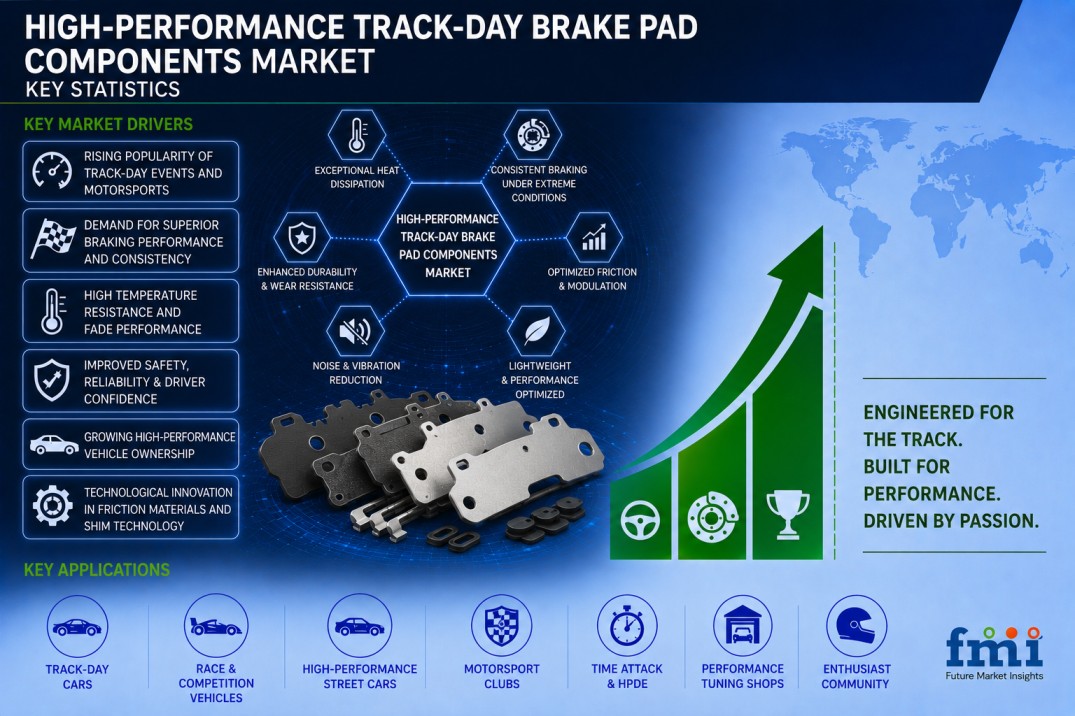
The global High-Performance Track-Day Brake Pad Components Market is projected to grow from USD 195.9 million in 2026 to USD 357.8 million by 2036, registering a CAGR of 6.2% during the forecast period. Rising participation in track-day events, increasing demand for heat-resistant braking solutions, and growing awareness of braking performance among enthusiasts are fueling market expansion. Track-day enthusiasts are expected to account for 54.3% of total demand in 2026, while sports cars will contribute 41.7% of market revenue.
Track-Day Culture Driving Premium Brake Component Demand
The growing popularity of amateur motorsports, open-lapping sessions, and driving schools is transforming the brake pad industry. Enthusiasts are increasingly replacing standard street brake pads with specialized track-day compounds capable of handling repeated high-speed braking and extreme thermal loads.
Performance-focused drivers are prioritizing brake fade resistance, pedal consistency, and predictable stopping power before participating in track events. As a result, brake pad replacement cycles are becoming shorter, with many enthusiasts purchasing dedicated track compounds ahead of every racing season.
Performance workshops and motorsport service providers are also encouraging complete brake preparation packages that include rotor inspections, brake fluid replacement, and proper pad bedding procedures to maximize braking efficiency and minimize component wear.
Market Growth Supported by Motorsport Participation
Demand for track-day brake pad components continues to rise alongside expanding amateur motorsport participation worldwide. Club racing organizations, driving academies, and track-day event operators are creating recurring demand for replacement friction materials and supporting hardware.
Market analysts note that revenue growth is increasingly linked to replacement frequency rather than vehicle population alone. Drivers are becoming more informed about heat ranges, friction characteristics, and compound compatibility, resulting in more disciplined purchasing behavior and repeat sales opportunities for manufacturers.
The industry is also benefiting from broader growth in the automotive performance aftermarket, where consumers continue to invest in vehicle upgrades that enhance safety, handling, and driving experience.
Cleaner and More Efficient Brake Technologies Gain Attention
The market is witnessing a shift toward advanced friction materials that combine thermal stability with reduced environmental impact. Manufacturers are developing compounds capable of maintaining consistent performance under extreme heat while generating less brake dust and rotor wear.
Recent product developments highlight the industry’s focus on balancing track performance with everyday drivability. New-generation performance pad systems are increasingly targeting dual-use customers who require strong circuit capability without sacrificing road comfort.
Regulatory developments are also influencing product innovation. Euro 7 regulations now place greater emphasis on brake particle emissions, encouraging manufacturers to explore cleaner friction technologies and copper-free material formulations that meet evolving environmental standards.
Semi-Metallic Materials Lead Product Demand
Semi-metallic compounds are expected to account for 38.9% of the market in 2026, making them the leading material category. Their popularity stems from their ability to deliver strong thermal resistance, reliable friction characteristics, and acceptable cold-temperature performance for vehicles that see both road and track use.
Sintered metallic compounds continue gaining traction among endurance-focused drivers due to their exceptional resistance to high-temperature degradation and repeated heavy braking cycles.
Manufacturers are increasingly investing in advanced compound chemistry to deliver predictable friction performance while reducing pad glazing and uneven wear.
Sports Cars Remain the Largest Vehicle Segment
Sports cars are projected to hold a 41.7% market share in 2026. Factory-installed performance braking systems and a large enthusiast ownership base make sports cars the primary platform for track-day brake upgrades.
Owners frequently upgrade brake pads before modifying more expensive components such as calipers, rotors, or suspension systems. Direct-fit replacement pad options and widespread aftermarket support further strengthen demand within this segment.
Modified hatchbacks are also emerging as a significant growth category, particularly among club-level motorsport participants seeking affordable entry into circuit driving.
Specialty Performance Shops Continue to Lead Sales
Specialty performance shops are expected to account for 36.4% of sales channel revenue in 2026. These outlets provide critical technical guidance regarding pad selection, heat range suitability, rotor compatibility, and bedding procedures.
Many enthusiasts continue to rely on specialist workshops to ensure proper installation and braking system setup before competitive events.
At the same time, online retail channels are expanding rapidly as consumers become more comfortable purchasing known pad shapes and comparing friction compounds through digital catalogs and technical data resources.
China and India Emerge as Key Growth Markets
China is forecast to be the fastest-growing market, expanding at a CAGR of 7.1% through 2036. Strong vehicle ownership growth, increasing motorsport participation, and a highly developed e-commerce ecosystem are supporting brake component demand. Rising attendance at major racing events and a growing market for performance vehicle modifications further strengthen opportunities for suppliers.
India follows closely with a projected CAGR of 6.8%. Growing enthusiast communities, expanding premium vehicle ownership, and the rise of performance-focused workshops in major cities such as Mumbai, Bengaluru, Delhi, and Pune are driving demand for track-capable brake solutions.
Australia is expected to grow at 6.5%, supported by an active motorsport culture and increasing participation in track-day programs, while the United States remains a significant market driven by mature aftermarket channels and strong amateur racing participation.
Competitive Landscape
Competition within the high-performance track-day brake pad components market centers on friction technology, thermal performance, motorsport validation, and product availability.
Leading manufacturers are investing heavily in compound development, braking system integration, and customer education initiatives to strengthen market positioning.
Major companies operating in the market include Brembo S.p.A., PAGID Racing, Hawk Performance, EBC Brakes Racing, Ferodo Racing, Endless Advance Co., Ltd., AP Racing, and Winmax Brake Pads.
Companies that combine proven track performance with clear heat-range guidance, regulatory compliance, and rapid product availability are expected to gain long-term competitive advantages.
Future Outlook
The future of the high-performance track-day brake pad components market will be shaped by increasing circuit participation, stricter environmental regulations, and growing demand for dual-purpose braking solutions capable of performing both on public roads and racing circuits.
As consumers become more knowledgeable about braking performance and vehicle preparation, manufacturers that provide advanced friction technologies, comprehensive technical support, and reliable product availability will be best positioned to capitalize on the market’s projected growth through 2036.
FMI Custom Research: Strategic Intelligence for Confident Decision-Making
In today’s rapidly evolving business environment, leadership teams need more than market data—they need clear, actionable intelligence tailored to their strategic objectives. FMI’s Custom Research solutions are designed around the specific business questions organizations need answered, enabling executives to evaluate growth opportunities, validate investments, assess competitive dynamics, and reduce uncertainty before making critical decisions. By combining deep industry expertise, primary research, and proprietary market intelligence, FMI delivers insights that help organizations move from assumptions to evidence-based strategies with greater speed and confidence.
Key Executive Benefits
- Decision-Ready Insights: Research tailored to your specific business challenges, growth plans, and investment priorities.
- Reduced Strategic Risk: Validate market opportunities, customer demand, and competitive positioning before committing resources.
- Market Entry Confidence: Assess opportunity size, regulatory barriers, channel dynamics, and competitive landscapes with precision.
- Competitive Advantage: Gain proprietary intelligence unavailable through syndicated reports or internal datasets.
- Faster Growth Decisions: Accelerate expansion, product development, portfolio optimization, and investment planning.
- Primary Market Validation: Access real-world customer, buyer, and stakeholder insights that support high-confidence decision-making.
- Global Industry Expertise: Powered by 100+ analysts, 20,000+ published reports, and 1.6 million+ hours of research experience.
- Proven Track Record: Over 7,000 market-entry engagements completed across six regions and 14 industry sectors with strong client retention.
Business Impact
FMI helps organizations transform market complexity into strategic clarity, enabling leadership teams to identify growth opportunities faster, optimize resource allocation, strengthen competitive positioning, and make high-stakes business decisions with confidence.
To explore how FMI Custom Research can support your strategic priorities, please connect with our team at – sales@futuremarketinsights.com
Browse More Industry Reports