

According to the latest insights by Future Market Insights, the global Dose Monitoring Devices Market is experiencing steady expansion as healthcare providers increasingly prioritize radiation safety, patient protection, and quality-driven imaging outcomes. In 2026, growing demand for advanced radiation monitoring solutions across hospitals, diagnostic imaging centers, and integrated healthcare systems is driving substantial market growth worldwide.
Industry analysts indicate that while dose monitoring devices were initially adopted primarily for regulatory compliance and radiation exposure tracking, long-term market growth is increasingly shaped by value-based care models, patient safety initiatives, workflow optimization, and analytics-driven radiation management. Companies capable of delivering connected, intelligent, and measurable dose management solutions are expected to strengthen their competitive positioning in the evolving medical imaging ecosystem.
Monitoring Devices Drives Market Growth
Dose monitoring devices are becoming an essential component of modern imaging infrastructure, helping healthcare organizations optimize radiation exposure, improve procedural safety, and enhance clinical outcomes.
Growing demand contributes to:
- Increased focus on radiation safety
• Higher adoption across diagnostic imaging departments
• Rising investments in enterprise radiation management systems
• Greater emphasis on reducing repeat imaging procedures
• Increased need for real-time dose analytics
Rising imaging volumes and growing concerns regarding cumulative radiation exposure are creating strong demand for technologies that enable continuous radiation tracking and optimization across healthcare environments.
As healthcare systems move toward quality-based reimbursement, stakeholders increasingly prioritize technologies that improve long-term safety and operational efficiency.
Traditional Radiation Monitoring Limitations Accelerate Device Adoption
Conventional radiation tracking often relies on manual logging, fragmented reporting systems, or isolated machine-level monitoring, limiting enterprise-wide visibility.
Key challenges include:
- Limited real-time dose visibility
• Manual reporting inefficiencies
• Delayed anomaly detection
• Poor protocol standardization
• Limited longitudinal exposure insights
Periodic or fragmented dose assessments may fail to identify excessive radiation exposure early, reducing the ability of healthcare providers to intervene before patient risk increases.
In high-volume imaging environments, limited dose oversight contributes to operational inefficiencies, increased repeat procedures, and financial risk.
As organizations seek better radiation governance, demand is rising for technologies that enable continuous dose tracking and early intervention.
Dose Monitoring Devices Improve Visibility and Radiation Optimization
Dose monitoring devices address traditional limitations by enabling real-time and longitudinal radiation monitoring across imaging workflows.
Key benefits include:
- Continuous radiation tracking
• Real-time exposure alerts
• Improved protocol compliance
• Centralized radiation oversight
• Better longitudinal analytics
These devices improve operational and clinical outcomes by providing continuous datasets that help providers detect dose anomalies earlier and optimize imaging protocols more effectively.
Integrated analytics and automated data transmission reduce manual oversight burdens and improve coordination across radiology departments and healthcare systems.
Dose monitoring is especially valuable in radiography, CT imaging, fluoroscopy, and interventional imaging procedures.
Outcome-Based Healthcare Strengthens Market Demand
Value-based healthcare models are increasingly driving demand for technologies that improve patient safety while reducing operational costs.
Organizations are prioritizing:
- Preventive risk management
• Reduced repeat imaging
• Improved radiation safety
• Better protocol adherence
• Outcome-driven reimbursement alignment
Dose monitoring devices directly support these goals by enabling early identification of dose anomalies and facilitating corrective action before risks escalate.
Healthcare providers are increasingly evaluating solutions not only on acquisition cost but also on their ability to improve long-term outcomes and reduce resource utilization.
As a result, market demand is increasingly linked to measurable economic and clinical value.
Pricing Dynamics Shift Toward ROI-Based Purchasing
Procurement strategies are evolving under value-based care and outcome-driven frameworks.
Buyers increasingly evaluate:
- Patient safety improvements
• Long-term cost savings
• Workflow efficiency gains
• Advanced analytics capabilities
• Platform interoperability
Historically, purchasing decisions focused heavily on hardware capabilities and compliance requirements.
Today, buyers increasingly prefer integrated ecosystems combining hardware, analytics, dashboards, and workflow integration.
This shift is placing pressure on hardware-only vendors while creating pricing advantages for companies offering enterprise radiation management platforms.
Manufacturers unable to demonstrate measurable ROI may face increasing margin pressure in premium segments.
Segment Insights Highlight Strong Demand for Medical Radiation Dosimeters
Segment analysis indicates strong market concentration in radiation dosimetry solutions.
Key segment highlights include:
- Medical Radiation Dosimeters — 41.0% market share in 2026
• Growing hospital adoption
• Increased imaging procedural volumes
• Rising radiation safety initiatives
• Expanding enterprise deployment
Medical radiation dosimeters dominate due to their effectiveness in tracking exposure levels and supporting evidence-based imaging decisions.
Advanced sensor integration and analytics capabilities are improving usability, accuracy, and enterprise scalability.
Procurement and Buyer Behavior Favor Integrated Platforms
Procurement decisions increasingly prioritize ecosystem capabilities over standalone device performance.
Organizations are focusing on:
- Platform interoperability
• Enterprise radiation management integration
• Cloud-based analytics
• Data security compliance
• Long-term vendor support
Procurement teams increasingly involve radiologists, clinicians, hospital administrators, IT specialists, and quality management leaders.
This multidisciplinary evaluation reflects the strategic importance of dose monitoring technologies in modern healthcare systems.
Long-term vendor partnerships are becoming more common as buyers prioritize upgrades, analytics improvements, and regulatory support.
Competitive Landscape Shifts from Devices to Ecosystems
The competitive environment is increasingly defined by ecosystem development rather than hardware differentiation alone.
Industry stakeholders are investing in:
- AI-driven predictive analytics
• Cloud radiation monitoring platforms
• Advanced mobile dashboards
• Smart alert systems
• Workflow integration
• Exposure risk analytics
Manufacturers that successfully combine monitoring devices with actionable analytics and intelligent intervention tools are gaining stronger competitive positions.
Technology partnerships are accelerating as vendors expand end-to-end radiation management capabilities.
The ability to convert dose data into actionable insights is becoming a major competitive differentiator.
Strategic Implications for Manufacturers
The shift toward value-based healthcare and radiation accountability is accelerating the transformation of dose monitoring devices from standalone tools into strategic infrastructure assets.
Organizations increasingly demand technologies that support:
- Radiation risk management
• Preventive intervention
• Protocol optimization
• Patient safety improvement
• Long-term cost reduction
Manufacturers capable of aligning product development with healthcare reimbursement models and operational priorities are expected to capture substantial market opportunities.
Future market leadership will increasingly depend on demonstrating measurable economic and clinical value rather than hardware innovation alone.
Future Outlook
The future of the Dose Monitoring Devices industry will be increasingly shaped by value-based healthcare adoption, rising imaging volumes, and growing investments in digital radiation safety infrastructure.
Growing adoption of connected dose monitoring ecosystems, predictive analytics, and AI-enabled management platforms is expected to create substantial opportunities across global markets.
Manufacturers capable of combining monitoring accuracy, digital integration, and measurable economic value are likely to achieve sustained growth throughout the forecast period.
As healthcare systems increasingly prioritize safety, accountability, and quality-driven imaging, dose monitoring devices are expected to remain critical components of future medical infrastructure.
Key Takeaways
- Traditional radiation monitoring provides limited episodic insights
• Dose monitoring devices improve continuous tracking and optimization
• Value-based healthcare is accelerating market adoption
• Integrated monitoring ecosystems offer stronger competitive advantages
• Market growth is increasingly driven by clinical and economic outcomes
Dose Monitoring Devices Market Snapshot
| Attributes | Key Insights |
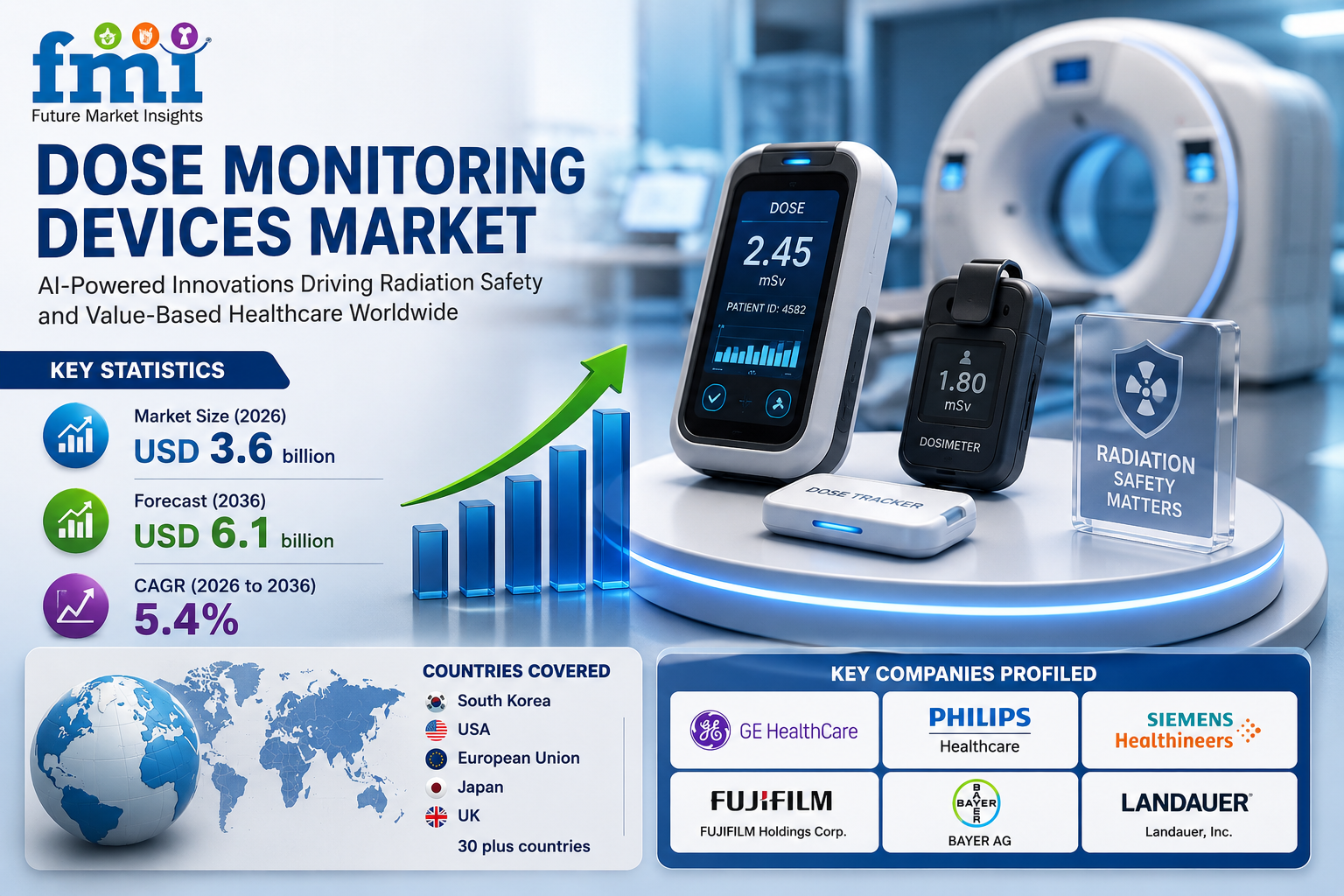
| Estimated Market Size (2026) | USD 3.6 Billion |
| Projected Market Value (2036) | USD 6.1 Billion |
| CAGR (2026 to 2036) | 5.4% |
Market Summary
The global Dose Monitoring Devices Market is projected to grow from USD 3.6 billion in 2026 to USD 6.1 billion by 2036, reflecting rising demand for radiation safety, dose optimization, and value-based imaging solutions.
Segment highlights include:
- Medical Radiation Dosimeters — 41.0% market share in 2026
• Growing hospital adoption
• Expanding radiation safety initiatives
• Key growth regions — North America, Europe, and Asia-Pacific
• High-growth markets — South Korea, United States, European Union, Japan, and United Kingdom
Country-wise Growth Outlook
| Country | CAGR |
| South Korea | 5.7% |
| USA | 5.6% |
| European Union | 5.5% |
| Japan | 5.3% |
| UK | 5.2% |
FMI Custom Research: Strategic Intelligence for Confident Decision-Making
In today’s rapidly evolving business environment, leadership teams need more than market data—they need clear, actionable intelligence tailored to their strategic objectives. FMI’s Custom Research solutions are designed around the specific business questions organizations need answered, enabling executives to evaluate growth opportunities, validate investments, assess competitive dynamics, and reduce uncertainty before making critical decisions. By combining deep industry expertise, primary research, and proprietary market intelligence, FMI delivers insights that help organizations move from assumptions to evidence-based strategies with greater speed and confidence.
Key Executive Benefits
- Decision-Ready Insights: Research tailored to your specific business challenges, growth plans, and investment priorities.
- Reduced Strategic Risk: Validate market opportunities, customer demand, and competitive positioning before committing resources.
- Market Entry Confidence: Assess opportunity size, regulatory barriers, channel dynamics, and competitive landscapes with precision.
- Competitive Advantage: Gain proprietary intelligence unavailable through syndicated reports or internal datasets.
- Faster Growth Decisions: Accelerate expansion, product development, portfolio optimization, and investment planning.
- Primary Market Validation: Access real-world customer, buyer, and stakeholder insights that support high-confidence decision-making.
- Global Industry Expertise: Powered by 100+ analysts, 20,000+ published reports, and 1.6 million+ hours of research experience.
- Proven Track Record: Over 7,000 market-entry engagements completed across six regions and 14 industry sectors with strong client retention.
Business Impact
FMI helps organizations transform market complexity into strategic clarity, enabling leadership teams to identify growth opportunities faster, optimize resource allocation, strengthen competitive positioning, and make high-stakes business decisions with confidence.
To explore how FMI Custom Research can support your strategic priorities, please connect with our team at – sales@futuremarketinsights.com
Explore More Related Studies Published by FMI Research
- The Pain Monitoring Devices Market is set to grow from USD 9.20 Billion in 2025 to USD 22.79 Billion by 2036, with a CAGR of 9.5%.
- The Nerve Monitoring Devices Market is projected to grow from USD 1.3 billion in 2025 to USD 2.2 billion by 2035, at a CAGR of 5.6%.
- The remote patient monitoring devices market is projected to grow from USD 1.5 billion in 2025 to USD 6.5 billion by 2035, at a CAGR of 15.7%.
Contact Us
Future Market Insights Inc.
Christiana Corporate, 200 Continental Drive,
Suite 401, Newark, Delaware – 19713, USA
T: +1-347-918-3531
Why FMI: Future Market Insights – Why FMI
For Sales Enquiries: sales@futuremarketinsights.com
Website: Future Market Insights