

According to the latest insights by Future Market Insights, the global Poultry Diagnostics Market is entering a period of sustained expansion as poultry producers, veterinary laboratories, and animal health authorities intensify efforts to strengthen disease surveillance and flock health management. Growing concerns surrounding avian influenza outbreaks, food safety compliance, and biosecurity requirements are accelerating the adoption of advanced diagnostic technologies across commercial poultry operations worldwide.
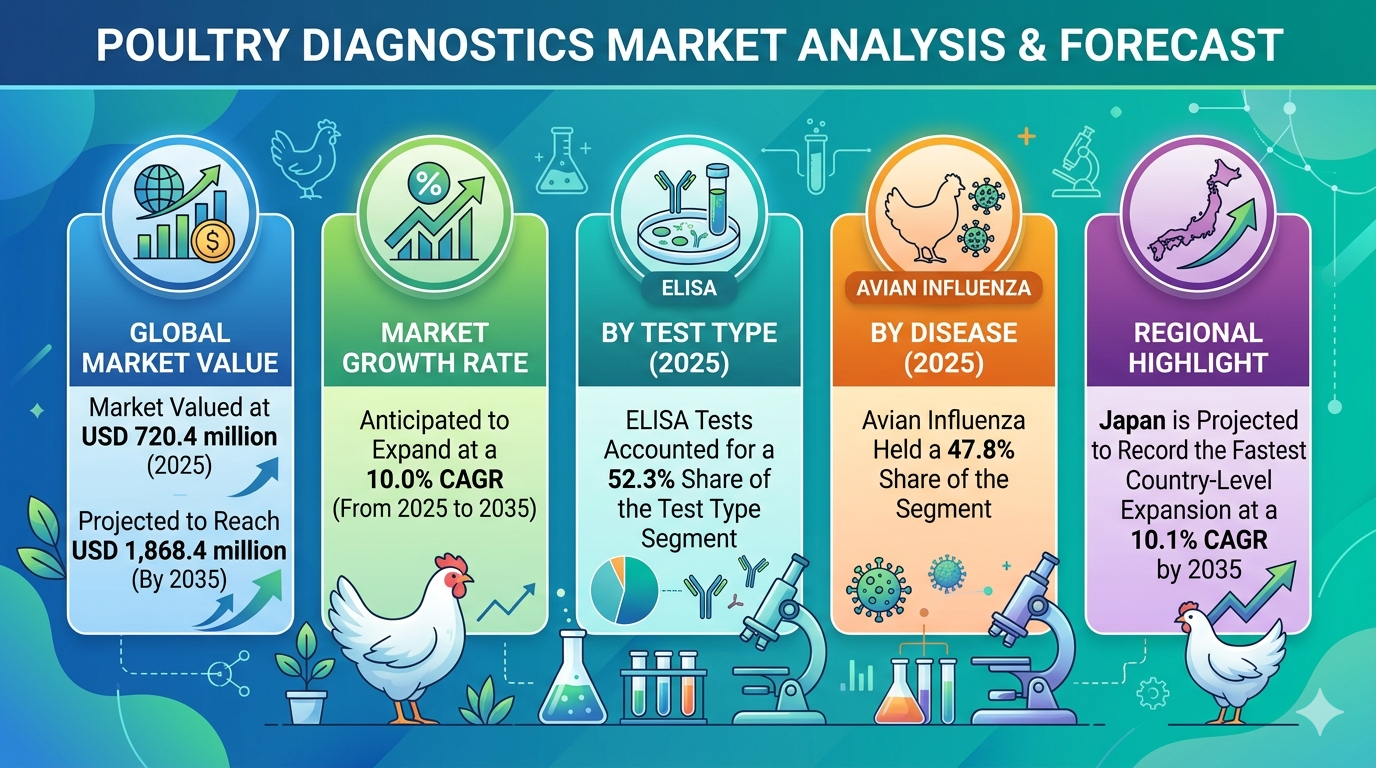
Valued at USD 720.4 million in 2025, the poultry diagnostics market is projected to reach USD 1,868.4 million by 2035, registering a CAGR of 10.0% during the forecast period. The market is witnessing a transition from outbreak-driven testing toward proactive disease monitoring and preventive health management strategies aimed at minimizing production losses and ensuring supply chain continuity.
As global poultry production continues to expand, diagnostic testing is becoming a critical component of modern livestock management, supporting early disease detection, regulatory compliance, and improved operational efficiency.
Quick Market Highlights
- Poultry diagnostics market valued at USD 720.4 million in 2025
- Market projected to reach USD 1,868.4 million by 2035
- Strong growth anticipated at a CAGR of 10.0% from 2025 to 2035
- ELISA tests accounted for 52.3% share of the test type segment in 2025
- Avian influenza held 47.8% share of disease-related revenue in 2025
- Japan expected to register the fastest country-level growth at 10.1% CAGR through 2035
- Increasing adoption of PCR technologies supporting rapid disease confirmation
- Growing investments in biosecurity and veterinary laboratory infrastructure worldwide
Disease Surveillance Becomes Central to Poultry Health Management
The poultry industry is increasingly prioritizing preventive disease surveillance as recurring outbreaks continue to threaten production efficiency and profitability. Poultry producers are investing in routine diagnostic programs to identify infections at earlier stages, reducing the risk of widespread transmission and minimizing economic losses.
Avian influenza, Newcastle disease, infectious bronchitis, and avian salmonellosis remain among the most significant disease concerns affecting poultry operations globally. Early detection through structured testing programs enables producers to implement containment measures quickly while ensuring compliance with national and international animal health standards.
Industry stakeholders are recognizing that proactive diagnostics not only protect flock health but also support long-term sustainability and supply continuity.
Food Safety Regulations Drive Testing Requirements Across Production Systems
Increasing consumer demand for safe poultry products is encouraging regulators and industry participants to strengthen disease monitoring protocols throughout the poultry value chain.
Export-oriented producers are facing stricter testing requirements to ensure disease-free certification and maintain access to international markets. Government agencies and veterinary authorities continue to implement surveillance programs designed to reduce zoonotic disease risks and improve traceability across poultry production systems.
As food safety standards become more rigorous, routine diagnostic testing is emerging as a strategic necessity rather than a reactive disease management tool.
ELISA Testing Maintains Leadership Through High-Volume Screening Capabilities
ELISA tests remained the dominant test type segment in 2025, accounting for 52.3% of total market revenue.
The widespread adoption of ELISA technologies is attributed to their ability to process large sample volumes efficiently while delivering reliable results at a relatively low cost. Poultry producers and veterinary laboratories rely heavily on ELISA platforms for flock-level screening and antibody detection across multiple disease categories.
The technology’s scalability, standardized workflows, and compatibility with automated laboratory systems continue to strengthen its position within commercial poultry surveillance programs.
Ongoing improvements in assay sensitivity and testing accuracy are expected to further support ELISA adoption throughout the forecast period.
PCR Technologies Expand Role in Rapid Disease Confirmation
Alongside ELISA testing, Polymerase Chain Reaction (PCR) diagnostics are becoming increasingly important for disease confirmation and outbreak response.
PCR technologies provide highly sensitive and specific pathogen detection, enabling veterinary professionals to identify infections quickly during suspected disease events. The ability to detect viral and bacterial pathogens with greater precision has made PCR a valuable tool in managing avian influenza, Newcastle disease, and other high-priority poultry diseases.
As molecular diagnostic platforms become more accessible and cost-effective, demand for PCR-based testing is expected to rise significantly across both developed and emerging poultry markets.
Avian Influenza Continues to Drive Diagnostic Demand
Avian influenza represented the largest disease segment in 2025, accounting for 47.8% of total disease-related market revenue.
The persistent threat posed by highly pathogenic avian influenza strains continues to drive investment in diagnostic infrastructure and surveillance programs worldwide. National governments, veterinary authorities, and poultry producers are prioritizing routine testing initiatives to mitigate outbreak risks and safeguard trade activities.
Advancements in molecular assays, high-sensitivity ELISA kits, and rapid testing solutions have enhanced disease detection capabilities, enabling faster containment measures and improved response strategies.
As international trade requirements become increasingly stringent, avian influenza testing is expected to remain a major driver of market growth.
Artificial Intelligence and Portable Diagnostics Create New Opportunities
Technological innovation is reshaping the poultry diagnostics landscape through the integration of artificial intelligence, machine learning, and portable testing technologies.
AI-powered disease surveillance platforms are helping producers analyze flock health trends, predict potential outbreaks, and receive real-time alerts that support preventive interventions. These solutions are enhancing disease management efficiency while reducing the operational burden associated with manual monitoring.
Meanwhile, portable diagnostic devices, biosensors, and smartphone-enabled testing platforms are improving access to rapid on-site disease detection. These innovations enable producers to obtain faster results, particularly in remote farming locations where laboratory access may be limited.
Companies investing in automated and real-time diagnostic technologies are expected to strengthen their competitive positioning as digital transformation accelerates across animal health markets.
Regional Markets Showcase Strong Growth Potential
Regional demand for poultry diagnostics continues to strengthen as governments and producers expand investments in disease prevention and animal health infrastructure.
Japan is projected to register the fastest growth globally, recording a CAGR of 10.1% through 2035. Strong emphasis on biosecurity measures, advanced veterinary testing adoption, and ongoing research investments are supporting market expansion across the country.
The United States is expected to grow at a CAGR of 9.8%, driven by increasing disease surveillance requirements and the widespread adoption of ELISA and PCR testing platforms.
The United Kingdom is forecast to expand at a CAGR of 9.9%, supported by growing concerns regarding zoonotic diseases and rising demand for antibiotic-free poultry production.
Across the European Union, market growth is projected at 10.0% CAGR as disease prevention initiatives and regulatory frameworks continue to encourage routine testing and biosecurity compliance.
South Korea is also expected to experience strong growth, supported by government-led disease monitoring programs and increasing poultry production activities.
Challenges Persist Despite Positive Market Fundamentals
While market prospects remain highly favorable, adoption challenges continue to affect portions of the industry.
Small and medium-sized poultry farms often face financial constraints when investing in advanced molecular diagnostic systems and real-time disease monitoring platforms. Limited access to specialized veterinary diagnostic facilities in certain regions can also delay disease identification and intervention efforts.
To address these challenges, industry participants are focusing on developing affordable rapid testing kits, mobile diagnostic solutions, and user-friendly technologies designed to improve accessibility for producers of all sizes.
Competitive Landscape Focuses on Innovation and Expanded Disease Detection
Competition within the poultry diagnostics market is intensifying as manufacturers seek to strengthen their product portfolios and expand global market presence.
Leading companies are investing in:
- Multiplex diagnostic assay development
- Rapid testing technologies
- Portable diagnostic platforms
- Automation-compatible laboratory solutions
- Expanded disease detection panels
- Strategic veterinary partnerships
- Training and technical support programs
Organizations capable of delivering accurate, scalable, and user-friendly diagnostic solutions are expected to gain a significant competitive advantage as disease surveillance requirements continue to evolve.
Recent industry developments highlight the pace of innovation. In 2024, Labcorp announced the commercial availability of its H5 Bird Flu Test in the United States. Additionally, Singapore’s Diagnostics Development Hub (DxD Hub), in collaboration with Japan’s National Institute for Environmental Studies and A*STAR Bioinformatics Institute, introduced the Steadfast diagnostic kit for detecting highly pathogenic H5N1 avian influenza virus.
Outlook: Poultry Diagnostics Evolve into a Strategic Biosecurity Investment
Looking ahead to 2035, poultry diagnostics are expected to play an increasingly critical role in global animal health management, food safety assurance, and agricultural sustainability.
As producers focus on preventing disease outbreaks, maintaining trade compliance, and improving operational resilience, demand for advanced surveillance technologies will continue to accelerate. The market is shifting toward integrated diagnostic ecosystems that combine laboratory testing, digital monitoring, artificial intelligence, and rapid field diagnostics.
Companies that can deliver reliable ELISA platforms, advanced PCR solutions, portable diagnostic tools, and comprehensive disease detection capabilities are likely to emerge as market leaders throughout the next decade.
Related Reports:
Poultry Diagnostic Testing Market
Bacterial Diagnostics in Aquaculture Market
Have a specific Requirements and Need Assistant on Report Pricing or Limited Budget please contact us – sales@futuremarketinsights.com
About Future Market Insights (FMI)
Future Market Insights, Inc. (FMI) is an ESOMAR-certified, ISO 9001:2015 market research and consulting organization, trusted by Fortune 500 clients and global enterprises. With operations in the U.S., UK, India, and Dubai, FMI provides data-backed insights and strategic intelligence across 30+ industries and 1200 markets worldwide.
Contact Us:
Future Market Insights Inc.
Christiana Corporate, 200 Continental Drive,
Suite 401, Newark, Delaware – 19713, USA
T: +1-347-918-3531
Why FMI: https://www.futuremarketinsights.com/why-fmi
For Sales Enquiries: sales@futuremarketinsights.com
Website: https://www.futuremarketinsights.com