

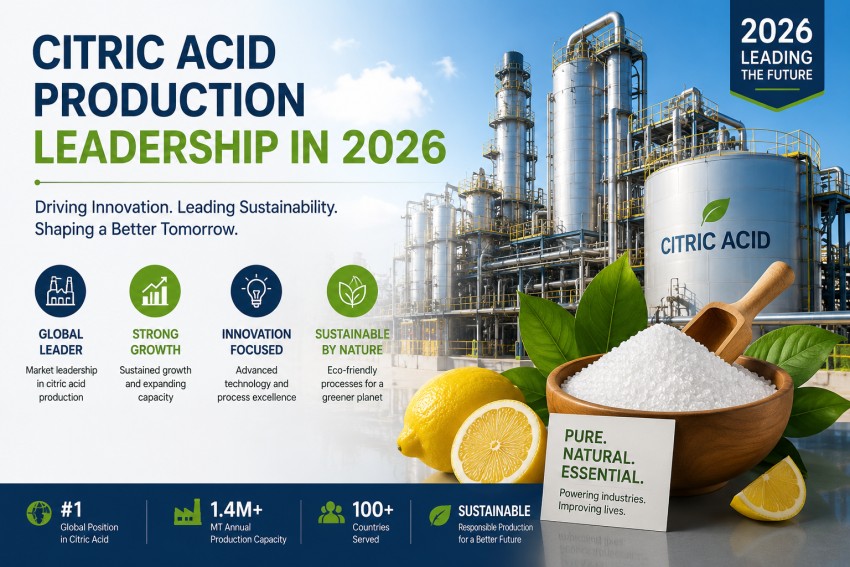
According to the latest insights by Future Market Insights, the global citric acid industry is experiencing a major supply chain transformation as production capacity becomes increasingly concentrated in China. In 2026, China continues to dominate global citric acid manufacturing due to large-scale fermentation infrastructure, integrated corn-based feedstock availability, advanced process optimisation, and cost-efficient production ecosystems.
Industry analysts highlight that global citric acid supply dynamics are increasingly influenced by China’s manufacturing scale, environmental regulations, energy costs, and export availability. While demand continues to expand across food and beverages, pharmaceuticals, personal care, and industrial applications, production concentration has created new considerations around supply security, pricing stability, and regional sourcing strategies.
China Emerges as the Global Citric Acid Manufacturing Hub
China has become the leading producer of citric acid, accounting for approximately 60% to 70% of global production capacity. This dominance has developed through decades of investment in fermentation technology, industrial infrastructure, and agricultural integration.
Large-scale manufacturers have established advanced production complexes supported by:
- High-volume fermentation facilities
• Integrated corn glucose supply chains
• Advanced microbial processing technology
• Efficient downstream purification systems
• Large export-oriented manufacturing networks
Unlike traditional production regions where facilities were smaller and more fragmented, Chinese producers have developed large fermentation sites capable of achieving significant economies of scale.
These production advantages allow manufacturers to optimise operating costs, improve output efficiency, and maintain competitive positioning across international markets.
Feedstock Integration Strengthens China’s Cost Advantage
The availability of corn-based glucose feedstock remains one of the most important factors supporting China’s citric acid leadership.
Citric acid production depends heavily on fermentation processes requiring reliable supplies of:
- Corn starch derivatives
• Glucose syrup
• Water resources
• Energy inputs
• Fermentation nutrients
Chinese producers benefit from close integration between corn processing facilities and citric acid manufacturing plants.
This integrated structure reduces transportation requirements, improves supply reliability, and lowers raw material costs compared with producers dependent on external glucose suppliers.
Feedstock efficiency has become a major competitive factor because raw materials represent a significant portion of overall citric acid manufacturing expenses.
Large-Scale Fermentation Technology Drives Production Efficiency
Modern citric acid manufacturing relies on fermentation technology using specialised microbial strains and controlled processing conditions.
Chinese producers have invested in:
- High-capacity fermentation vessels
• Process automation systems
• Strain optimisation techniques
• Advanced quality control platforms
• Efficient crystallisation technology
Large fermentation systems allow manufacturers to achieve improved conversion efficiency and consistent product quality.
Higher production volumes also enable better utilisation of infrastructure, reducing per-unit manufacturing costs and strengthening export competitiveness.
Environmental Regulations Influence Global Citric Acid Availability
Environmental compliance has become a major factor shaping China’s effective citric acid production capacity.
Citric acid fermentation generates wastewater streams requiring advanced treatment systems. Increasing environmental enforcement has encouraged producers to invest in:
- Wastewater treatment infrastructure
• Cleaner production methods
• Energy-efficient processing systems
• Modern pollution control technologies
During periods of stricter environmental inspections, some facilities experience temporary production reductions or shutdowns.
Because China supplies a large share of global demand, regulatory actions can quickly influence international availability and pricing.
Capacity Concentration Creates Global Supply Dependence
The concentration of production capacity in China has significantly reshaped global trade flows.
Major importing regions increasingly depend on Chinese exports for:
- Food and beverage manufacturing
• Pharmaceutical formulations
• Cleaning products
• Industrial applications
• Personal care products
Regions with limited domestic production face greater exposure to:
- Shipping disruptions
• Export restrictions
• Production interruptions
• Price fluctuations
As a result, many buyers are exploring supplier diversification strategies while maintaining relationships with established Chinese manufacturers.
Regional Production Gaps Increase Import Dependency
Outside China, citric acid production capacity remains more limited.
European manufacturers continue supplying specialised and premium applications, while North American producers focus on selected market segments.
However, commodity-grade citric acid supply increasingly relies on Chinese production due to cost competitiveness.
Regions including Africa, the Middle East, and several Asian markets depend heavily on imports because developing new fermentation capacity requires:
- Significant capital investment
• Long construction timelines
• Access to glucose supply chains
• Technical fermentation expertise
These barriers make rapid relocation of production challenging.
Byproduct Utilisation Improves Production Economics
Modern citric acid facilities are increasingly improving profitability through byproduct recovery.
Manufacturers are developing methods to utilise:
- Fermentation biomass
• Organic residues
• Nutrient-rich materials
• Industrial byproducts
These recovery systems support:
- Lower waste generation
• Additional revenue opportunities
• Improved sustainability performance
• Better resource efficiency
Byproduct utilisation has become an important factor in improving overall manufacturing economics.
Trade Dynamics and Pricing Remain Linked to Chinese Capacity
Global citric acid pricing is strongly influenced by Chinese production conditions.
Capacity expansions can increase supply availability and place downward pressure on prices, while environmental shutdowns or reduced operating rates can create shortages.
Market participants increasingly monitor:
- Chinese plant utilisation rates
• Export availability
• Inventory levels
• Regulatory developments
• New capacity announcements
Because alternative supply sources cannot quickly replace Chinese output, production changes within China have a significant impact on global markets.
Future Outlook
The future of the global citric acid industry will be shaped by supply diversification, manufacturing efficiency, sustainability improvements, and technological innovation.
China is expected to remain the dominant production hub due to its integrated feedstock ecosystem, fermentation expertise, and large-scale manufacturing infrastructure.
However, increasing focus on supply chain resilience may encourage investment in alternative regional production, strategic inventory management, and diversified sourcing approaches.
As demand continues growing across food, beverage, pharmaceutical, and industrial sectors, companies that balance cost efficiency with supply security will be best positioned to succeed in the evolving citric acid market.
Explore More Related Studies Published by FMI Research:
Citric Acid Market is projected to expand through 2036, supported by rising demand from food processing, pharmaceuticals, personal care, and industrial applications.
Food and Beverage Industry: Global Industry Analysis and Opportunity Assessment 2026–2036
About Future Market Insights (FMI)
Future Market Insights, Inc. (FMI) is an ESOMAR-certified, ISO 9001:2015 market research and consulting organization, trusted by Fortune 500 clients and global enterprises. With operations in the U.S., UK, India, and Dubai, FMI provides data-backed insights and strategic intelligence across 30+ industries and 1200 markets worldwide.
Frequently Asked Questions
What share of global citric acid production capacity is located in China?
China is estimated to account for approximately 60% to 70% of global citric acid production capacity. This dominance is driven by large-scale fermentation facilities, integrated feedstock availability, and cost-efficient manufacturing systems.
Why is citric acid production concentrated in China?
Citric acid production is concentrated in China because of strong fermentation expertise, access to corn-based glucose feedstock, lower production costs, and large integrated industrial facilities.
How do environmental regulations affect citric acid supply?
Environmental inspections and compliance requirements can temporarily reduce operating rates at some facilities. Since China supplies a major share of global demand, these changes can influence international availability and pricing.
Which regions depend most on imported citric acid?
Africa, the Middle East, and several Asian markets rely heavily on imports because domestic fermentation capacity remains limited.
Can global citric acid production shift away from China?
Diversification is possible, but developing competitive production outside China requires significant investment, access to feedstock infrastructure, technical expertise, and long development timelines.
How does China’s production scale influence global prices?
Large-scale Chinese capacity strongly influences global pricing. Expansion projects can increase supply availability, while shutdowns or reduced production can create tighter markets and higher prices.
Explore More Related Studies Published by FMI Research:
Folic Acid Market is segmented by Application Type (Pharmaceuticals, Nutraceuticals, and Food And Beverages), Source (Plants and Animal), Form (Tablets, Soft Gels, and Lozenges), Distribution Channel (Offline and Online) and Region. Forecast for 2026 to 2036.
Amino Acids Premixes Market : Global Industry Analysis 2009 – 2018 and Opportunity Assessment 2019 – 2029
Future Market Insights (FMI)
Future Market Insights, Inc. (FMI) is an ESOMAR-certified, ISO 9001:2015 market research and consulting organization, trusted by Fortune 500 clients and global enterprises. With operations in the U.S., UK, India, and Dubai, FMI provides data-backed insights and strategic intelligence across 30+ industries and 1200 markets worldwide.
Contact Us:
Future Market Insights Inc.
Christiana Corporate, 200 Continental Drive,
Suite 401, Newark, Delaware – 19713, USA
T: +1-347-918-3531
Why FMI: https://www.futuremarketinsights.com/why-fmi
For Sales Enquiries: sales@futuremarketinsights.com
Website: https://www.futuremarketinsights.com
LinkedIn| Twitter| Blogs | YouTube