

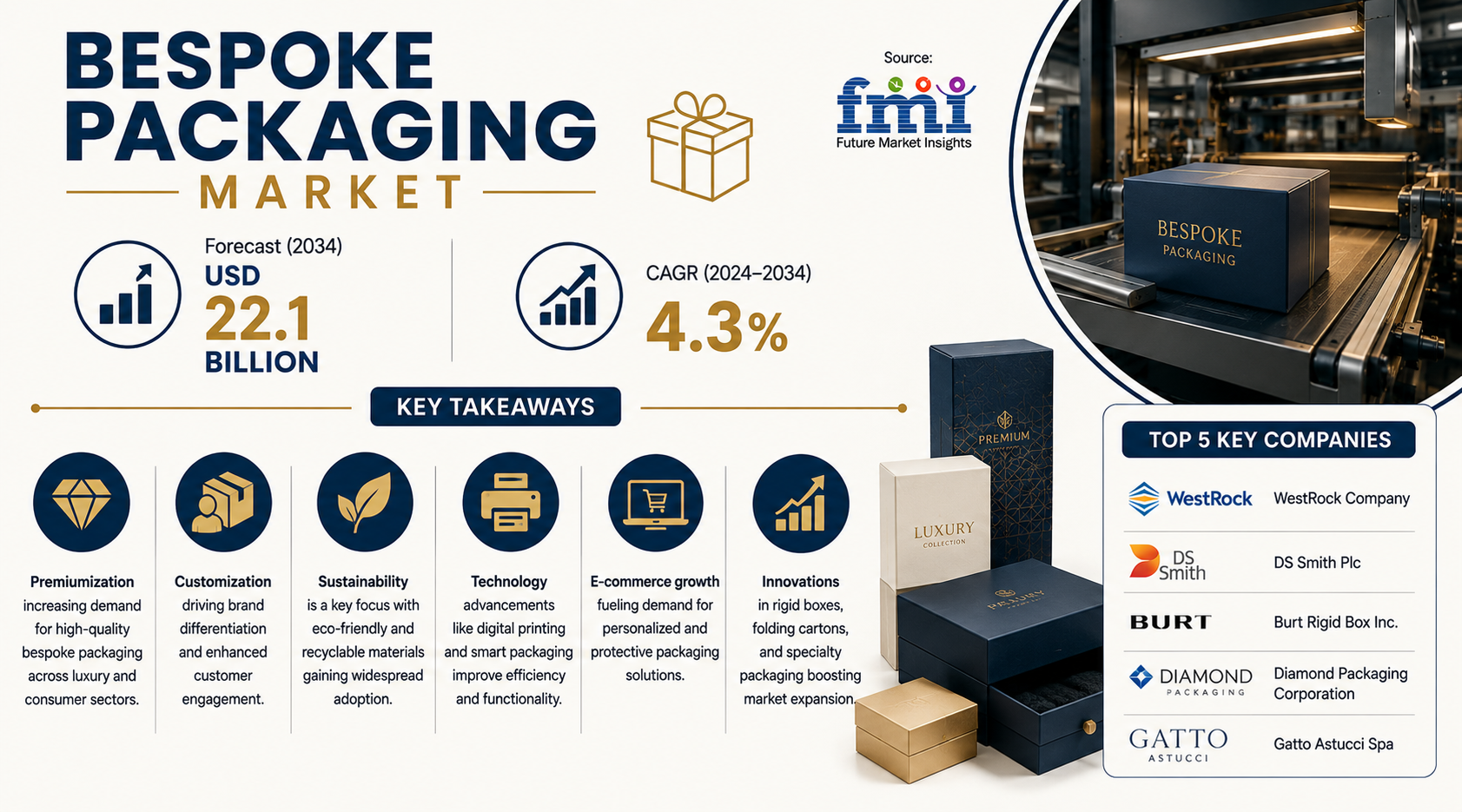
The global bespoke eco packaging market is gaining significant momentum as brands increasingly invest in sustainable, customized packaging solutions that align with consumer expectations and regulatory requirements. According to recent market analysis, the market is valued at USD 14.7 billion in 2024 and is projected to reach USD 22.1 billion by 2034, expanding at a CAGR of 4.3% during the forecast period. The industry’s growth reflects a broader shift toward environmentally responsible packaging formats made from natural fibers, molded pulp, bamboo, bagasse, and bio-based materials. While sustainability remains a key growth catalyst, the economics of bespoke eco packaging are becoming increasingly complex as manufacturers navigate raw material volatility, energy-intensive production processes, certification requirements, and global logistics challenges.
Featured Snippet: Key Market Answer
Q: What is driving growth in the bespoke eco packaging market?
A: Growth is being fueled by rising consumer demand for sustainable packaging, increasing adoption of compostable materials, stricter environmental regulations, premium brand differentiation strategies, and growing investments in customized packaging solutions across food, beverage, cosmetics, personal care, and retail industries.
Quick Stats of Bespoke Eco Packaging Market
- Market Size (2024): USD 14.7 Billion
- Forecast Market Value (2034): USD 22.1 Billion
- CAGR (2024–2034): 4.3%
- Leading Materials: Molded Fiber, Bagasse, Bamboo, and Bio-Based Polymers
- Key Trend: Premium Sustainable Packaging Customization
- Fastest Growth Opportunity: Compostable Luxury Packaging
Market Overview: Sustainability Meets Customization
Bespoke eco packaging refers to customized packaging solutions developed using renewable, recyclable, biodegradable, or compostable materials. Unlike conventional packaging formats, these products are designed to support both environmental objectives and brand differentiation.
Demand is increasing across industries seeking alternatives to plastic packaging while maintaining premium aesthetics and product protection. However, unlike traditional packaging markets, bespoke eco packaging is influenced by a unique mix of feedstock availability, tooling requirements, compliance standards, and logistics economics. As companies prioritize sustainability commitments and circular economy initiatives, customized eco-packaging solutions are becoming an important strategic investment.
Key Growth Drivers
Rising Consumer Preference for Sustainable Packaging
Consumers are increasingly choosing brands that demonstrate environmental responsibility. This shift is encouraging manufacturers and retailers to adopt eco-friendly packaging formats that reduce environmental impact while enhancing brand perception.
Growth of Premium and Luxury Packaging
Luxury cosmetics, personal care products, premium beverages, and gourmet foods are increasingly utilizing bespoke eco packaging as part of their brand positioning strategies. Customized sustainable packaging helps companies differentiate products while reinforcing premium value propositions.
Expansion of Compostable Packaging Solutions
Demand for compostable packaging continues to rise as governments and corporations implement waste-reduction initiatives. Certifications such as EN 13432 and ASTM D6400 are becoming increasingly important purchasing criteria for environmentally conscious brands.
Regulatory Pressure on Conventional Packaging
Global efforts to reduce plastic waste are encouraging investment in renewable packaging materials. Many organizations are transitioning toward molded fiber, bamboo, and bagasse-based solutions to meet evolving sustainability requirements.
Market Trends Shaping the Industry
Natural Fiber Volatility Influences Cost Structures: Feedstocks such as bagasse, bamboo, and recycled fiber remain subject to seasonal availability and regional supply conditions. As a result, manufacturers often experience raw material cost fluctuations ranging from 15% to 40% during production cycles.
Compostability and PFAS-Free Compliance Gain Importance: Regulatory scrutiny surrounding food-contact materials and chemical safety is increasing. Manufacturers are investing in PFAS-free coatings and certified compostable materials to strengthen market competitiveness.
Increased Focus on Design-Led Packaging: Brands are seeking unique packaging formats that combine sustainability with superior consumer experience. Custom shapes, premium finishes, and innovative structural designs are becoming major differentiators.
Supply Chain Resilience Becomes Critical: Freight disruptions and ocean transportation volatility continue to impact landed costs, particularly for bulky molded fiber packaging products. Companies are increasingly exploring regional manufacturing strategies to reduce logistics exposure.
Segment Insights
Molded Fiber Packaging Leads Adoption
Molded fiber remains one of the most widely adopted materials within the bespoke eco packaging sector.
Key advantages include:
- Renewable raw material sourcing
- Compostability
- Recyclability
- Strong protective performance
- Design flexibility
Luxury Packaging Emerges as a High-Value Segment
Premium brands in cosmetics, personal care, spirits, and gourmet food categories are driving demand for customized eco-packaging solutions. These applications often support higher margins due to their emphasis on brand differentiation rather than cost minimization.
Regional Insights
Europe: Europe remains a major market due to stringent sustainability regulations and strong consumer demand for environmentally responsible packaging. The region continues to lead adoption of compostable and fiber-based packaging solutions.
North America: North America is witnessing growing investment in sustainable packaging technologies as consumer brands strengthen ESG commitments and regulatory compliance efforts.
Asia-Pacific: Asia-Pacific serves as both a major manufacturing hub and a rapidly growing consumer market. China, India, and Southeast Asian countries play important roles in supplying molded fiber, bamboo, and bagasse packaging products globally.
Competitive Landscape
The bespoke eco packaging market features a mix of global packaging leaders, regional specialists, and design-focused packaging innovators.
Leading companies focus on:
- Sustainable material innovation
- Compostability certification
- Custom design capabilities
- Manufacturing efficiency
- Supply chain optimization
- Regulatory compliance expertise
Competition increasingly revolves around balancing sustainability, customization, and cost efficiency.
Expert Insight
The future of bespoke eco packaging extends beyond sustainability alone. Success will increasingly depend on a company’s ability to manage raw material volatility, navigate regulatory requirements, and deliver customized solutions that create measurable brand value. As premium brands continue to prioritize sustainable differentiation, bespoke eco packaging is evolving from a compliance-driven purchase into a strategic marketing and consumer engagement tool. Companies capable of combining environmental performance with design innovation are expected to capture the greatest long-term opportunities.
Conclusion
The bespoke eco packaging market is positioned for sustained growth as sustainability, customization, and premium consumer experiences become central business priorities. With the market projected to reach USD 22.1 billion by 2034, demand for molded fiber, bamboo, bagasse, and compostable packaging solutions is expected to accelerate across multiple industries. Manufacturers that invest in material innovation, supply chain resilience, certification capabilities, and design excellence will be best positioned to capitalize on future market opportunities while addressing the evolving expectations of both regulators and consumers.
Related Research Reports
Toy Packaging Market: The market is set to reach USD 1.8 billion by 2026-end and grow at a CAGR of 3.2% between 2026-2036 to reach USD 2.4 billion by 2036.
Packaging Bins Market: The market will be around USD 2,256 million in 2025 and will be USD 3,627 million in 2035 with a 4.9% CAGR from 2025 to 2035.
Pie Packaging Market: The Market is projected to reach USD 100.1 billion by 2035, registering a compound annual growth rate (CAGR) of 6.0% over the forecast period.
About Future Market Insights (FMI)
Future Market Insights is a leading provider of market intelligence, consulting services, and syndicated research reports. FMI delivers actionable insights across packaging, logistics, industrial manufacturing, food and beverage, healthcare, chemicals, and emerging technologies, helping organizations identify growth opportunities and make informed strategic decisions in rapidly evolving markets.
Contact
Future Market Insights Inc.
Christiana Corporate
200 Continental Drive, Suite 401
Newark, Delaware 19713, USA
Email: sales@futuremarketinsights.com
Website: www.futuremarketinsights.com