

The global plant-based food market is entering a critical phase of commercial evolution as brands, manufacturers, and retailers work to overcome one of the industry’s biggest barriers: the persistent Green Premium. According to the latest analysis, the market is valued at USD 14.2 billion in 2025 and is projected to reach USD 49.5 billion by 2036, expanding at a CAGR of 12.0%.
Despite strong consumer awareness regarding sustainability, health, and ethical food choices, price remains a major adoption challenge. The concept of Biological Arbitrage the strategic use of plant-derived inputs to replicate animal-based sensory experiences while avoiding the inefficiencies of animal agriculture offers significant theoretical cost advantages. However, processing complexity, ingredient refinement, distribution inefficiencies, and retail markups continue to keep many plant-based products more expensive than conventional alternatives.
As the industry seeks mainstream adoption, closing the Green Premium gap is becoming the defining commercial challenge of the next decade.
Featured Snippet: Key Market Answer
Q: Why does the Green Premium persist in the plant-based food market?
A: The Green Premium persists because while plant-based ingredients benefit from biological efficiency advantages over animal agriculture, additional costs related to ingredient processing, formulation complexity, manufacturing scale, supply chain fragmentation, and retail margins continue to elevate shelf prices. Achieving price parity requires improvements in technology, manufacturing efficiency, supply chain visibility, and formulation optimization.
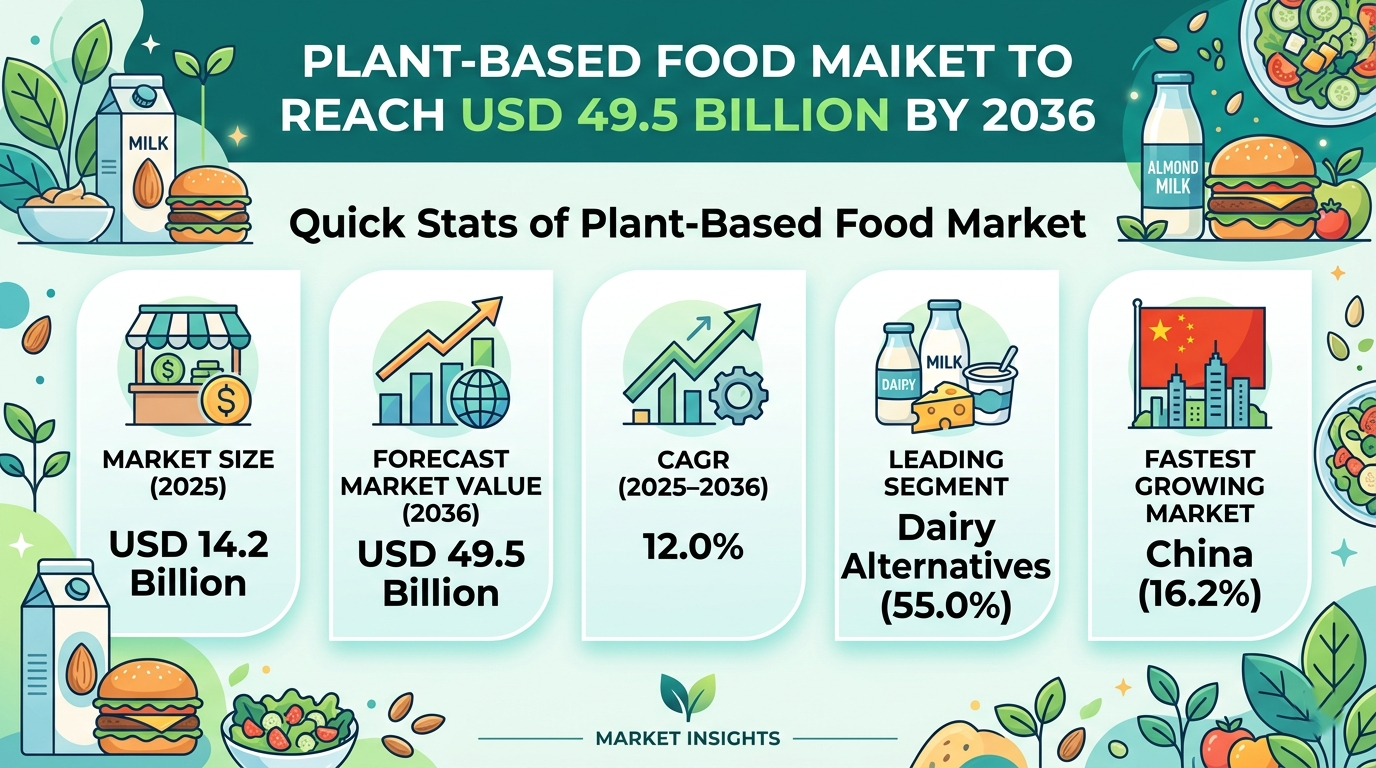
Quick Stats of Plant-Based Food Market
Market Size (2025): USD 14.2 Billion
Forecast Market Value (2036): USD 49.5 Billion
CAGR (2025–2036): 12.0%
Leading Segment: Dairy Alternatives (55.0%)
Fastest Growing Market: China (16.2%)
Emerging Trend: Biological Arbitrage Optimization and AI-Driven Price Parity Modeling
Market Overview: The Economics Behind Biological Arbitrage
The plant-based food market encompasses meat alternatives, dairy alternatives, plant-based beverages, protein ingredients, ready meals, snacks, and other food products developed using plant-derived raw materials.
The industry’s long-term growth potential is supported by increasing consumer demand for sustainable diets, rising environmental awareness, expanding flexitarian populations, and advancements in food technology.
However, market expansion continues to face a significant obstacle: pricing.
Although biological conversion efficiency strongly favors plant-based production pathways, many finished products still carry retail premiums ranging between 40% and 80% compared to conventional animal-derived products.
Three major forces are shaping the market today:
- Growing demand for sustainable and ethical food consumption
- Continued challenges in achieving price parity
- Rapid advancements in formulation science, AI, and manufacturing technologies
These factors are redefining the future competitiveness of plant-based food systems.
Key Growth Drivers
Growing Consumer Shift Toward Sustainable Diets
Consumers increasingly seek products that align with environmental sustainability, animal welfare, and personal health objectives.
This trend continues to drive adoption across plant-based meat, dairy alternatives, and functional food categories.
Expansion of Flexitarian Consumption
The fastest-growing consumer group is no longer strict vegetarians or vegans.
Flexitarian consumers are actively incorporating plant-based products into their diets while continuing to consume animal products, creating substantial market opportunities.
Advancements in Food Technology
Innovations in protein extraction, precision fermentation, texture engineering, and ingredient functionality are improving product quality while supporting cost reduction efforts.
Increasing Retail and Foodservice Penetration
Major retailers and foodservice chains continue expanding plant-based offerings, improving consumer accessibility and product visibility.
Market Trends Shaping the Industry
Rise of Biological Arbitrage Optimization
Manufacturers are increasingly focusing on ingredient systems that maximize sensory performance while minimizing biological and economic conversion costs.
AI-Powered Formulation Platforms
Artificial intelligence is being used to identify lower-cost ingredient combinations capable of delivering equivalent taste, texture, and nutritional performance.
Supply Chain Digital Twins
Digital twin technologies are helping companies model manufacturing, logistics, and procurement scenarios to identify cost-saving opportunities throughout the value chain.
Dynamic Pricing Strategies
Brands are adopting data-driven pricing models designed to attract price-sensitive flexitarian consumers while preserving profitability.
Real-Time Green Premium Transparency
Emerging technologies allow manufacturers to communicate cost drivers more transparently, helping consumers understand pricing differences between conventional and plant-based products.
Segment Insights
Product Leadership: Dairy Alternatives (55.0%)
Dairy alternatives continue to dominate the plant-based food market because of:
- Strong consumer familiarity
- Broad retail distribution
- High repeat purchase rates
- Continuous innovation in milk, yogurt, and cheese alternatives
Protein Leadership: Soy Protein (30.0%)
Soy protein maintains leadership due to:
- Established supply chains
- Competitive pricing
- Strong functional performance
- Extensive manufacturing experience
Plant-Based Milk Leadership: Almond Milk (30.0%)
Almond milk remains the leading category because of:
- Widespread consumer acceptance
- Premium and mainstream positioning
- Strong retail shelf presence
- Versatile consumption occasions
Related Plant-Based Market Segments
Plant-Based Protein Market
Market Value (2026): USD 24.3 Billion
Forecast Value (2036): USD 59.4 Billion
CAGR: 9.5%
Growth is supported by increasing demand for protein-rich alternative foods and expanding applications across food manufacturing.
Dairy Alternatives Market
Market Value (2025): USD 24.9 Billion
Forecast Value (2036): USD 51.9 Billion
CAGR: 6.9%
Demand continues to rise as consumers seek lactose-free, vegan, and environmentally friendly alternatives.
Plant-Based Milk Market
Market Value (2026): USD 25.4 Billion
Forecast Value (2036): USD 53.5 Billion
CAGR: 7.8%
Growth is driven by product diversification, premiumization, and expanding retail distribution.
Regional Insights
North America
North America remains a major market due to:
- Strong consumer awareness
- Advanced food innovation ecosystem
- Established plant-based brands
- Significant retail penetration
Europe
Europe continues to experience strong growth supported by:
- Sustainability-focused consumer behavior
- Regulatory support for environmental initiatives
- Mature alternative protein markets
- Expanding retail assortments
Asia-Pacific
Asia-Pacific is expected to record the fastest long-term expansion owing to:
- Growing middle-class populations
- Rapid urbanization
- Rising health consciousness
- Increasing investment in food innovation
China
China is projected to remain the fastest-growing market with a CAGR of 16.2%, driven by dietary diversification and government support for sustainable food systems.
India
India presents significant opportunities due to:
- Strong vegetarian consumer base
- Expanding food processing industry
- Growing demand for affordable protein alternatives
Competitive Landscape
The plant-based food market is becoming increasingly competitive as global food manufacturers, ingredient suppliers, and food technology companies seek to achieve price parity and accelerate mass-market adoption.
Key Players
- Unilever
- Danone
- Beyond Meat
- SunOpta
- Oatly
- Nestlé
- Impossible Foods
- The Vegetarian Butcher
- Califia Farms
- Alpro
Competitive Differentiation Factors
- Formulation efficiency
- Manufacturing scale
- Ingredient sourcing capabilities
- AI-driven product development
- Supply chain visibility
- Retail partnerships
- Brand positioning and consumer trust
Recent Developments
- Increased investment in precision fermentation technologies
- Expansion of AI-powered formulation optimization platforms
- Growing adoption of digital supply chain visibility systems
- Development of real-time ingredient pricing analytics tools
- Strategic partnerships focused on reducing production costs and accelerating price parity
Expert Insight
The plant-based food industry is entering what can be described as the “Price Parity Era,” where long-term success will depend less on sustainability messaging and more on economic competitiveness.
Biological Arbitrage offers a powerful theoretical advantage by eliminating inefficient animal conversion processes. However, realizing this advantage requires sophisticated technology infrastructure, advanced formulation science, and real-time supply chain intelligence.
Organizations that successfully integrate predictive analytics, AI-driven formulation tools, and cost transparency platforms will be better positioned to reduce the Green Premium and unlock mainstream adoption.
Key Market Research Pointers for B2B SaaS Providers
AI-Driven Price Parity Prediction Engines
Future SaaS solutions will help companies forecast when categories can realistically achieve parity based on ingredient, manufacturing, and logistics economics.
Biological Arbitrage Optimization Platforms
Advanced software will identify ingredient combinations capable of replicating animal-product functionality at lower overall production costs.
Green Premium Transparency Dashboards
Real-time cost attribution tools can improve stakeholder understanding of pricing dynamics across the value chain.
Decentralized Manufacturing Management Systems
Digital platforms may support regional production networks that reduce freight expenses and improve responsiveness to local demand.
Dynamic Flexitarian Pricing Engines
Predictive pricing models can encourage repeat purchasing behavior while supporting volume growth and long-term cost reductions.
FAQs
What is the future outlook for the plant-based food market?
The market is projected to reach USD 49.5 billion by 2036, growing at a CAGR of 12.0% as consumer demand for sustainable and alternative food products continues to expand.
What is Biological Arbitrage?
Biological Arbitrage refers to the use of plant-derived ingredients to recreate animal-based food experiences while avoiding the biological inefficiencies associated with livestock production.
Why are plant-based foods often more expensive?
Additional costs related to protein extraction, ingredient processing, manufacturing complexity, distribution, and retail margins contribute to higher shelf prices.
Which segment leads the plant-based food market?
Dairy alternatives currently dominate the market, accounting for 55.0% of total market share.
Which protein source leads the market?
Soy protein remains the leading protein source with a 30.0% market share due to its affordability, scalability, and functional performance.
Which regions offer the strongest growth opportunities?
China and India are expected to provide significant growth opportunities, supported by rising consumer demand, urbanization, and growing awareness of sustainable food choices.
Conclusion
The plant-based food market stands at a pivotal moment where future growth depends not only on consumer demand but also on the industry’s ability to reduce the Green Premium. While Biological Arbitrage offers a compelling pathway toward lower-cost food production, economic realities across formulation, manufacturing, and distribution continue to create pricing challenges.
Companies that leverage AI-driven optimization, supply chain transparency, predictive analytics, and advanced formulation technologies will be best positioned to close the price gap and accelerate mainstream adoption. As price parity becomes increasingly achievable, plant-based food is expected to evolve from a premium niche category into a core component of the global food system.
Related Research Reports
Plant-Based Protein Market is projected to grow from USD 24.3 billion in 2026 to USD 59.4 billion by 2036, expanding at a CAGR of 9.5%.
Dairy Alternatives Market is expected to increase from USD 24.9 billion in 2025 to USD 51.9 billion by 2036, registering a CAGR of 6.9%.
About Future Market Insights (FMI)
Future Market Insights is a leading provider of market intelligence, consulting services, and syndicated research reports. FMI delivers actionable insights across food and beverage, consumer goods, healthcare, chemicals, biotechnology, industrial products, and emerging technologies, helping organizations identify growth opportunities and make informed strategic decisions in rapidly evolving markets.
Contact
Future Market Insights Inc.
Christiana Corporate
200 Continental Drive, Suite 401
Newark, Delaware 19713, USA
Email: sales@futuremarketinsights.com
Website: www.futuremarketinsights.com