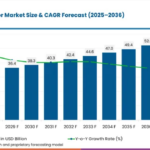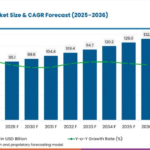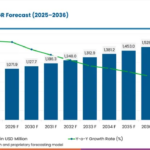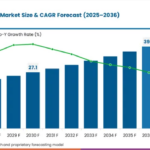


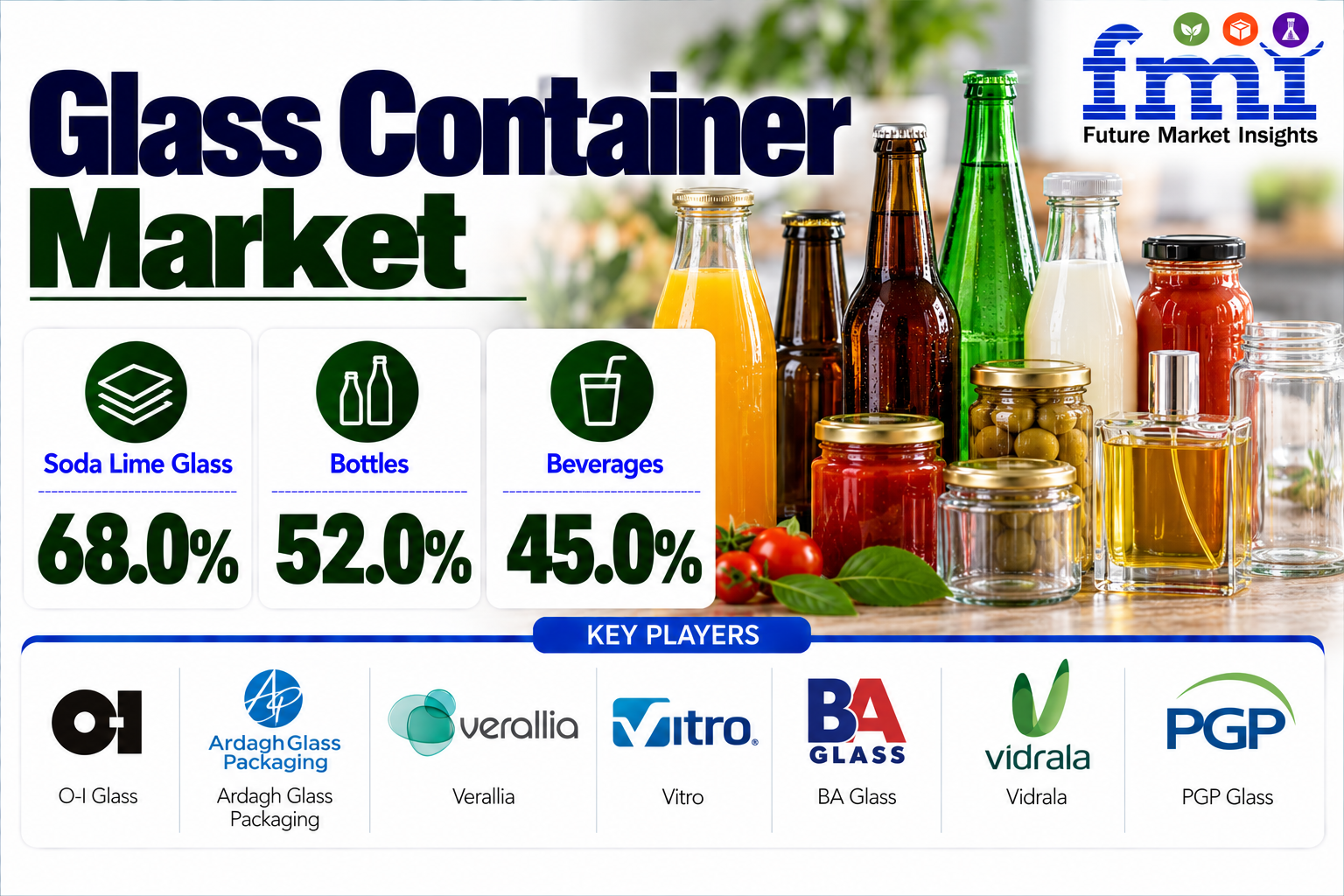
The global glass container market is projected to increase from US$67.4 billion in 2026 to US$94.2 billion by 2036, registering a compound annual growth rate (CAGR) of 3.4% during the 2026–2036 forecast period, according to Future Market Insights (FMI). The market was valued at US$65.2 billion in 2025, with an additional revenue opportunity of US$26.8 billion expected between 2026 and 2036.
Glass containers remain important across beverage, food, pharmaceutical, cosmetics and personal care packaging. Their chemical stability, product protection, recyclability and premium presentation make them suitable for applications where material integrity and packaging quality influence purchasing decisions. As sustainability requirements evolve, manufacturers are focusing on recycled glass utilization, energy-efficient furnaces and lightweight container designs.
>> Get Detailed Market Forecasts, Competitive Benchmarking, and Pricing Trends: https://www.futuremarketinsights.com/reports/sample/rep-gb-935
Bottles and Soda Lime Glass Lead Market Demand
FMI estimates that bottles will account for 52.0% of the glass container market by product type in 2026. Standardized neck finishes, closure compatibility and established high-speed filling operations support the leading position of bottles across beverage and pharmaceutical applications.
By material, soda lime glass is projected to hold a 68.0% share in 2026. Its established manufacturing processes, controlled production economics and compatibility with high-volume furnace operations support widespread use across food and beverage packaging.
Other important market segments include:
- Beverages: Expected to account for 45.0% of end-use demand in 2026, supported by beer, spirits, water and soft drink packaging.
- Pharmaceuticals: Projected to represent 48.0% of application demand, reflecting requirements for chemical stability and dimensional consistency.
- Lightweighting technology: Expected to hold a 42.0% share in 2026 as manufacturers seek to reduce container weight and transportation costs.
- Narrow-neck containers: Projected to account for 58.0% of neck-type demand, supported by closure reliability and compatibility with automated filling lines.
Recyclability and Product Protection Drive Market Growth
Growing demand for packaging materials that protect product quality is a major factor supporting glass container adoption. Glass provides a non-reactive packaging surface, making it suitable for beverages, food products and pharmaceutical formulations that require material compatibility and reliable storage.
Regulatory developments are also influencing purchasing decisions. The European Union’s Packaging and Packaging Waste Regulation (EU) 2025/40 establishes requirements intended to improve packaging sustainability and recyclability. These developments are encouraging packaging producers and brand owners to evaluate material recovery, recycled content and packaging design.
Glass recycling offers an additional advantage because recovered glass, known as cullet, can be reintroduced into manufacturing. Increasing cullet availability can reduce demand for virgin raw materials and support furnace energy efficiency. However, effective recycling requires collection infrastructure and appropriate color sorting.
Lightweighting and Hybrid Furnaces Shape Industry Innovation
Several developments are influencing manufacturing strategies and product innovation:
- Container lightweighting: Improved forming techniques can reduce container weight while maintaining required strength and handling performance.
- Hybrid furnace technology: Combining electrical energy with conventional fuel can help manufacturers pursue lower-emission glass production.
- Higher recycled-glass utilization: Better cullet collection and sorting can support circular manufacturing and reduce virgin material requirements.
- Premium container designs: Customized colors, embossing and decorative finishes help brands differentiate beverages, cosmetics and specialty products.
- Pharmaceutical-grade manufacturing: Consistent dimensions, chemical resistance and inspection capabilities remain important for regulated packaging applications.
For glass manufacturers, the challenge is balancing lower production emissions and material consumption with container strength, quality consistency and commercial furnace economics.
Regional Outlook: India Leads Country-Level Growth
FMI’s country analysis identifies India as the fastest-growing evaluated market, with a projected CAGR of 6.0% between 2026 and 2036. Expanding pharmaceutical packaging requirements and beverage-filling capacity are supporting demand across the country.
Other country-level forecasts include:
- China: 5.3% CAGR, supported by beverage manufacturing clusters and demand for premium glass packaging.
- Canada: 2.9% CAGR, influenced by deposit-return systems and circular bottle programs.
- United States: 2.5% CAGR, supported by craft beverages and pharmaceutical replacement demand.
- Germany: 2.0% CAGR, reflecting mature return systems and established cullet availability.
- Spain: 1.8% CAGR, supported by wine packaging and investment in hybrid furnace technology.
- United Kingdom: 1.6% CAGR, reflecting premium drinks, food jars and lightweighting applications.
These forecasts highlight different regional opportunities. India and China offer comparatively stronger growth potential, while mature European and North American markets create opportunities through production efficiency, recycled-glass utilization and premium packaging development.
Competitive Landscape: Top Players in the Glass Container Market
The global glass container market includes large-scale manufacturers, regional producers and specialized suppliers serving beverage, food, pharmaceutical and cosmetics customers. Competition is influenced by furnace capacity, geographic reach, product range, recycled-glass capabilities and manufacturing consistency.
Companies identified in FMI’s report include:
- O-I Glass, Inc.
- Ardagh Glass Packaging
- Verallia
- Vitro Glass Containers
- BA Glass
- Vidrala
- PGP Glass Pvt. Ltd.
These companies compete through different manufacturing and customer-service strengths. O-I Glass, Ardagh Glass Packaging and Verallia operate broad production networks serving beverage and food packaging customers. BA Glass and Vidrala maintain established regional positions, while PGP Glass serves premium and specialized packaging applications, including cosmetics and pharmaceuticals.
Recent industry developments illustrate the direction of competition. In April 2026, Verallia inaugurated a hybrid furnace in Zaragoza, Spain. In July 2025, Ardagh Glass Packaging-Europe supplied emerald green Jägermeister bottles produced using its NextGen furnace. In March 2025, Vitro Glass Containers started Furnace #4 in Toluca to expand capacity for liquor and cosmetics packaging.
Business Priorities for Glass Container Manufacturers
The market outlook creates opportunities for manufacturers to invest in lightweighting, furnace modernization and improved cullet utilization. Suppliers can strengthen their competitive positions by improving production efficiency while maintaining container quality and dimensional consistency.
Companies targeting pharmaceutical and premium cosmetics customers can prioritize inspection capabilities, specialized container formats and reliable supplier qualification. Manufacturers serving beverage producers should evaluate regional production networks, mold availability and transportation costs when planning capacity investments.
For buyers, supplier selection should consider more than container price. Furnace reliability, backup production capacity, recycled-glass availability, product quality and delivery distance can influence long-term supply performance.
Realted Report Of Packaging Industry :
Labels Market: https://www.futuremarketinsights.com/reports/labels-market
Reusable Water Bottle Market: https://www.futuremarketinsights.com/reports/reusable-water-bottles-market
Rolling Papers Market: https://www.futuremarketinsights.com/reports/rolling-papers-market
MEDIA CONTACT
Contact Person: Media Relations Team
Designation: Corporate Communications
Email: sales@futuremarketinsights.com
Phone: +1-347-918-3531
Website: https://www.futuremarketinsights.com/
ABOUT FUTURE MARKET INSIGHTS
Future Market Insights, Inc. (FMI) is an ESOMAR-certified market research and consulting firm headquartered in Delaware, USA, with offices in the United Kingdom, the United Arab Emirates, and India. FMI delivers syndicated and custom research across food and beverage, healthcare, chemicals, technology, packaging, consumer goods, and industrial sectors. Its research helps organizations assess market opportunities, understand industry developments, and make informed strategic decisions.