

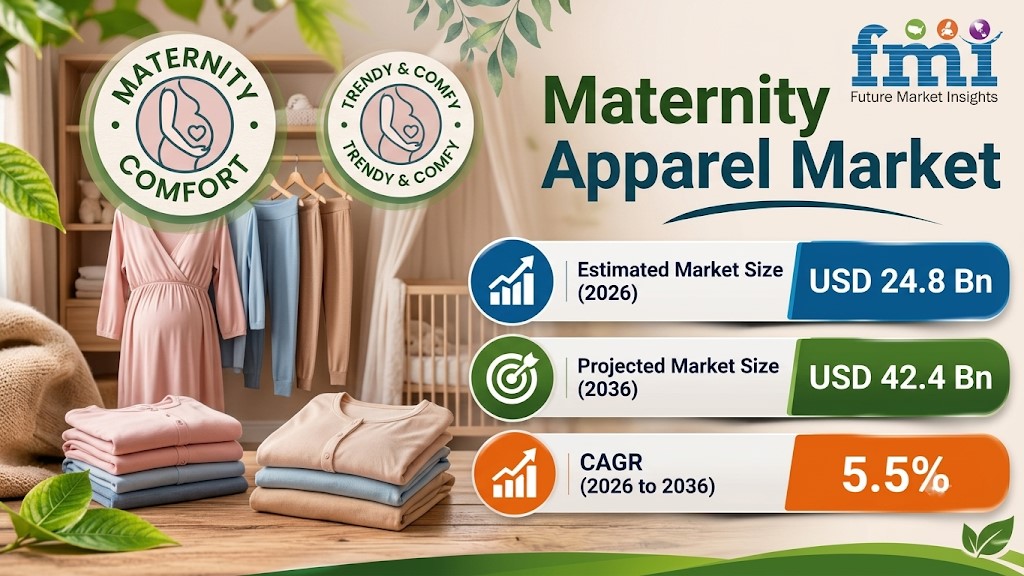
The global maternity apparel market is projected to grow from USD 23.5 billion in 2025 to USD 24.8 billion in 2026, reaching USD 42.4 billion by 2036, according to the latest market intelligence report published by Future Market Insights (FMI). The market is expected to expand at a compound annual growth rate (CAGR) of 5.5% between 2026 and 2036, generating an additional USD 17.6 billion in market value over the forecast period.
The expansion reflects changing purchasing preferences among expectant mothers, including growing demand for clothing that accommodates multiple stages of pregnancy, postpartum recovery, and breastfeeding. Manufacturers are increasingly focusing on adaptable garment construction, breathable fabrics, accurate digital sizing, and nursing functionality to extend product usability beyond pregnancy.
Maternity Apparel Market: Size and Growth Forecast
Key findings from Future Market Insights include:
- 2025 Market Value: USD 23.5 billion.
- 2026 Market Size: USD 24.8 billion.
- 2036 Projected Market Value: USD 42.4 billion.
- Forecast CAGR: 5.5% between 2026 and 2036.
- Incremental Growth Opportunity: USD 17.6 billion during the forecast period.
- Leading Product Category: Maternity Dresses and Gowns, with a projected 38.0% share in 2026.
- Leading Sales Channel: Dedicated Online D2C Brand Platforms, accounting for an estimated 52.0% share in 2026.
- Fastest-Growing Country: India, with a projected CAGR of 6.4% through 2036.
Get detailed market forecasts, competitive benchmarking, and pricing trends: https://www.futuremarketinsights.com/reports/sample/rep-gb-13841
Key Market Segments and Purchasing Trends
Maternity Dresses and Gowns Lead Product Demand
Maternity Dresses and Gowns are expected to account for 38.0% of product category demand in 2026. Wrap designs, Empire-waist silhouettes, and shirred-bodice constructions accommodate changing abdominal measurements while remaining suitable for professional and social occasions.
Manufacturers are also incorporating concealed nursing access and four-way stretch panels into everyday clothing. These designs support continued use during postpartum recovery and breastfeeding, reducing the need for consumers to purchase separate wardrobes for each stage.
Early-Pregnancy Comfort Garments Maintain Demand
First and Second Trimester Concealing and Comfort garments are projected to represent 48.0% of the stage-of-pregnancy segment in 2026. Working women increasingly purchase expandable trousers, comfortable tunics, and flexible everyday clothing as conventional waistbands become restrictive.
Mass Market and Fast Fashion Affordable Tier collections are expected to capture 54.0% of the market by price tier. Budget-conscious households continue to favour accessible maternity basics, multipack leggings, and versatile clothing that can accommodate changing body measurements.
Online Platforms Strengthen Their Position
Dedicated Online D2C Brand Platforms are forecast to secure 52.0% of sales channel demand in 2026. Digital retailers are using trimester-specific sizing tools, broader size availability, and home-fitting return policies to attract expectant mothers.
Stretch Cotton and Organic Natural Blends are also expected to maintain a leading 46.0% share of fabric material demand. Their breathability, softness, and flexibility make them suitable for everyday maternity clothing and nursing intimates.
Regional Outlook: India Leads Country-Level Expansion
FMI’s country-level forecasts indicate varying growth opportunities across major maternity apparel markets between 2026 and 2036.
- India: 6.4% CAGR, supported by rising urban female employment and the expansion of organised online maternity brands.
- Brazil: 5.7% CAGR, driven by demand for post-cesarean recovery clothing and domestic stretch-viscose garment production.
- United States: 5.6% CAGR, supported by professional first-time mothers and digital maternity apparel purchasing.
- Japan: 5.4% CAGR, reflecting premium spending on technical maternity innerwear and abdominal support garments.
- Spain: 5.3% CAGR, supported by fast-fashion omnichannel distribution and projected birth cohort stabilisation.
- Italy: 5.2% CAGR, reflecting demand for tailored maternity knitwear and workplace clothing.
- United Kingdom: 5.1% CAGR, supported by specialist maternity brand consolidation and online retail platforms.
- France: 4.9% CAGR, driven by female workforce participation and demand for nursing and postpartum rehabilitation wear.
India’s leading growth projection highlights opportunities for companies developing affordable maternity clothing suited to urban professionals and expanding online consumer markets.
Major Market Drivers and Emerging Opportunities
Changing maternal demographics and increasing demand for functional clothing are influencing product development across the maternity apparel industry.
One important trend is the shift from short-term pregnancy clothing towards multi-stage garments. Consumers increasingly prefer products that accommodate early pregnancy, third-trimester support, and postpartum nursing. This preference is encouraging brands to introduce crossover designs, concealed nursing openings, and flexible waist constructions.
Extended breastfeeding requirements are also creating opportunities for nursing tops, drop-cup intimates, and breastfeeding-compatible dresses. Manufacturers are incorporating breathable fabrics and discreet access features to improve everyday garment functionality.
However, declining birth rates in several developed economies and the growing resale of gently used maternity clothing could limit first-hand garment volumes. Brands therefore have opportunities to improve customer retention through longer-lasting designs, postpartum collections, and multi-piece wardrobe offerings.
Competitive Landscape and Industry Developments
The competitive landscape includes global fashion retailers, specialist maternity clothing brands, and technical nursing apparel manufacturers.
Key companies profiled in the FMI report include:
- H & M Hennes & Mauritz AB
- Industria de Diseño Textil S.A. (Inditex / Zara)
- The Gap, Inc.
- ASOS plc
- Seraphine (Next plc)
- Motherhood Maternity (Marquee Brands LLC)
- HATCH Collection
- Kindred Bravely
- Boob Design AB
- Cake Maternity Pty Ltd
Recent industry developments illustrate the importance of brand positioning and product innovation. In July 2025, Next plc acquired the brand name and intellectual property assets of Seraphine, strengthening its position in specialist maternity apparel.
In July 2026, Kindred Bravely expanded its SoftStretch Cotton Collection of maternity and nursing intimates, reflecting continued product development around breathable fabrics and all-trimester comfort.
Analyst Perspective
“Maternity apparel buyers no longer accept boxy nine-month throwaway clothes. Brands that engineer one garment to handle early bump concealment, third-trimester lumbar support, and fourth-trimester nursing access through soft cotton-modal knits and accurate online fit tools will capture repeat wardrobe spend.”
— Rahul Pandita, Principal Consultant, Future Market Insights
Market Outlook and Research Scope
FMI’s maternity apparel market assessment covers product category, stage of pregnancy, price tier, sales channel, and fabric material. The study includes maternity outerwear, dresses, bottoms, nursing bras, intimates, activewear, and postpartum recovery clothing specifically designed for pregnant and lactating women.
The forecast methodology combines primary interviews with maternity apparel technical designers, D2C e-commerce category directors, lactation garment specialists, and textile sourcing managers with secondary research and demographic and retail data analysis. Market sizing uses top-down and bottom-up approaches to assess purchasing patterns, garment volumes, and country-level growth opportunities.
As demand moves towards adaptable pregnancy-to-nursing wardrobes, manufacturers and retailers have opportunities to strengthen product differentiation through functional garment engineering, affordable collections, and improved digital fitting experiences.
Explore More Related Reports Links:
Sweat Resistant Apparel Market : https://www.futuremarketinsights.com/reports/sweat-resistant-apparel-market
Smart Rings Market: https://www.futuremarketinsights.com/reports/smart-rings-market
Plano Sunglasses Market: https://www.futuremarketinsights.com/reports/plano-sunglasses-market
About Future Market Insights (FMI)
Future Market Insights (FMI) is an ESOMAR-certified market research and consulting organisation providing market intelligence, strategic insights, and business analysis to organisations across industries. With its headquarters in Delaware and offices in the United Kingdom, the United Arab Emirates, and India, FMI serves clients across food and beverage, healthcare, chemicals, technology, packaging, consumer goods, and industrial sectors.
Media Contact
Corporate Communications Team
Future Market Insights, Inc.
Email: sales@futuremarketinsights.com
Phone: +1-347-918-3531
Explore the Maternity Apparel Market Report