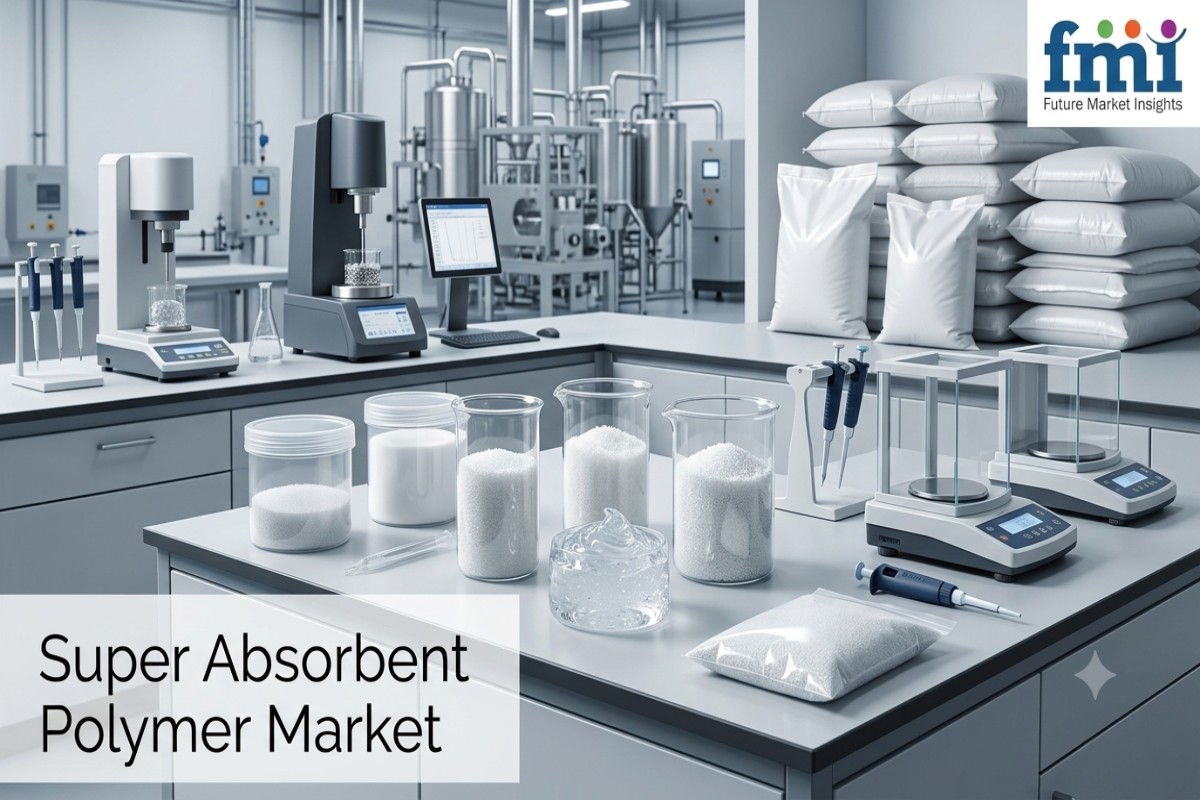
The global super absorbent polymer market is estimated at USD 10.8 billion in 2026 and is projected to reach USD 19.0 billion by 2036, expanding at a CAGR of 5.8% during the forecast period. The market was valued at USD 10.2 billion in 2025.
Demand is driven by rising consumption of superabsorbent polymers in baby diapers, adult incontinence products, feminine hygiene and medical applications. The shift toward fluffless diaper cores, higher polymer loading and improved liquid retention is increasing resin consumption. At the same time, feedstock price volatility and environmental concerns around conventional polyacrylate materials are encouraging manufacturers to develop bio-balanced and circular polymer solutions.
The short version
- The super absorbent polymer market is expected to add USD 8.2 billion in revenue between 2026 and 2036.
- Sodium Polyacrylate Partially Neutralized grades will lead polymer chemistry with a 78.0% share in 2026, while Baby Disposable Diapers and Nappies will account for 68.0%.
- India will record the fastest country-level growth at a 7.2% CAGR, followed by Brazil at 6.7% and South Korea at 6.5%.
Where growth is strongest
India is expected to lead country-level growth at a CAGR of 7.2% from 2026 to 2036, supported by domestic baby diaper production, adult incontinence demand and new hygiene converter capacity. BASF’s Global Diaper and Superabsorbents Performance Lab in Mumbai, inaugurated in August 2026, is expected to strengthen local technical support for hygiene manufacturers.
Brazil is projected to grow at 6.7%, driven by adult incontinence product adoption, hygiene industry consolidation and agricultural hydrogel applications. South Korea is forecast to record a CAGR of 6.5%, supported by export-oriented polymer production and the development of bio-balanced superabsorbent grades.
The United Kingdom is expected to expand at 6.1%, supported by institutional incontinence procurement and private-label hygiene products. Canada is projected to grow at 5.8%, matching the global market rate, while the United States is expected to register 5.4% growth.
Germany is forecast to record a CAGR of 5.1%, supported by specialty polyacrylate development and automated hygiene production. Japan is projected to grow at 4.9%, reflecting demand for adult incontinence products and investments in superabsorbent polymer recycling.
Who is moving
The industry is responding to rising demand for high-performance hygiene materials, investment in regional polymerization capacity and growing interest in low-carbon feedstocks and recycling technologies.
Key dated developments
- 3 November 2026: Evonik reported Q3 financial results, with Custom Solutions sales increasing 4% to EUR 1,394 million following the strategic carve-out of its superabsorbents division to International Chemical Investors Group.
- 18 August 2026: BASF inaugurated its Global Diaper and Superabsorbents Performance Lab in Mumbai to support hygiene product testing and technical development.
- 8 August 2025: Nippon Shokubai held a groundbreaking ceremony for a 50,000-metric-ton-per-year super absorbent polymer plant in Cilegon, Indonesia, with commercial operations scheduled for July 2027.
- 6 February 2025: BASF launched HySorb B 6610 ZeroPCF at its Antwerp Verbund site, introducing a polyacrylate superabsorbent polymer marketed with a cradle-to-gate product carbon footprint of zero.
- January 2026: Sumitomo Seika commissioned a pilot facility at its Himeji Works in Japan to validate chemical recycling of used diaper superabsorbent polymers into virgin-grade resin.
Key players profiled
Nippon Shokubai Co. Ltd, BASF SE, LG Chem Ltd, Evonik Industries AG, Sumitomo Seika Chemicals Co. Ltd, Sanyo Chemical Industries Ltd, Formosa Plastics Corporation, Satellite Chemical Co. Ltd, Yixing Danson Technology and SNF Group.
Where to act
- Expand in high-growth Asian markets: India’s 7.2% CAGR and South Korea’s 6.5% growth forecast create opportunities for resin suppliers serving hygiene converters and regional manufacturers.
- Develop high-performance hygiene grades: Sodium Polyacrylate Partially Neutralized formulations account for 78.0% of polymer chemistry demand in 2026, creating opportunities for products with improved saline retention and permeability.
- Invest in fluffless core applications: Baby Disposable Diapers and Nappies account for 68.0% of end-use demand. Higher polymer loading in thinner diaper cores can increase resin consumption per unit.
- Strengthen bio-balanced product portfolios: Certified mass-balance acrylic feedstocks and lower-carbon polymer grades can help manufacturers meet changing hygiene brand procurement requirements.
- Explore recycling and specialty applications: Chemical recycling, adult incontinence products, agricultural hydrogels and medical wound dressings offer additional areas for product development.
Where to be careful
- Petroleum-derived acrylic acid and propylene price fluctuations can increase production costs and reduce resin manufacturers’ margins.
- Conventional cross-linked polyacrylate materials face environmental scrutiny because of their limited biodegradability.
- High energy costs and weaker chemical production conditions in parts of Europe can affect polymerization economics.
- Mature birth rates in Japan and other developed markets may limit baby diaper volume growth.
- Strict hygiene product specifications require consistent saline retention, low residual monomer levels and reliable particle-size distribution.
Analyst perspective
“Hygiene converters no longer purchase superabsorbent polymers on free-swell capacity alone; they procure guaranteed centrifuge retention and saline permeability under load that allow fluffless diaper lines to run at 1,000 pieces per minute. Resin producers that integrate upstream glacial acrylic acid with localized diaper testing labs will lock in long-term converter supply contracts through 2036.”
— Nikhil Kaitwade, Principal Consultant, Future Market Insights.
Related Report:
https://www.openpr.com/news/4677149/top-companies-in-the-high-performance-fibers-market-usd-43-4
https://www.openpr.com/news/4677151/top-companies-in-the-esters-market-as-global-revenue-reaches-usd
https://www.openpr.com/news/4677152/top-companies-in-the-construction-polymer-market-as-revenue
https://www.openpr.com/news/4677155/top-companies-in-conductive-plastics-market-as-revenue-reaches
About Future Market Insights
Future Market Insights (FMI) is an ESOMAR-certified market research and consulting firm providing syndicated, customized, investment, and social media research across industries, including food and beverage, healthcare, chemicals, technology, and consumer markets. FMI delivers market intelligence, competitive analysis, and strategic insights to help organizations evaluate emerging opportunities and make informed business decisions. The company has offices in the United States, the United Kingdom, the UAE, and India.
For Press & Corporate Inquiries
Rahul Singh
AVP – Marketing and Growth Strategy
Future Market Insights, Inc.
For Sales: sales@futuremarketinsights.com
For Media: Rahul.singh@futuremarketinsights.com
Website: https://www.futuremarketinsights.com/