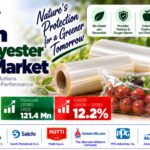


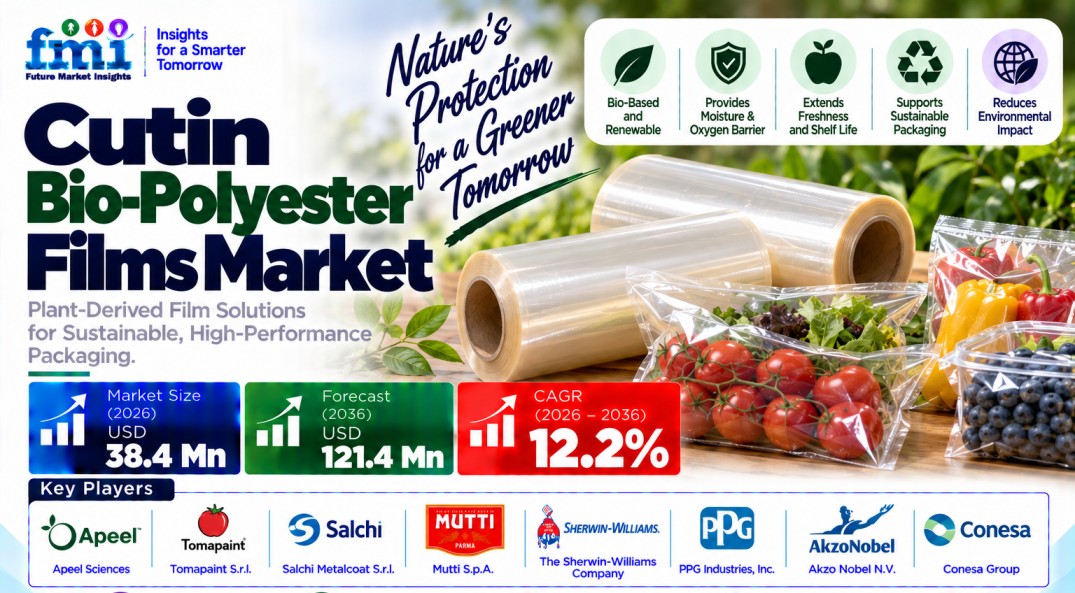
According to the latest market intelligence report published by Future Market Insights (FMI), the global cutin bio-polyester films market is estimated to reach USD 38.4 million in 2026, up from USD 34.2 million in 2025, and is projected to grow to USD 121.4 million by 2036. The market is forecast to expand at a compound annual growth rate (CAGR) of 12.2% from 2026 to 2036, adding an estimated USD 83.0 million in market value over the forecast period.
Growth is being supported by demand for plant-derived alternatives to conventional bisphenol-based food-can coatings, increased utilization of tomato-processing waste, and the development of cutin-based materials for food packaging and post-harvest produce protection.
Market Size & Growth Forecasts
- 2025 Baseline Value: USD 34.2 million
- 2026 Estimated Market Size: USD 38.4 million
- 2036 Projected Market Value: USD 121.4 million
- Forecast CAGR: 12.2% from 2026 to 2036
- Incremental Growth Opportunity: USD 83.0 million
FMI’s analysis covers cutin-derived hydroxy-fatty-acid monomers, thermoset bio-resin lacquers for internal metal-can coatings, cutin-copolymer films, and cuticular lipid emulsions used to protect fresh produce. The report excludes unextracted wet tomato pomace sold for animal feed or biogas, conventional petrochemical coatings without plant cutin, and downstream filled cans or fresh produce.
>> Get Detailed Market Forecasts, Competitive Benchmarking, and Pricing Trends: https://www.futuremarketinsights.com/reports/sample/rep-gb-35881
Key Market Segments
By Agro-Industrial Pomace Source
Industrial Tomato Peel Pomace (10,16-Dihydroxypalmitic Acid) is projected to account for 66.2% of the segment in 2026. Tomato-processing facilities generate peel residues that can supply cutin-rich material for monomer extraction. According to FMI, the relatively uniform composition of tomato cuticles supports consistent feedstock characteristics for bio-polyester production.
Other profiled sources include Apple, Cranberry & Grape Cuticular Pomace and Citrus & Bell-Pepper Peel Cuticle Residues.
By Application Format
BPA-Free Internal Metal Can Lacquer (Cutin Bio-Resin) is forecast to represent 48.5% of application-format turnover in 2026. Demand is associated with packaging manufacturers seeking alternatives to conventional bisphenol-based internal coatings for metal food and beverage containers.
The report also examines free-standing melt-extruded and cast bio-polyester films, alongside post-harvest cuticular produce spray emulsions.
By Co-Polymer Formulation and End Use
- Pure Polyhydroxy-Fatty-Acid Cutin Ester: Projected to account for 52.0% of co-polymer formulation revenue in 2026.
- Acidic Canned Tomatoes, Beans & Beverage Can Linings: Expected to represent 46.8% of end-use sector demand in 2026.
- Emerging applications: Include fresh berry, avocado and stone-fruit shelf-life coatings, as well as home-compostable dry food pouches.
By Country / Region
FMI projects the following country-level growth rates for 2026–2036:
- Mexico: 13.4% CAGR, supported by horticultural exports, domestic canning and post-harvest produce coatings.
- Chile: 13.1% CAGR, associated with fruit exports and tomato-processing by-product utilization.
- Turkey: 12.7% CAGR, supported by tomato-paste production and demand for packaging coatings compatible with European market requirements.
- Italy: 11.9% CAGR, reflecting opportunities in tomato processing and metal-can coatings.
- United States: 11.7% CAGR, supported by California tomato-processing capacity and interest in plant-derived produce coatings.
- Spain: 11.6% CAGR, driven by canning applications and the use of agricultural processing residues.
The report covers North America, Latin America, Western Europe, Eastern Europe, East Asia, South Asia and Pacific, and the Middle East and Africa.
Major Market Trends & Drivers
Transition toward bisphenol-free coatings: Regulatory restrictions on bisphenol A in food-contact materials are encouraging manufacturers to assess alternative internal can-lining formulations.
Agricultural by-product valorization: Tomato peel pomace offers a potential feedstock for cutin extraction, creating opportunities to turn food-processing residues into higher-value materials. However, seasonal harvests and the rapid deterioration of wet pomace make storage, drying and collection infrastructure important operational considerations.
Expansion of bio-based material applications: Cutin-based formulations are being explored for metal-can lacquers, flexible films and post-harvest produce coatings. Formulation performance, processing compatibility and feedstock availability will influence commercial adoption.
>> Access Detailed Market Insights: https://www.futuremarketinsights.com/reports/cutin-bio-polyester-films-market
Competitive Landscape
The market brings together specialist cutin and produce-coating businesses, metal-packaging coating suppliers and tomato-processing companies. Competitive positioning is influenced by access to agricultural feedstock, cutin monomer and ester expertise, and the ability to qualify coatings for industrial packaging and produce-handling lines.
Key Companies Profiled Include: Apeel Sciences, Tomapaint S.r.l., Salchi Metalcoat S.r.l., Mutti S.p.A., The Sherwin-Williams Company, PPG Industries, Inc., Akzo Nobel N.V., and Conesa Group.
Analyst Perspective / Insight
“Tomato-derived 10,16-dihydroxypalmitic acid cutin resins give metal can coaters a truly bisphenol-free internal lacquer that survives 121-degree-Celsius acidic tomato and bean retorting without delamination. Scaling beyond seasonal August-to-October cannery harvests requires ensiling or rapid belt-drying of wet peel pomace at regional collection hubs.”
— Nandini Roy Choudhury, Principal Consultant, Future Market Insights
MEDIA CONTACT
Contact Person: Media Relations Team
Designation: Corporate Communications
Email: sales@futuremarketinsights.com
Phone: +1-347-918-3531
Website: https://www.futuremarketinsights.com/
ABOUT FUTURE MARKET INSIGHTS
Future Market Insights, Inc. (FMI) is an ESOMAR-certified market research and consulting firm headquartered in Delaware, USA, with offices in the United Kingdom, the United Arab Emirates, and India. FMI delivers syndicated and custom research across food and beverage, healthcare, chemicals, technology, packaging, consumer goods, and industrial sectors. Its research helps organizations assess market opportunities, understand industry developments, and make informed strategic decisions.