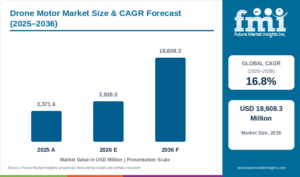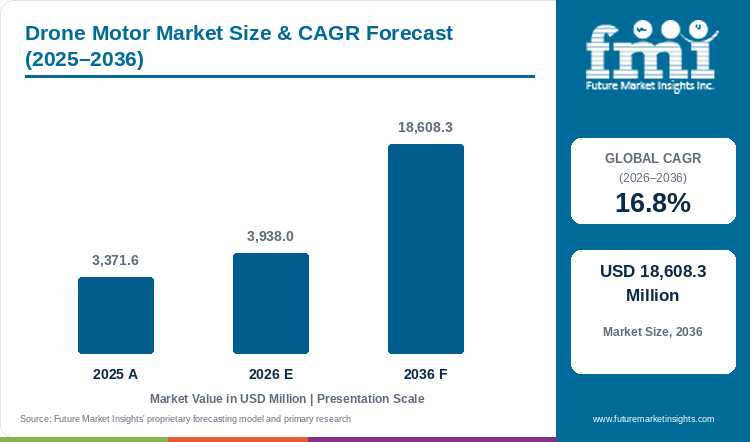
The global drone motor market is projected to grow from USD 3.94 billion in 2026 to USD 18.61 billion by 2036, registering a compound annual growth rate (CAGR) of 16.8% during the forecast period. Rising adoption of unmanned aerial vehicles (UAVs) across commercial, consumer, industrial, and military applications is expected to support demand for efficient, reliable, and high-performance electric propulsion motors.
According to Future Market Insights (FMI), drone motors play a central role in determining aircraft performance, flight stability, payload capacity, and operational efficiency. Brushless motors are projected to dominate the motor-type segment, while quadcopters represent the largest share of the separate drone-type category. These trends highlight the importance of motor technology and propulsion integration as drone manufacturing and deployment expand.
Get Detailed Market Forecasts, Competitive Benchmarking & Industry Insights — Request a Sample Report: https://www.futuremarketinsights.com/reports/sample/rep-gb-12915
Drone Motor Market Size and Growth Forecast
The global drone motor market is projected to increase from USD 3.37 billion in 2025 to USD 3.94 billion in 2026, reaching USD 18.61 billion by 2036. FMI forecasts a CAGR of 16.8% between 2026 and 2036, reflecting the expanding role of drones across a range of commercial and specialized applications.
Key market indicators include:
- Market value (2026): USD 3,938.03 million
- Forecast value (2036): USD 18,608.33 million
- CAGR (2026–2036):8%
- Leading motor type: Brushless motors, with a projected 86.1% share in 2026
- Leading drone type: Quadcopters, with a projected 56.5% share in 2026
- Market scope: Motors used in consumer, commercial, and military drones
These figures underscore the growing importance of propulsion technologies as drone manufacturers seek improved efficiency, dependable performance, and motors suited to increasingly diverse flight requirements.
Five Key Trends Shaping the Drone Motor Market
- Brushless Motors Maintain a Dominant Position
Brushless motors are projected to account for 86.1% of the motor-type segment in 2026, reflecting their importance in drone propulsion systems. Their design supports electronic speed control and can provide favorable efficiency, power-to-weight characteristics, and maintenance requirements for many UAV applications.
As drone manufacturers develop aircraft for longer missions, heavier payloads, and more demanding operating conditions, motor selection remains a critical engineering consideration. Suppliers that deliver consistent performance, compact designs, and reliable thermal management may be well positioned to address evolving requirements.
- Quadcopters Support Significant Motor Demand
Quadcopters are projected to represent 56.5% of the drone-type segment in 2026. Their configuration is widely used across consumer and commercial applications, including aerial photography, inspection, surveying, mapping, and selected industrial operations.
The configuration’s role in these applications creates demand for motors that support stable flight, precise control, and dependable operation. Motor manufacturers serving quadcopter producers must consider thrust requirements, aircraft weight, flight duration, and compatibility with electronic speed controllers.
- Commercial Drone Adoption Expands Propulsion Requirements
Commercial drones are being adopted across industries for tasks such as infrastructure inspection, agricultural monitoring, surveying, logistics support, and asset assessment. These applications require propulsion systems matched to different payloads, flight durations, and operating environments.
As organizations evaluate drones for operational use, motor performance becomes an important factor in mission planning and equipment selection. Suppliers may find opportunities by developing motor solutions tailored to specific aircraft designs and commercial operating requirements.
- Military and Specialized UAV Applications Create Technical Opportunities
Military and specialized unmanned aircraft applications can require motors designed for demanding operational conditions, precise maneuverability, and dependable performance. Different UAV configurations place distinct requirements on propulsion systems, depending on aircraft size, mission profile, payload, and endurance needs.
These applications can encourage continued engineering development in motor efficiency, power density, thermal control, and system integration. Manufacturers that meet the technical and procurement requirements of specialized drone programs may access additional market opportunities.
- Propulsion Integration Becomes a Competitive Differentiator
Drone performance depends on the combined operation of motors, propellers, electronic speed controllers, batteries, and flight-control systems. Effective integration helps manufacturers balance thrust, power consumption, responsiveness, and flight stability.
As drone designs become more application-specific, motor suppliers may need to work more closely with airframe manufacturers and propulsion-system integrators. Consistent manufacturing quality, technical support, and compatibility with complete propulsion systems can help suppliers differentiate their offerings.
Regional Opportunities in the Drone Motor Market
Regional demand is expected to reflect differences in drone manufacturing capacity, commercial UAV adoption, defense procurement, and regulatory development.
- Asia Pacific: Drone manufacturing activity, industrial applications, and expanding commercial UAV use may support demand for motors and integrated propulsion components.
- North America: Commercial drone deployment, technology development, and defense-related UAV programs may create opportunities for specialized motor suppliers.
- Europe: Industrial inspection, surveying, agricultural applications, and drone technology development may contribute to demand for reliable propulsion systems.
- Middle East and Africa: Infrastructure monitoring, industrial applications, and selected public-sector uses may support additional drone deployment.
- Latin America: Agricultural monitoring, mapping, environmental observation, and infrastructure inspection may create opportunities for commercial drone motor applications.
Specific country-level growth rates and regional market rankings require detailed regional data and are not quantified in the supplied market excerpt.
Competitive Landscape of the Drone Motor Market
Competition in the drone motor market is shaped by motor efficiency, power-to-weight ratio, reliability, thermal performance, manufacturing consistency, and compatibility with different drone configurations.
Motor suppliers can differentiate themselves through compact product designs, application-specific engineering, dependable production capacity, and technical collaboration with drone manufacturers. As the market expands across consumer, commercial, and military applications, the ability to meet distinct performance requirements may become increasingly important.
The growing emphasis on propulsion integration also creates opportunities for companies that coordinate motor design with propeller selection, electronic speed control, and overall aircraft performance. Suppliers that combine technical capabilities with consistent quality and responsive customer support may be better positioned to compete.
Explore the Full Carborane Polymers Market Report: https://www.futuremarketinsights.com/reports/drone-motors-market
Business Outlook
The drone motor market is positioned for substantial expansion over the 2026–2036 forecast period, with projected growth from USD 3.94 billion to USD 18.61 billion at a CAGR of 16.8%. Increasing drone adoption across commercial, consumer, and military applications is expected to strengthen demand for specialized electric propulsion systems.
Brushless motors and quadcopters are important market categories based on their projected 2026 shares. For manufacturers, component suppliers, and investors, opportunities may emerge from improvements in motor efficiency, aircraft-specific propulsion design, and closer integration between motors and complete UAV systems.
Companies that align product development with aircraft performance requirements, application-specific operating conditions, and customer expectations for reliability may be better positioned to participate in the market’s projected growth.
About the Drone Motor Market Report
Future Market Insights’ Drone Motors Market report examines the market outlook, growth forecasts, motor types, drone configurations, and industry developments shaping global demand. The research supports manufacturers, suppliers, investors, and other stakeholders assessing commercial opportunities in the drone propulsion ecosystem.
Report Details
- Report title: Drone Motors Market
- Author: Nikhil Kaitwade
- Report length: 250 pages
- Forecast period: 2026–2036
- Projected market value in 2026: USD 3,938.03 million
- Projected market value in 2036: USD 18,608.33 million
- CAGR:8%
Frequently Asked Questions
- What is the projected size of the drone motor market in 2026?
The global drone motor market is projected to reach USD 3,938.03 million in 2026.
- What is the expected market value by 2036?
The market is forecast to reach USD 18,608.33 million by 2036.
- What is the projected CAGR for the drone motor market?
The market is expected to grow at a CAGR of 16.8% from 2026 to 2036.
- Which motor type is expected to dominate the market in 2026?
Brushless motors are projected to account for 86.1% of the motor-type segment in 2026.
- Which drone type is expected to hold the largest share?
Quadcopters are projected to account for 56.5% of the separate drone-type segment in 2026.
- What factors are supporting demand for drone motors?
Key factors include growing commercial UAV adoption, consumer drone demand, military and specialized drone applications, and the need for efficient, reliable propulsion systems.
- What is the role of propulsion integration in the drone motor market?
Propulsion integration helps align motor performance with propellers, electronic speed controllers, batteries, and flight-control systems to support thrust, efficiency, stability, and mission requirements.
Related Reports:
Agricultural Bucket Market- https://www.futuremarketinsights.com/reports/agricultural-bucket-market
Agricultural Sprayers Market Share Analysis- https://www.futuremarketinsights.com/reports/agricultural-sprayers-market-share-analysis
Composite Roller Market- https://www.futuremarketinsights.com/reports/composite-rollers-market
About Future Market Insights (FMI)
Future Market Insights, Inc. (FMI) is an ESOMAR-certified, ISO 9001:2015 market research and consulting organization, trusted by Fortune 500 clients and global enterprises. With operations in the U.S., UK, India, and Dubai, FMI provides data-backed insights and strategic intelligence across 30+ industries and 1200 markets worldwide.
Contact Us:
Future Market Insights Inc.
Christiana Corporate, 200 Continental Drive,
Suite 401, Newark, Delaware – 19713, USA
T: +1-347-918-3531
Why FMI: https://www.futuremarketinsights.com/why-fmi
For Sales Enquiries: sales@futuremarketinsights.com
Website: https://www.futuremarketinsights.com
LinkedIn| Twitter| Blogs | YouTube