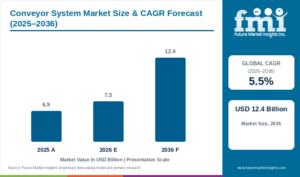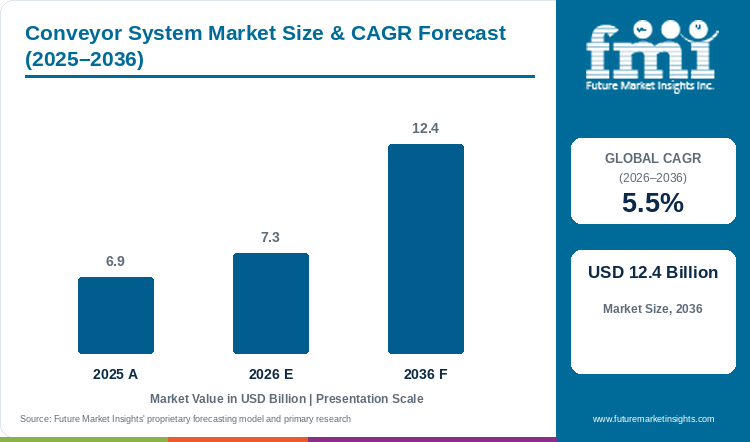
The global conveyor system market is projected to grow from USD 7.3 billion in 2026 to USD 12.4 billion by 2036, registering a compound annual growth rate (CAGR) of 5.5% during the forecast period. Increasing demand for efficient material movement across manufacturing facilities, warehouses, distribution centers, and industrial operations is expected to support investment in conveyor equipment.
According to Future Market Insights (FMI), conveyor systems remain essential for moving goods and bulk materials through production, storage, and distribution processes. Belt conveyors are projected to account for 28.0% of product-type demand in 2026, while manual systems represent 48.0% of the separate operation-type breakdown. Unit handling is expected to dominate the capacity-type category, with a projected 72.0% share.
Get Detailed Market Forecasts, Competitive Benchmarking & Industry Insights — Request a Sample Report: https://www.futuremarketinsights.com/reports/sample/rep-gb-48
Conveyor System Market Size and Growth Forecast
The global conveyor system market is projected to increase from USD 6.92 billion in 2025 to USD 7.3 billion in 2026, reaching USD 12.4 billion by 2036. FMI forecasts a CAGR of 5.5% between 2026 and 2036, reflecting the continuing need for dependable material handling equipment across industrial and commercial environments.
Key market indicators for 2026 include:
- Market value: USD 7.3 billion
- Forecast value by 2036: USD 12.4 billion
- CAGR (2026–2036):5%
- Leading product type: Belt conveyors, with a projected 28.0% share
- Leading operation type: Manual systems, with a projected 48.0% share
- Leading capacity type: Unit handling, with a projected 72.0% share
These indicators highlight the importance of conveyor equipment in supporting material movement, workflow continuity, and operational efficiency across manufacturing, warehousing, and distribution activities.
Five Key Trends Shaping the Conveyor System Market
- Belt Conveyors Maintain a Leading Product Position
Belt conveyors are projected to account for 28.0% of the product-type segment in 2026. Their role in transporting goods and materials across production lines, warehouses, and distribution facilities makes them an important component of industrial material handling.
Demand is supported by the need to move products continuously between operational stages while reducing unnecessary manual transportation. Belt conveyor configurations can serve different layouts and material requirements, making them relevant across multiple industries.
Manufacturers that provide durable equipment, application-specific designs, and dependable maintenance support may be better positioned to address the needs of industrial buyers.
- Manual Conveyor Operations Continue to Represent a Significant Share
Manual systems are projected to account for 48.0% of the operation-type segment in 2026. This reflects the continued interaction between conveying equipment and workers who load, inspect, sort, check, or redirect materials during handling processes.
Not every material handling task can be fully automated. Some facilities rely on manual intervention where product variety, operational flexibility, or specific inspection requirements make human involvement necessary.
Conveyor suppliers may benefit from designing systems that support safe access, practical workstation layouts, and efficient coordination between equipment and workers. Such designs can help businesses improve material flow without requiring complete automation of every process.
- Unit Handling Dominates the Capacity-Type Segment
Unit handling is projected to represent 72.0% of the capacity-type segment in 2026. Unit handling systems move discrete items such as cartons, packages, containers, and individual products through production, storage, sorting, and distribution operations.
The growing complexity of warehouse and distribution workflows can increase the need for equipment that moves individual products reliably between operational stages. Conveyor systems can help organize material flows and support order processing across facilities with varied handling requirements.
Suppliers that offer flexible layouts and equipment suited to different package sizes, weights, and throughput needs may be well positioned to serve this segment.
- Warehouse and Distribution Modernization Supports Equipment Demand
Warehouses and distribution centers need to move products efficiently between receiving, storage, picking, packing, sorting, and dispatch areas. Conveyor systems can help reduce unnecessary transportation between these stages and support more organized workflows.
As businesses review facility layouts and material handling processes, conveyor investments may form part of broader modernization programs. The required system configuration depends on throughput, available space, product characteristics, and the level of automation deployed.
Manufacturers that can support facility-specific designs and integration with warehouse operations may find opportunities among logistics providers, retailers, and distribution businesses.
- Manufacturing Efficiency Encourages Conveyor System Investment
Manufacturing facilities use conveyor systems to move components, work-in-progress materials, and finished goods between production stages. Effective conveying can help maintain a consistent flow of materials and reduce delays associated with manual transportation.
Demand may be influenced by production-line upgrades, facility expansion, process redesign, and efforts to improve operational consistency. Buyers typically need to evaluate system capacity, reliability, layout compatibility, maintenance requirements, and integration with existing equipment.
Conveyor manufacturers that combine practical system design with dependable service and installation support may strengthen their position in industrial procurement programs.
Regional Opportunities in the Conveyor System Market
Regional demand is expected to reflect differences in manufacturing activity, logistics infrastructure, warehouse development, and industrial modernization.
- Asia Pacific: Manufacturing expansion, industrial investment, and growing warehousing and distribution requirements may support conveyor system demand.
- North America: Distribution center development, manufacturing upgrades, and material handling improvements may create opportunities for conveyor equipment suppliers.
- Europe: Industrial modernization, production efficiency initiatives, and logistics infrastructure investments may support demand across manufacturing and distribution facilities.
- Middle East and Africa: Industrial development, logistics projects, and investment in distribution infrastructure may create opportunities for conveyor system providers.
- Latin America: Manufacturing activity, warehouse development, and improvements in industrial material handling may contribute to market growth.
Specific country-level growth rates and regional market rankings require detailed regional data and are not quantified in the supplied market excerpt.
Competitive Landscape of the Conveyor System Market
Competition in the conveyor system market is influenced by equipment reliability, throughput requirements, system flexibility, installation capabilities, maintenance support, and the ability to meet industry-specific handling needs.
Manufacturers can differentiate themselves through application-specific conveyor designs, modular configurations, durable components, and integration capabilities. Buyers may also evaluate suppliers based on their ability to support facility planning, installation, troubleshooting, and long-term equipment maintenance.
As industrial and logistics operations seek more efficient material flows, suppliers that combine dependable equipment with responsive technical support may be better positioned to compete for new installations and system upgrade projects.
Explore the Full Carborane Polymers Market Report: https://www.futuremarketinsights.com/reports/global-conveyor-systems-market
Business Outlook
The conveyor system market is projected to grow from USD 7.3 billion in 2026 to USD 12.4 billion by 2036, at a CAGR of 5.5%. The outlook reflects the continued role of conveyor equipment in manufacturing, warehousing, distribution, and industrial material handling.
Belt conveyors, manual operation systems, and unit handling represent important market categories based on their projected 2026 shares. For manufacturers and suppliers, opportunities may emerge from facility modernization, material flow improvements, and demand for conveyor solutions tailored to specific products and operational requirements.
Companies that prioritize system reliability, practical design, efficient installation, and ongoing service support may be better positioned to respond to changing customer needs.
About the Conveyor System Market Report
Future Market Insights’ Global Conveyor Systems Market report examines market size, growth forecasts, product types, operation types, capacity categories, and industry developments shaping demand for conveying equipment. The research supports manufacturers, suppliers, investors, and other stakeholders evaluating opportunities across industrial and commercial material handling.
Report Details
- Report title: Global Conveyor Systems Market
- Author: Nikhil Kaitwade
- Report length: 250 pages
- Forecast period: 2026–2036
- Market value in 2026: USD 7.3 billion
- Forecast value in 2036: USD 12.4 billion
- CAGR:5%
Frequently Asked Questions
- What is the projected size of the conveyor system market in 2026?
The global conveyor system market is projected to reach USD 7.3 billion in 2026.
- What is the expected market value by 2036?
The market is forecast to reach USD 12.4 billion by 2036.
- What is the projected CAGR for the conveyor system market?
The market is expected to grow at a CAGR of 5.5% from 2026 to 2036.
- Which product type is expected to hold the largest share in 2026?
Belt conveyors are projected to account for 28.0% of the product-type segment in 2026.
- What share are manual systems projected to hold?
Manual systems are projected to represent 48.0% of the operation-type segment in 2026.
Related Reports:
Biomass Boiler Market
https://www.futuremarketinsights.com/reports/biomass-boiler-market
Industrial Cooling Systems Market: https://www.futuremarketinsights.com/reports/industrial-cooling-systems-market
Ductless Heating & Cooling Systems Market: https://www.futuremarketinsights.com/reports/ductless-heating-and-cooling-systems-market
About Future Market Insights (FMI)
Future Market Insights, Inc. (ESOMAR-certified, recipient of the Stevie® Award, and a member of the Greater New York Chamber of Commerce) provides comprehensive market intelligence, consulting services, and syndicated research across industrial equipment, renewable energy, manufacturing, sustainability, waste management, and advanced processing technologies.
With global research expertise and industry-focused analytical capabilities, FMI helps organizations understand evolving market trends, identify growth opportunities, and make informed strategic business decisions.
Contact
Future Market Insights Inc.
Christiana Corporate, 200 Continental Drive, Suite 401, Newark, Delaware 19713, USA
Rahul Singh
AVP – Marketing and Growth Strategy
Future Market Insights, Inc.
+91 8600020075
For Media: Rahul.Singh@futuremarketinsights.com
Email: sales@futuremarketinsights.com
Website: https://www.futuremarketinsights.com