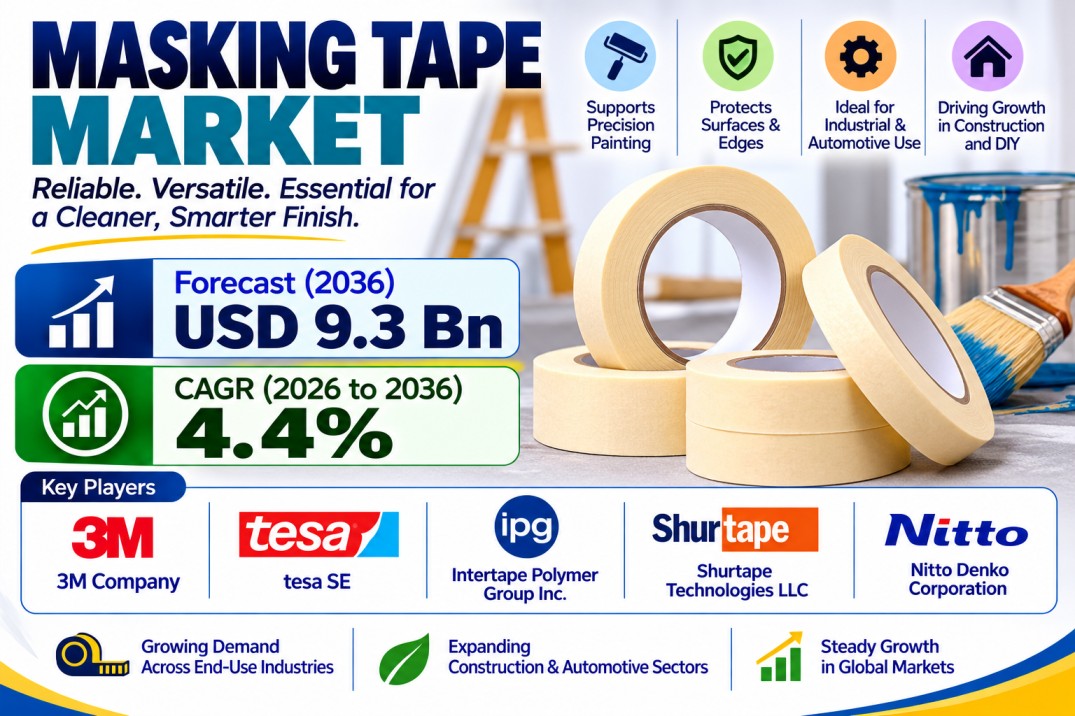
The global masking tape market is projected to increase from USD 6.3 billion in 2026 to USD 9.3 billion by 2036, at a compound annual growth rate (CAGR) of 4.4%, according to Future Market Insights (FMI). The market was valued at USD 6.1 billion in 2025, and FMI reports an incremental opportunity of USD 3.0 billion between 2026 and 2036. Paper backing is expected to account for 70.0% of backing-material demand in 2026, while offline retail is forecast to represent 65.0% of distribution-channel demand.
Paint quality and faster job-site decisions drive demand
Masking tape remains a routine consumable, but performance during application and removal is becoming an important purchasing consideration. Painters and vehicle-refinishing teams need tape that holds during coating, creates clean edges and removes without leaving residue or damaging the underlying surface. In April 2026, the U.S. Census Bureau reported that sales at building-material and garden-equipment dealers were up 2.2% year over year, while the U.S. Bureau of Labor Statistics (BLS) reported a 4.2% year-over-year change for paints and allied products.
Product specifications also illustrate the emphasis on performance. A 3M technical data sheet for its 233+ masking tape, dated October 2025, lists temperature resistance up to 120°C (250°F) for 30 minutes for automotive repair work. In February 2026, Shurtape’s CP 27 product sheet described clean removal from most surfaces for up to 60 days in temporary indoor floor-marking applications. These examples show how removal time, heat resistance and surface compatibility can influence product selection.
>> Get Detailed Market Forecasts, Competitive Benchmarking, and Pricing Trends: https://www.futuremarketinsights.com/reports/sample/rep-gb-2642
Where growth is fastest
India and China lead the profiled country forecasts, supported by construction activity, vehicle finishing and manufacturing demand. Canada follows, while Germany and Spain represent the European markets with the strongest growth rates listed in the report.
India – CAGR 6.3%: Construction projects and vehicle finishing are expected to increase tape use. The report cites the Press Information Bureau’s February 19, 2024, statement that India needs to add around 700 million to 900 million square metres of commercial and residential space annually by 2030.
China – CAGR 5.4%: Vehicle production and building work support demand for masking during painting and surface finishing. The report cites government data showing that China produced 34.531 million vehicles in 2025.
Canada – CAGR 4.1%: Building investment and renovation work support repeat purchases through paint and hardware channels. Statistics Canada reported CAD 23.0 billion in building-construction investment for February 2026.
Germany – CAGR 3.5%: Automotive refinishing and professional painting support steady demand. Destatis recorded a 5.9% monthly rise in the seasonally adjusted main construction production index for March 2026.
Spain – CAGR 3.5%: Renovation work and building output support contractor purchases. Spain’s Instituto Nacional de Estadística (INE) reported a 0.4% annual rate for its seasonally and calendar-adjusted Construction Production Index in January 2026.
United States – CAGR 3.2%: Construction activity, retail access and automotive refinishing support regular tape replenishment. The U.S. Census Bureau estimated March 2026 construction spending at USD 2,185.5 billion on a seasonally adjusted annual basis.
United Kingdom – CAGR 3.1%: Repair and maintenance work supports demand through home-improvement and professional paint-supply channels. The Office for National Statistics reported a 1.5% monthly rise in construction output in March 2026, with repair and maintenance output up 0.8%.
What leads the market
Masking tape demand is concentrated in everyday painting and coating work, where flexible paper backing and ready access through retail channels support frequent use. FMI’s 2026 estimates identify the following leading segments:
Paper backing – 70.0% of backing-material demand: Paper-backed tapes are valued for easy tearing and flexibility across walls, trim and curved surfaces.
Offline retail – 65.0% of distribution-channel demand: Contractors often need replacement tape immediately during an active job, making nearby hardware and paint stores important purchase points.
General-purpose masking tape – 55.0% of product demand: Routine wall and trim painting keeps this grade in regular use across residential and commercial projects.
Painting and coating – 60.0% of application demand: Masking helps create clean borders between coated and uncoated surfaces and can reduce touch-up work.
Construction – 55.0% of end-use demand: Residential repainting and commercial renovation support purchases through contractor and trade-supply channels.
The hurdle: adhesive costs and consistent removal performance
Masking tape suppliers must balance adhesive performance with price and the needs of different surfaces. A tape that adheres too weakly may allow paint bleed; one that adheres too strongly or remains in place too long can leave residue or damage a finished surface. Buyers therefore need to match the tape grade to the substrate, coating process, temperature and planned removal time.
Input costs add pressure to pricing. The BLS reported a 3.0% year-over-year change for adhesives and sealants in April 2026, while paper prices recorded a 6.7% year-over-year change. Such cost movements can affect converters and distributors, particularly where contractors compare products on shelf price.
FMI identifies paper-based formats as an opportunity for suppliers, provided they maintain adhesive consistency, clear product grading and reliable supply. Clear instructions about suitable surfaces and removal windows can also help users select the appropriate product and reduce avoidable rework.
Recent developments
Supplier activity points to continued product development in professional masking and materials used in pressure-sensitive adhesive tapes.
October 15, 2025 – tesa SE: The company introduced a product line for professional craftspeople, aimed at trade users seeking cleaner masking and job-ready surface protection.
February 11, 2026 – Ahlstrom: The company launched Acti-V® RRF Natural, a double-sided silicone-coated release liner for pressure-sensitive adhesive tapes designed to be recyclable with paper. The development is relevant to converters evaluating paper-recyclable inputs.
FMI profiles the following companies in the masking tape market: 3M Company, tesa SE, Intertape Polymer Group Inc., Shurtape Technologies LLC, Nitto Denko Corporation, PPI Adhesive Products Ltd. and Berry Global Group Inc. The report describes competition as centered on clean removal, surface compatibility, backing quality, adhesive control and access to retail and industrial distribution.
>> Access detailed market insights: https://www.futuremarketinsights.com/reports/brochure/rep-gb-2642
Analyst perspective
“Masking tape is shifting from a low-value consumable into a surface-quality control item. Contractors and refinish shops choose tapes with clean removal and steady edge hold. Suppliers that prove paper backing quality and adhesive consistency will get repeat shelf space across hardware and paint stores.”
— Ismail Sutaria, Future Market Insights.
What this means for paint contractors, automotive refinishers and distributors
Select tape by surface and process, not price alone. Check the substrate, paint or coating type, exposure temperature and planned removal time. Use technical data sheets to confirm that the grade is appropriate for the job.
Reduce rework by standardizing selection and removal instructions. Keep clear guidance for common tasks such as wall painting, trim work and automotive refinishing. Train users to test unfamiliar surfaces and follow the manufacturer’s application and removal recommendations.
Plan purchasing around availability and input costs. Compare supply reliability, roll dimensions, adhesive performance and unit cost across grades. Distributors should make the differences between general-purpose and high-performance products easy to understand, helping customers choose the right tape without unnecessary overspending.