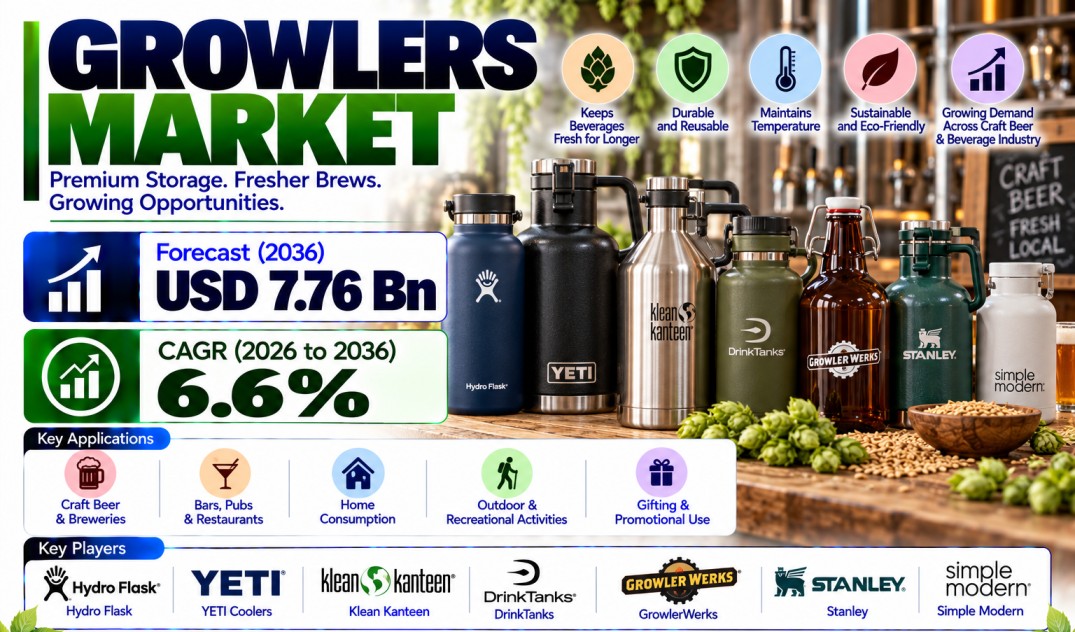
The global growlers market is projected to increase from USD 4.09 billion in 2026 to USD 7.76 billion by 2036, at a compound annual growth rate (CAGR) of 6.6%, according to Future Market Insights (FMI). The market was valued at USD 3.84 billion in 2025, and FMI estimates an incremental opportunity of USD 3.66 billion between 2026 and 2036. Glass is forecast to account for 39.0% of material demand in 2026, while breweries are expected to represent 52.6% of end-use demand.
Reusable formats and procurement requirements shape demand
Demand is being supported by interest in reusable beverage containers, sustainability initiatives and the expansion of retail and e-commerce distribution. FMI identifies restrictions on single-use plastics and extended producer responsibility requirements as factors encouraging buyers to consider recyclable and reusable packaging formats.
The report also points to changing procurement priorities. Buyers are increasingly assessing product specifications, regulatory compliance, material performance and supply reliability rather than selecting suppliers on price alone. For growler manufacturers, this creates opportunities to differentiate through product design, material options and distribution reach. However, the commercial case still depends on whether higher-specification products can compete on cost.
>> Get Detailed Market Forecasts, Competitive Benchmarking, and Pricing Trends: https://www.futuremarketinsights.com/reports/sample/rep-gb-2648
Where growth is fastest
China leads the country forecasts, followed by India and Germany. The report connects these growth outlooks to manufacturing capacity, domestic consumption, retail development and the requirements of established markets.
- China – CAGR 8.5%: Manufacturing capacity, urbanization, expanding domestic consumption and retail modernization support the country’s growth outlook.
- India – CAGR 7.9%: Infrastructure investment, expanding industrial capacity, organized retail and domestic consumption are identified as growth factors.
- Germany – CAGR 7.2%: Advanced manufacturing infrastructure, regulatory standards and demand for higher-specification products support the forecast.
- Brazil – CAGR 6.6%: Industrial and agricultural capacity, domestic consumption and cost-competitive production support demand.
- United States – CAGR 6.0%: Established distribution infrastructure, quality requirements and demand for premium product configurations support growth.
- United Kingdom – CAGR 5.3%: Craft breweries, micropubs and taprooms, alongside demand for refillable takeaway draught-beer containers, support the market.
What leads the market
Glass and brewery-related demand account for significant shares of the forecast market, although application and end-use categories represent different parts of the segmentation.
- Glass – 39.0% of material demand: Glass is the largest material segment in the 2026 forecast, reflecting established procurement patterns and requirements across major applications.
- Craft breweries – 46.0% of application demand: Craft breweries are the leading application segment, supported by established purchasing patterns and recurring demand for growler formats.
- Breweries – 52.6% of end-use demand: Breweries account for the largest reported end-use share, reflecting concentrated demand through established procurement channels.
The hurdle: balancing cost, performance and compliance
Raw-material price volatility and the cost of higher-specification or sustainable products can limit adoption in price-sensitive applications. Manufacturers must balance product durability and material requirements with the cost of production, distribution and regulatory compliance.
FMI also identifies production scale, supply-chain relationships and certification requirements as competitive barriers. Suppliers with multi-region distribution and the ability to serve different material preferences may be better positioned to meet buyer specifications, but cost competitiveness remains important.
Recent developments
The report describes two company activities in 2025. It does not specify the months in which they occurred, so they are identified by year only.
- 2025 – Hydro Flask: The company expanded its growler portfolio with additional sizes and colors for its Wide Mouth Growlers and Growler Flex Caps, focusing on vacuum-insulated stainless-steel designs for craft-beer and outdoor-lifestyle consumers.
- 2025 – YETI Coolers: The company continued development of its Rambler growler range and invested in production capacity and supply-chain improvements to serve demand for durable, double-wall vacuum-insulated products.
FMI profiles Hydro Flask, YETI Coolers, Klean Kanteen, DrinkTanks, GrowlerWerks, Stanley, Simple Modern, Takeya, Contigo and Thermos. The report describes competition in terms of product range, manufacturing scale, distribution reach and specialization across end-use applications.
>> Access detailed market insights: https://www.futuremarketinsights.com/reports/brochure/rep-gb-2648
Analyst perspective
“The growlers market is transitioning from volume driven growth toward value led differentiation. Companies that can align product development with regulatory requirements, end use specifications, and regional procurement preferences are likely to strengthen their competitive position through 2036. Cost competitiveness, supply chain reliability, and certification compliance remain the critical factors shaping buyer decisions across key markets.”
— Nandini Roy Choudhury, Principal Consultant at FMI.
What this means for beverage brands, breweries and distributors
- Match material to the intended use. Compare glass, stainless steel, ceramic and plastic options against the product’s handling requirements, expected use and total cost. Do not assume one material will suit every customer or distribution channel.
- Evaluate suppliers beyond the purchase price. Consider production capacity, supply reliability, product range and documentation for relevant material or regulatory requirements. These factors can matter when replenishment needs vary across regions.
- Test demand by market and channel before expanding distribution. China and India have the strongest country growth forecasts in the report, while the United Kingdom’s outlook is linked to craft breweries, taprooms and micropubs. Use local customer demand and channel access to determine which formats and product specifications to prioritize.