

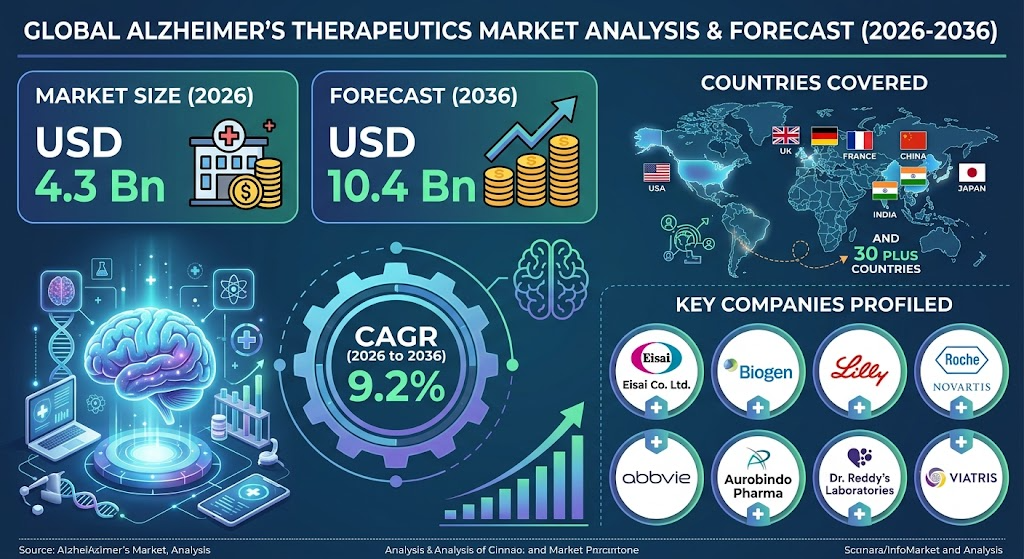
NEWARK, Del., September 30, 2026 — According to Future Market Insights, the global Alzheimer’s Therapeutics Market is valued at USD 4.3 billion in 2026 and is projected to reach USD 10.4 billion by 2036, expanding at a 9.2% CAGR from 2026 to 2036. The market was valued at USD 3.9 billion in 2025, with an incremental opportunity of USD 6.1 billion expected during the forecast period. Growth is being supported by the expansion of disease-modifying therapies for early symptomatic Alzheimer’s disease, alongside continued demand for oral symptom-management drugs.
The treatment pathway is increasingly influenced by anti-amyloid therapy approvals and the infrastructure required to identify eligible patients, confirm amyloid pathology, monitor safety, and administer treatment. The World Health Organization reported in March 2025 that 57 million people were living with dementia in 2021, with Alzheimer’s disease accounting for an estimated 60% to 70% of dementia cases, reinforcing the need for earlier diagnosis and treatment planning.
👉 Get Detailed Market Forecasts, Competitive Benchmarking, and Pricing Trends
Global Segment Leaders
- Drug Class — Donepezil: 67.7% share in 2026 — Donepezil leads because of its long prescribing history and broad oral use among diagnosed Alzheimer’s dementia patients.
- Distribution Channel — Hospital Pharmacies: 35.0% share in 2026 — Hospital pharmacies lead as biologic therapies require controlled handling, pharmacy oversight, and supervised treatment workflows.
- Administration Mode — Oral Therapies: 70.0% share in 2026 — Oral therapies retain the largest share because tablets support daily symptom management across routine care and retail pharmacy settings.
- Patient Stage — Mild Dementia: 46.0% share in 2026 — Mild dementia leads as disease-modifying therapies are increasingly focused on patients in the early symptomatic stage.
- End User — Hospitals: 40.0% share in 2026 — Hospitals account for the largest share because specialist neurology assessment, infusion capacity, and imaging-based monitoring are central to biologic treatment.
Country-Level Performance
- Japan – 12.0% CAGR (2026–2036): Real-world research published in 2025 reported about 6,000 patients treated with lecanemab during its first year in Japan, supporting early biologic adoption.
- India – 11.6% CAGR (2026–2036): A large underdiagnosed dementia population and increasing use of branded generics across urban neurology centers support therapy demand.
- Germany – 11.0% CAGR (2026–2036): A 2025 Robert Koch Institute study reported dementia prevalence of 2.8% among people aged 40 and older in 2022.
- China – 10.4% CAGR (2026–2036): China’s State Council reported in January 2025 that Alzheimer’s disease and other dementias affected more than 16 million people in China in 2021.
- UK – 9.7% CAGR (2026–2036): The MHRA licensed lecanemab for early Alzheimer’s disease in August 2024, creating a regulatory pathway while NICE reimbursement review controls public access.
- USA – 9.0% CAGR (2026–2036): The Alzheimer’s Association reported in April 2025 that 7.2 million Americans aged 65 and older were living with Alzheimer’s dementia.
- France – 8.6% CAGR (2026–2036): France’s HAS refused early access for lecanemab in September 2025 before full review, slowing premium biologic access while oral therapy demand remains established.
Japan records the highest CAGR among the profiled countries at 12.0%, while France records the lowest at 8.6%.
Market Drivers, Restraints and Opportunities
Disease-modifying therapy approvals are creating a higher-value treatment layer within Alzheimer’s care. Anti-amyloid therapies require confirmed patient eligibility, treatment monitoring, and specialist workflows, increasing the role of hospitals and memory clinics in the commercial treatment pathway.
Oral symptom therapies remain a volume foundation. Donepezil’s 67.7% share reflects its established use across diagnosed Alzheimer’s dementia patients, while oral treatment continues to support prescription volume outside the narrower eligibility population for disease-modifying biologics.
Treatment cost is a major restraint. The Alzheimer’s Association reported in April 2026 that lecanemab’s treatment price was USD 26,500 per person per year, compared with an independently assessed value-based range of USD 8,900 to USD 21,500. The report notes that this gap can result in stricter payer-access requirements.
The full cost of anti-amyloid treatment also extends beyond the medicine itself. A Frontiers review reported in April 2026 that annual pricing exceeded USD 26,000 for lecanemab and USD 32,000 for donanemab, while total annual per-patient costs could approach USD 80,000 to USD 90,000 after imaging, MRI monitoring, and infusion administration.
Subcutaneous maintenance dosing and biomarker-based patient selection represent opportunities to reduce treatment-service burdens. FMI cites Eisai’s Leqembi IQLIK maintenance option as an example of a delivery approach that could reduce pressure on infusion centers after initial intravenous treatment.
Competitive Landscape
Competition is divided between branded companies developing and commercializing anti-amyloid therapies and generic manufacturers supplying established oral symptom-management drugs. Eisai Co. Ltd., Biogen, Eli Lilly and Company, F. Hoffmann-La Roche Ltd., Novartis, AbbVie, Aurobindo Pharma, Dr. Reddy’s Laboratories, and Viatris are among the key companies profiled by FMI.
Eisai has a strong position through Leqembi and its delivery-development program. Biogen contributes anti-amyloid commercialization and clinical education capabilities, while Eli Lilly competes through Kisunla and its dosing strategy. Roche and Novartis bring research and pipeline capabilities, while AbbVie participates through its broader CNS portfolio. Aurobindo Pharma, Dr. Reddy’s Laboratories, and Viatris maintain positions in oral generic therapies and pharmacy distribution.
Key Developments
- July 2025: Roche announced new Alzheimer’s portfolio data at AAIC 2025, including Phase Ib/IIa Brainshuttle AD results for trontinemab and planned Phase III TRONTIER studies in early symptomatic Alzheimer’s disease.
- July 2025: Eli Lilly announced that the U.S. FDA approved a label update for Kisunla (donanemab-azbt) adding a new recommended titration dosing schedule for adults with early symptomatic Alzheimer’s disease. Lilly stated that the modified schedule reduced ARIA-E incidence compared with the original schedule while maintaining comparable amyloid plaque removal and P-tau217 reduction.
Analyst Perspective
Anurag Sharma, Principal Consultant for the Healthcare domain at Future Market Insights, says Alzheimer’s therapy has moved beyond symptom control toward evidence-led care. She highlights the need for hospitals to establish clear patient-selection rules and manageable safety workflows, while noting that oral drugs continue to support prescription volume and biologics are shaping early-disease treatment value. MRI capacity and reimbursement rules are also influencing country-level launch planning.
Report Scope
The Alzheimer’s Therapeutics Market report covers:
- Drug Class: Cholinesterase Inhibitors, NMDA Receptor Antagonists, Amyloid Immunotherapies, Combination Therapies, Other Drug Classes
- Distribution Channel: Hospital Pharmacies, Retail Pharmacies, Drug Stores, Online Pharmacies
- Administration Mode: Oral Therapies, Intravenous Therapies, Subcutaneous Therapies, Transdermal Therapies
- Patient Stage: Mild Dementia, Mild Impairment, Moderate Dementia, Severe Dementia
- End User: Hospitals, Memory Clinics, Retail Care, Home Care, Research Centers
- Regions: North America, Latin America, Europe, East Asia, South Asia and Pacific, Middle East and Africa
- 2026 Market Size: USD 4.3 billion
- 2036 Forecast: USD 10.4 billion
- CAGR:2%
- Incremental Opportunity: USD 6.1 billion
- Forecast Period: 2026–2036
- Key Companies: Eisai Co. Ltd., Biogen, Eli Lilly, Roche, Novartis, AbbVie, Aurobindo Pharma, Dr. Reddy’s Laboratories, Viatris
- Country Coverage: USA, UK, Germany, France, China, India, Japan, and 30+ countries
Access Full Report: https://www.futuremarketinsights.com/reports/alzheimers-therapeutics-market
About Future Market Insights
Future Market Insights (FMI) is a leading provider of market research and consulting services, offering syndicated and customized research across industries including healthcare, pharmaceuticals, and biotechnology.
Related Reports:
- https://www.openpr.com/news/4655590/podiatry-services-market-to-reach-usd-6-22-billion-by-2035
- https://www.openpr.com/news/4655593/aquaculture-vaccines-market-to-reach-usd-1-17-billion-by-2036
- https://www.openpr.com/news/4655597/opioid-use-disorder-treatment-market-to-reach-usd-1-75-billion
- https://www.openpr.com/news/4655600/mri-coils-market-to-reach-usd-3-8-billion-by-2036-india-cagr
- https://www.openpr.com/news/4655603/glucose-monitoring-device-market-to-reach-usd-49-3-billion
About Future Market Insights (FMI)
Future Market Insights (FMI) is a global market intelligence and consulting firm providing comprehensive market research, competitive intelligence, and strategic business insights across industries. The firm delivers detailed forecasts, technology analysis, and data-driven recommendations that support informed decision-making for manufacturers, investors, distributors, and policymakers worldwide.
For Press & Corporate Inquiries
Rahul Singh
AVP – Marketing and Growth Strategy
Future Market Insights, Inc.
+91 8600020075
For Sales – sales@futuremarketinsights.com
For Media – Rahul.singh@futuremarketinsights.com
For Web – https://www.futuremarketinsights.com