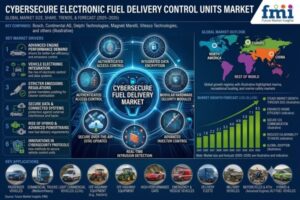


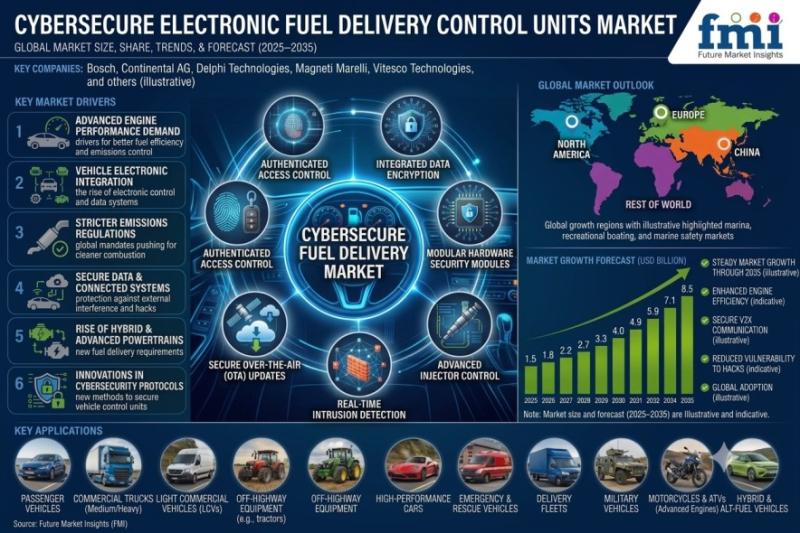
The global cybersecure electronic fuel delivery control units market was valued at USD 0.77 billion in 2025 and is projected to reach USD 0.86 billion in 2026. Expanding at a strong 11.5% CAGR from 2026 through 2036, global market revenue is set to reach USD 2.56 billion by 2036, creating an absolute incremental revenue opportunity of USD 1.70 billion over the ten-year forecast period. Driven by stringent global cybersecurity regulations such as UN R155 and UN R156, expanding connected diagnostic networks, and higher fuel injection system content across gasoline, flex-fuel, and hybrid platforms, automotive OEMs and Tier-1 suppliers are prioritizing secure fuel control nodes to protect critical powertrain functions against unauthorized calibration changes and cyber threats.
Get detailed market forecasts, competitive benchmarking, and pricing trends:
https://www.futuremarketinsights.com/reports/sample/rep-gb-33178
Key Market Highlights at a Glance
• 2025 Baseline Market Valuation: USD 0.77 billion
• 2026 Estimated Market Value: USD 0.86 billion
• 2036 Forecasted Market Size: USD 2.56 billion
• Ten-Year Compound Annual Growth Rate (CAGR 2026-2036): 11.5%
• Absolute Incremental Revenue Opportunity (2026-2036): USD 1.70 billion
• Leading Control Type Segment (2026 Share): Fuel pump controllers, capturing a 45.0% market share
• Leading Security Layer Segment (2026 Share): Secure boot, capturing a 41.0% market share
• Leading Vehicle Type Segment (2026 Share): Passenger cars, accounting for a 49.0% market share
• Leading Powertrain Segment (2026 Share): Gasoline ICE platforms, holding a 40.0% market share
• Leading Sales Channel Segment (2026 Share): OEM fitment, commanding an 82.0% market share
• Fastest-Growing Regional Demand Centers: India expanding at a 13.2% CAGR and China expanding at a 12.7% CAGR
• Report Page Count: 250 Pages
Why Is the Cybersecure Electronic Fuel Delivery Control Units Market Growing?
Demand for cybersecure electronic fuel delivery control units is transitioning from basic pump regulation into a mandatory powertrain security requirement:
• Connected Diagnostics and Gateway Exposure: Modern vehicle architectures connect powertrain control modules to vehicle gateways, making authenticated fuel map changes and protected calibration access vital to prevent remote tampering.
• Mandated Regulatory Compliance: UN Regulation No. 155 for cybersecurity management systems and UN Regulation No. 156 for secure software updates require automakers to document threat analysis and component-level security validation before vehicle type approval.
• Advanced Powertrain Calibration and OTA Updates: The expansion of flex-fuel platforms and over-the-air (OTA) engine control module updates requires hardware security modules and secure boot protocols to verify incoming software packages and preserve emissions compliance.
“Cybersecure fuel delivery control now acts as a compliance filter beyond a small added feature,” stated Nikhil Kaitwade, Principal Consultant at FMI. “Suppliers with the clearest advantage will combine fuel pressure control with verified secure development. OEM sourcing is anticipated to favor companies that can document threat analysis and safe software updates.”
Speak to Analyst: Customize insights for your business strategy:
https://www.futuremarketinsights.com/customization-available/rep-gb-33178
Which Segments Lead the Cybersecure Electronic Fuel Delivery Control Units Market?
Control Type and Security Layer Breakdown
Fuel pump controllers are projected to lead control type demand, accounting for 45.0% share in 2026 as precise pressure regulation remains central to high-efficiency fuel injection systems. Rail pressure controllers and dedicated injector drivers comprise the remaining control type share. From a cybersecurity perspective, secure boot is expected to represent 41.0% share in 2026 because automotive OEMs demand cryptographic startup verification to ensure ECU code integrity before granting network access. Encrypted CAN communication and OTA hardening represent additional critical security layers.
• Fuel Pump Controllers: Projected to command 45.0% of control type demand in 2026 due to essential pressure management roles in direct-injection engines.
• Secure Boot: Forecast to capture 41.0% of security layer demand in 2026, serving as the foundational cryptographic layer for startup code validation.
• Alternative Control and Security Types: Rail pressure controllers, injector drivers, encrypted CAN, and OTA hardening represent the remaining market shares.
Vehicle Type, Powertrain, and Sales Channel Analysis
Passenger cars lead vehicle type adoption, forecast to account for 49.0% share in 2026 as high-volume vehicle platforms integrate advanced electronic content and connected gateways. Commercial vehicles and two-wheelers make up the rest of the market. Among powertrains, gasoline ICE platforms are expected to capture 40.0% share in 2026, closely followed by hybrid and flex-fuel platforms requiring adaptive fuel delivery protection. In terms of distribution, OEM fitment is estimated to account for 82.0% share in 2026 because cybersecurity validation, key provisioning, and software audits are established prior to factory production.
• Passenger Cars: Forecast to represent 49.0% of vehicle type demand in 2026, supported by high electronic content per vehicle.
• Gasoline ICE Platforms: Projected to hold 40.0% of powertrain demand in 2026 due to widespread direct injection adoption.
• OEM Fitment: Estimated to capture 82.0% of sales channel share in 2026, driven by pre-production compliance requirements.
Market Dynamics: Drivers, Restraints, and Trends
Key Market Drivers
Vehicle networks expose more engine control units (ECUs) to diagnostic tools and telematics gateways. Compliance deadlines under UN R155 and UN R156, which became mandatory for new vehicles in UNECE markets, compel OEMs to secure all fuel command paths. Additionally, strict fuel economy standards mean gasoline and hybrid platforms rely heavily on precise, tamper-proof calibration files to maintain real-world efficiency and meet stringent emissions targets.
Key Market Restraints
High software integration complexity and elevated hardware costs present barriers for cost-sensitive segments, particularly low-margin entry-level vehicles. Furthermore, managing cryptographic keys across multi-tier automotive supply chains introduces operational challenges and requires specialized engineering resources during module development.
Key Market Trends
Sensors and microcontrollers are embedding hardware security modules (HSMs) directly at the silicon level. For instance, microcontrollers achieving ISO/SAE 21434 certification enable component suppliers to deliver root-of-trust protection directly within fuel delivery hardware. Furthermore, suppliers are combining fuel pressure management with message authentication and secure flash memory to support lifetime over-the-air engine calibration updates.
Regional and Country Outlook: India and China Lead Global Expansion
• India: Projected CAGR of 13.2% (2026-2036)
• China: Projected CAGR of 12.7% (2026-2036)
• United States: Mature market focused on secure OTA update capabilities, flex-fuel calibration protection, and compliance with federal vehicle safety standards.
• Germany: High-value innovation center driven by stringent European regulatory frameworks, advanced hybrid powertrain engineering, and premium OEM adoption.
India Market Story
India represents the fastest-growing market globally, expanding at a 13.2% CAGR from 2026 through 2036. Growth is driven by the rapid transition to electronic fuel injection across passenger cars and two-wheelers, along with expanding domestic vehicle production and aligning vehicle safety standards.
China Market Story
China is forecast to grow at a 12.7% CAGR through 2036. High domestic vehicle manufacturing scale, robust connected car ecosystem development, and national alignment with software update security rules create strong demand for cybersecure fuel delivery control modules.
Latest Automotive Industry Analysis Reports:
https://www.futuremarketinsights.com/industry-analysis/automotive
Competitive Landscape
The global cybersecure electronic fuel delivery control units market features leading Tier-1 automotive suppliers and specialized ECU manufacturers. Industry participants focus on offering integrated hardware and software architectures that pair precise fuel pressure control with certified cybersecurity development frameworks.
• Robert Bosch GmbH: Industry leader offering integrated powertrain ECUs, secure fuel pump controllers, and certified automotive cybersecurity software architectures.
• DENSO Corporation: Major automotive supplier delivering high-precision fuel injection controls with built-in hardware security module integration.
• Continental AG: Global powertrain and electronics specialist providing secure engine control units and advanced vehicle gateway communications.
• Hitachi Astemo, Ltd.: Key automotive system supplier offering combined fuel management electronics and secure engine control modules.
• Infineon Technologies AG: Leading automotive semiconductor provider supplying ISO/SAE 21434 certified microcontrollers for secure fuel delivery applications.