

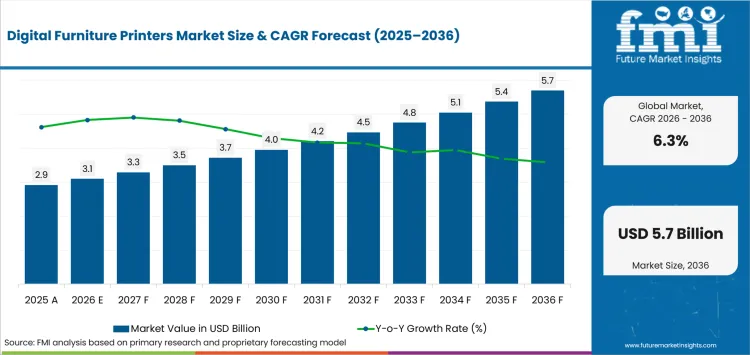
The Digital Furniture Printers Market is projected to reach USD 5.7 billion by 2036, up from USD 3.1 billion in 2026, expanding at a 6.3% CAGR during the forecast period. Growth is being supported by furniture manufacturers seeking greater design flexibility, shorter décor changeovers, and efficient production of multiple design variants without relying heavily on traditional plate- or screen-based processes.
Get detailed market forecasts, competitive benchmarking, and pricing trends: https://www.futuremarketinsights.com/reports/sample/rep-gb-35150
Global Segment Leaders
The market’s leading segments in 2026 highlight the importance of UV printing technology, ink performance, and substrate compatibility:
- Flatbed UV printers account for 33.0% of the printer type segment.
- UV-curable inks hold 42.0% of the ink type segment.
- MDF/HDF panels represent 31.0% of the substrate segment.
These segments reflect the growing relevance of digital printing platforms that can support customized décor, varied design requirements, and efficient production across furniture-panel applications.
Market Growth Drivers
Digital furniture printing is gaining traction as furniture manufacturers face growing demand for design variety and shorter production runs. Traditional décor processes can become less economical when manufacturers frequently change patterns because each new design may require plates, screens, or additional finished-décor inventory.
Digital printing changes this production equation by allowing manufacturers to move from one digital file to another with fewer physical setup requirements. This capability can make smaller design batches and frequent décor changes more practical for furniture producers.
Shorter Décor Runs Strengthen Digital Printing Demand
Shorter décor runs are an important factor supporting adoption of digital furniture printers. When manufacturers produce multiple designs in smaller quantities, conventional printing methods can carry additional setup and inventory costs.
File-driven printing allows designs to be changed digitally, reducing the need for repeated physical preparation. This can shorten changeovers and help furniture producers respond to changing décor preferences while maintaining greater flexibility across production schedules.
Koenig & Bauer’s March 2026 annual report states that digital décor printing for furniture and flooring enables fast design changes and low-cost idea testing. This supports the role of digital printing in production environments where design flexibility and rapid experimentation are increasingly important.
Flatbed UV Printers Lead Printer Types
Flatbed UV printers account for 33.0% of printer type demand in 2026, making them the leading printer category. Their position reflects the importance of direct digital printing capabilities for furniture panels and other rigid substrates.
Flatbed configurations can support direct printing workflows in which manufacturers need to apply décor designs onto rigid furniture components. Buyers continue to evaluate printer selection based on substrate dimensions, production requirements, print quality, curing technology, and integration with existing manufacturing operations.
UV-Curable Inks Dominate Ink Types
UV-curable inks represent 42.0% of the ink type segment in 2026. Their leading position highlights the importance of curing performance and compatibility with digital furniture-printing workflows.
Ink selection influences print appearance, substrate compatibility, durability requirements, and production performance. For furniture manufacturers, these considerations become particularly relevant when printed panels must maintain consistent décor quality across repeated production runs.
MDF and HDF Panels Represent a Key Substrate Segment
MDF/HDF panels account for 31.0% of substrate demand in 2026. These engineered wood panels are widely suited to digitally printed furniture décor applications where manufacturers need consistent surfaces for decorative finishes.
Digital printing can allow manufacturers to apply different visual patterns and designs without maintaining large quantities of pre-printed décor inventory. This provides greater flexibility when furniture ranges contain numerous finishes, textures, or visual variations.
Integration and Capital Approval Remain Constraints
Despite the advantages of digital printing, broader conversion can be limited by production-line integration and capital approval requirements. Furniture manufacturers must determine whether new printing equipment can operate efficiently alongside existing panel preparation, finishing, handling, and downstream processes.
Capital approval can also depend on production volume, expected utilization, design turnover, and the economics of replacing or supplementing conventional printing systems. As a result, adoption decisions are increasingly based on the complete production workflow rather than printer performance alone.
Competitive Landscape
Competition in the Digital Furniture Printers Market centers on printing technology, substrate compatibility, ink systems, production speed, automation, and integration with furniture manufacturing lines.
Manufacturers and buyers are likely to evaluate:
- Printer type and configuration
- UV-curable ink performance
- MDF/HDF and other substrate compatibility
- Print quality and décor consistency
- Changeover requirements
- Digital workflow and file management
- Production-line integration
- Capital investment and utilization economics
The ability to combine design flexibility with reliable production performance is expected to remain important as furniture manufacturers expand their digital décor capabilities.
Get the Complete Story—Read More About Our Latest Report
The Digital Furniture Printers Market report provides analysis of market growth, printer types, ink types, substrates, and other factors shaping demand through 2036.
Get the Complete Story—Read More About Our Latest Report: https://www.futuremarketinsights.com/reports/digital-furniture-printers-market
Related analysis on industrial printing technologies is also available through FMI’s Industrial Printer Market research.
Analyst Perspective
“Digital furniture printing is becoming increasingly relevant where manufacturers need to manage shorter décor runs and a wider range of design variants. Flatbed UV printers leading with 33.0% share, alongside UV-curable inks at 42.0%, highlights the importance of flexible digital workflows. However, successful conversion still depends on integrating printing equipment into existing production lines and achieving sufficient utilization to justify capital investment,” says Nikhil Kaitwade, Future Market Insights.
Related Reports:
Material Handling Integration Market- https://www.futuremarketinsights.com/reports/material-handling-integration-market
Manure Handling Equipment Market- https://www.futuremarketinsights.com/reports/manure-handling-equipment-market
Industrial Robotics Market
https://www.futuremarketinsights.com/reports/industrial-robotics-market
About Future Market Insights (FMI)
Future Market Insights, Inc. (FMI) is an ESOMAR-certified, ISO 9001:2015 market research and consulting organization, trusted by Fortune 500 clients and global enterprises. With operations in the U.S., UK, India, and Dubai, FMI provides data-backed insights and strategic intelligence across 30+ industries and 1200 markets worldwide.
For Press & Corporate Inquiries
Rahul Singh
AVP – Marketing and Growth Strategy
Future Market Insights, Inc.
+91 8600020075
For Sales: sales@futuremarketinsights.com
For Media: Rahul.singh@futuremarketinsights.com
For Web: Future Market Insights