

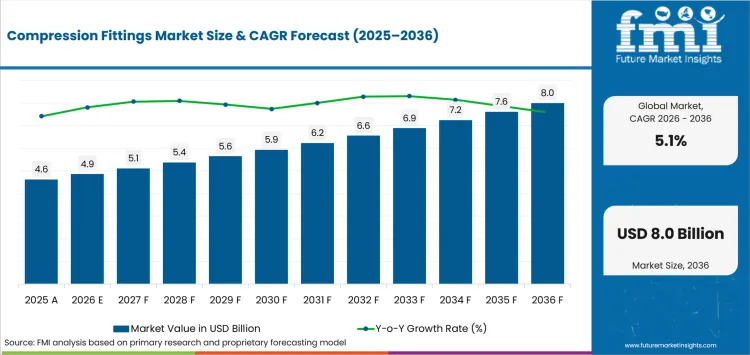
The Compression Fittings Market is projected to reach USD 8.0 billion by 2036, up from USD 4.9 billion in 2026, expanding at a 5.1% CAGR during the forecast period. Market demand is supported by the growing number of serviceable tube connections required across pneumatic, hydraulic, cooling, and instrumentation circuits in industrial equipment.
Get detailed market forecasts, competitive benchmarking, and pricing trends: https://www.futuremarketinsights.com/reports/sample/rep-gb-35140
Global Segment Leaders
The market’s leading segments in 2026 highlight the importance of fitting configuration, material compatibility, and tube dimensions:
- Straight unions account for 24.0% of fitting type demand.
- Brass represents 34.0% of the material segment.
- Below 6 mm tube sizes account for 18.0% of tube size demand.
These segments reflect the continued importance of reliable, serviceable connections across industrial systems where tube routing, connection fit, and material compatibility influence component selection.
Market Growth Drivers
Compression fittings are an important component in equipment requiring serviceable tube connections. Industrial machinery can incorporate pneumatic, hydraulic, cooling, and instrumentation circuits, increasing the number of connection points required during equipment assembly.
As manufacturers expand machinery installations, the installed base of fittings also grows. Replacement demand can subsequently arise as equipment is serviced, modified, or maintained, creating a recurring requirement for compatible connection components.
Industrial Equipment Expansion Supports Demand
Machine investment increases the number of tube connections incorporated into industrial systems. Pneumatic circuits, hydraulic lines, cooling systems, and instrumentation networks each require appropriate connections based on pressure, tube dimensions, material, and service conditions.
The International Federation of Robotics (IFR) documented 542,000 industrial robot installations during 2024 in its September 2025 release. While robot installations do not directly determine the Compression Fittings Market forecast, expanding industrial equipment deployment creates additional machinery infrastructure where fittings can be installed during assembly and subsequently replaced through maintenance requirements.
Straight Unions Lead Fitting Types
Straight unions account for 24.0% of fitting type demand in 2026, making them the leading fitting configuration. Their role reflects the need for straightforward tube-to-tube connections in systems where serviceability and connection reliability are important.
Selection can depend on tube dimensions, connection requirements, operating conditions, and the broader system configuration. Manufacturers and maintenance teams therefore need fittings that match existing tubing and connection specifications.
Brass Leads Material Demand
Brass represents 34.0% of material demand in 2026. Material selection is closely connected to application requirements, compatibility with the tubing and surrounding system, and operating conditions.
For equipment manufacturers and maintenance teams, maintaining material compatibility is particularly important when replacing existing components. A fitting that does not meet the required material or connection specifications can create qualification and reliability concerns.
Smaller Tube Sizes Maintain a Significant Role
The below 6 mm tube-size segment accounts for 18.0% of demand in 2026. Smaller tubing can be relevant in compact pneumatic and instrumentation applications where limited installation space requires appropriately sized connection components.
As equipment becomes increasingly integrated, fitting selection must account for available space, tube routing, connection access, and the requirements of individual circuits.
Qualification and Local Stock Influence Substitution
Although compression fittings can be standardized components, substitution is not always immediate. Qualification records, connection specifications, material requirements, and existing system designs can influence purchasing decisions.
Local stock availability also plays an important role in maintenance environments. When equipment requires rapid servicing, buyers may prioritize suppliers that can provide compatible fittings without extended procurement lead times. This creates an advantage for suppliers with established distribution networks and readily available inventories.
Competitive Landscape
Competition in the Compression Fittings Market centers on connection reliability, material selection, dimensional compatibility, product availability, and application suitability.
Manufacturers and buyers are likely to evaluate:
- Fitting type and connection configuration
- Brass and alternative material options
- Tube size compatibility
- Connection fit and sealing performance
- Application and operating requirements
- Qualification and specification records
- Replacement compatibility
- Local inventory and distribution availability
The ability to provide compatible products quickly while meeting application and qualification requirements remains important for both original equipment and replacement demand.
Get the Complete Story—Read More About Our Latest Report
The Compression Fittings Market report provides analysis of market growth, fitting types, materials, tube sizes, and other factors shaping demand through 2036.
Explore the full Compression Fittings Market report: https://www.futuremarketinsights.com/reports/compression-fittings-market
Analyst Perspective
“Compression fittings remain closely linked to the installed base of industrial equipment because pneumatic, hydraulic, cooling, and instrumentation systems all require reliable tube connections. Straight unions leading with 24.0% share and brass accounting for 34.0% of material demand demonstrate the importance of standardized connection formats and material compatibility. At the same time, qualification requirements and local stock availability can influence replacement decisions,” says Nikhil Kaitwade, Future Market Insights.
Related Reports:
Hedge Trimmers Market- https://www.futuremarketinsights.com/reports/hedge-trimmers-market
Electric Blind Rivet Gun Market- https://www.futuremarketinsights.com/reports/electric-blind-rivet-gun-market
Electric Power Tools Market- https://www.futuremarketinsights.com/reports/electric-power-tools-market
About Future Market Insights (FMI)
Future Market Insights, Inc. (FMI) is an ESOMAR-certified, ISO 9001:2015 market research and consulting organization, trusted by Fortune 500 clients and global enterprises. With operations in the U.S., UK, India, and Dubai, FMI provides data-backed insights and strategic intelligence across 30+ industries and 1200 markets worldwide.
For Press & Corporate Inquiries
Rahul Singh
AVP – Marketing and Growth Strategy
Future Market Insights, Inc.
+91 8600020075
For Sales: sales@futuremarketinsights.com
For Media: Rahul.singh@futuremarketinsights.com
For Web: Future Market Insights