

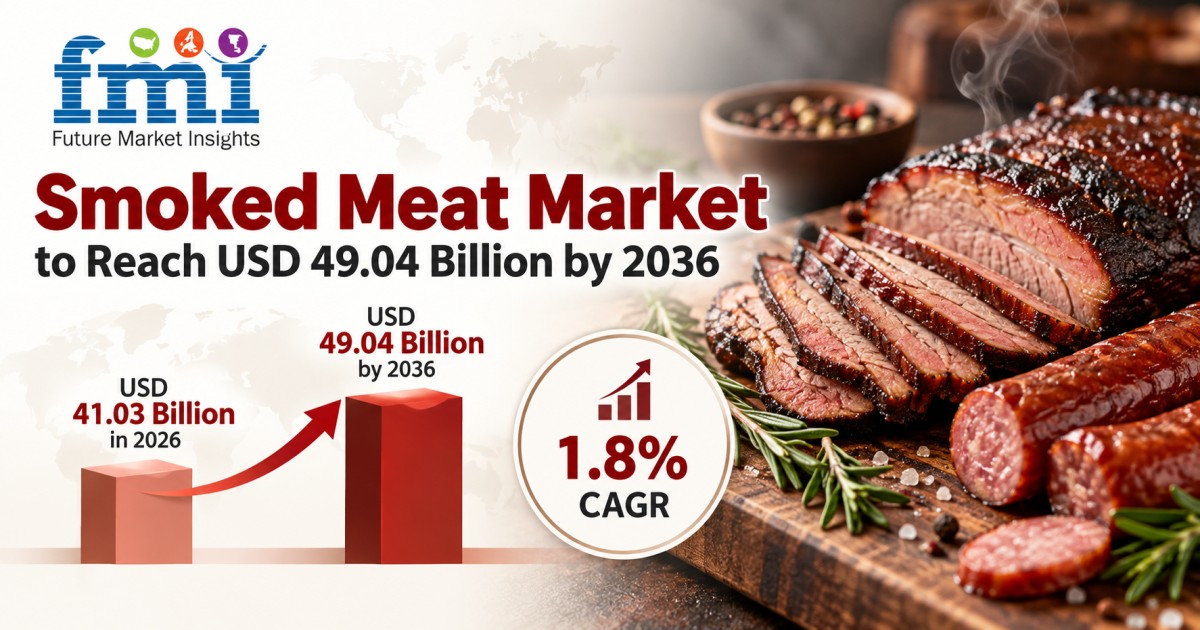
The global smoked meat market is forecast to increase from USD 41.03 billion in 2026 to USD 49.04 billion by 2036, expanding at a 1.8% CAGR during the 2026–2036 forecast period, according to Future Market Insights. The market was valued at USD 40.30 billion in 2025. Growth is being supported by premium smoked meat offerings, foodservice premiumization, clean-label curing reformulation, convenience-oriented packaging, and the commercialization of traditional Asian smoked meat products. At the same time, regulatory requirements and health-related perceptions surrounding processed meat remain important market constraints.
Get detailed market forecasts, competitive benchmarking, and pricing trends:
https://www.futuremarketinsights.com/reports/sample/rep-gb-23014
Regional Segment Leaders
The smoked meat market is segmented by type and end use, with pork and hotel & restaurant representing the leading categories.
- Pork — 34.7% of Type demand in 2026: Versatility, affordability, widespread cultural acceptance, and adaptability to regional flavor profiles support pork’s leading position in smoked meat.
- Hotel & restaurant — 41.2% of End Use demand in 2026: Smoked proteins provide differentiated menu offerings, premium dining experiences, and opportunities for higher-value foodservice positioning.
Country-Level Performance
The report profiles country-specific growth trajectories across major markets, with China recording the highest projected CAGR among the countries tracked.
- China | CAGR 2.4% (2026–2036) | Key drivers: Growing demand for ready-to-eat meals and premium smoked meat snacks, strong pork consumption, vacuum-sealed packaging adoption, and expanding online retail and specialty meat outlets.
- India | CAGR 2.3% (2026–2036) | Key drivers: Rising acceptance of processed meat in urban households and hospitality, demand for smoked chicken and fish, natural smoking techniques, and expanding online meat delivery.
- Germany | CAGR 2.1% (2026–2036) | Key drivers: Demand for traditional smoked sausages and ham, premium artisanal products, gourmet retail, and high-protein convenience snacks.
- France | CAGR 1.9% (2026–2036) | Key drivers: Strong culinary traditions, gourmet charcuterie demand, smoked ham and duck consumption, vacuum-packed formats, and flavor innovation.
- UK | CAGR 1.7% (2026–2036) | Key drivers: Established demand for smoked bacon and fish, premium retail and online grocery sales, low-sodium and nitrate-free product development, and restaurant partnerships.
- USA | CAGR 1.5% (2026–2036) | Key drivers: Established supply chains and replacement demand cycles within a mature smoked meat consumption base.
- Brazil | CAGR 1.4% (2026–2036) | Key drivers: Established supply infrastructure and replacement demand supporting steady category development.
Regional Context
Across the global smoked meat market, growth is shaped by a combination of premiumization, culinary preferences, convenience, and regulatory considerations. Mature consumption bases in North America and Europe limit volume expansion, while value creation is increasingly linked to heritage-breed sourcing, wood-specific smoking profiles, clean-label reformulations, and premium foodservice applications.
Traditional Asian smoked meat products are also moving from household and artisanal production toward commercial-scale manufacturing. Meanwhile, vacuum-sealed single-serve packs and resealable formats are expanding smoked meat into convenience stores, cafeterias, airline catering, and other grab-and-go consumption occasions.
Regulatory scrutiny around processing, smoke flavoring techniques, chemical usage, and labeling continues to increase operational costs. Manufacturers are therefore investing in advanced smoking chambers, filtration systems, quality testing, natural smoking processes, and reduced-nitrite formulations.
Competitive Landscape
The smoked meat market is moderately consolidated, with WH Group holding a leading position through extensive global processing capabilities, distribution networks, and a diversified smoked meat portfolio.
Key companies profiled include WH Group, Hormel, Yunrun Group, Fratelli Beretta SpA, Columbus Foods, Peer Foods Group, Inc., Kayem Foods, Inc., Schwartz, Falls Brand and Independent Meat Company, and Sunnyvalley Smoked Meats, Inc.
The competitive landscape features several strategic approaches:
- Scaled Meat Processing Platforms: WH Group and Hormel leverage broad processing capabilities and established retail and foodservice distribution.
- Regional and Specialty Producers: Fratelli Beretta, Columbus Foods, Kayem Foods, and other specialty producers focus on differentiated smoked meat products and regional consumer preferences.
- Premiumization and Clean-Label Development: Leading suppliers are introducing natural wood-smoking processes, low-sodium formulations, and clean-label products to address changing consumer expectations.
- Operational and Distribution Investment: Automated processing facilities, cold-chain logistics, and e-commerce distribution are being used to improve efficiency and market reach.
Get the Complete Story-Read More About Our Latest Report:
https://www.futuremarketinsights.com/reports/smoked-meat-market
Analyst Perspective
The market outlook indicates that smoked meat value growth is increasingly connected to premiumization and foodservice applications rather than broad commodity-volume expansion. Traditional Asian smoked meat products also provide opportunities for commercial-scale development, while rising input costs, energy-intensive smoking processes, and tightening labeling requirements remain important considerations for manufacturers. — Nandini Roy Choudhury, Principal Consultant, Future Market Insights
Explore More Research Reports by FMI
Meat Pies Market:
https://www.futuremarketinsights.com/reports/meat-pies-market
Smoked Fish Market:
https://www.futuremarketinsights.com/reports/smoked-fish-market
Meat Based FPP Market:
https://www.futuremarketinsights.com/reports/meat-based-fpp-market
Deli Meat Market:
https://www.futuremarketinsights.com/reports/deli-meat-market
Crab Meat Market:
https://www.futuremarketinsights.com/reports/crab-meat-market
About Future Market Insights (FMI)
Future Market Insights, Inc. (FMI) is an ESOMAR-certified, ISO 9001:2015 market research and consulting organization, trusted by Fortune 500 clients and global enterprises. With operations in the U.S., UK, India, and Dubai, FMI provides data-backed insights and strategic intelligence across 30+ industries and 1200 markets worldwide.
Contact Us:
Future Market Insights Inc.
Christiana Corporate, 200 Continental Drive,
Suite 401, Newark, Delaware – 19713, USA
T: +1-347-918-3531
Why FMI: https://www.futuremarketinsights.com/why-fmi
For Sales Enquiries: sales@futuremarketinsights.com
Website: https://www.futuremarketinsights.com