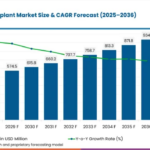


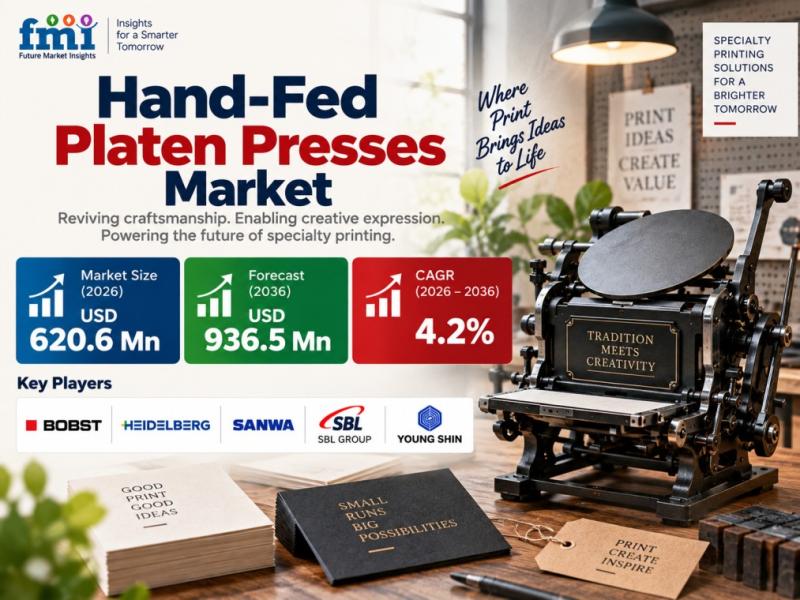
The global Hand-Fed Platen Presses Market is projected to reach USD 936.5 million by 2036, up from USD 620.6 million in 2026, registering a 4.2% CAGR between 2026 and 2036, according to Future Market Insights (FMI).
The market continues to serve converters, printers, label shops, and specialty operations where short-run work, finishing requirements, and flexible production can make operator-centered platen equipment relevant.
Hand-fed equipment can provide a lower-capital route for selected applications when a fully automated line would not achieve sufficient utilization. However, the purchase decision increasingly requires buyers to consider operator time, changeovers, safeguarding, maintenance, parts availability, and the workload the machine is expected to handle.
Get Detailed Market Forecasts, Competitive Benchmarking, and Pricing Trends: https://www.futuremarketinsights.com/reports/sample/rep-gb-35278
Semi-Automatic Presses Account for 31.0% of Press-Type Demand
Semi-automatic platen presses are estimated to account for 31.0% of press-type demand in 2026.
Assisted feeding can improve consistency and output while retaining flexibility for varied and shorter production runs. This positions semi-automatic equipment between fully manual presses and higher-throughput automated systems.
Safety remains an important consideration. In September 2025, the UK Health and Safety Executive issued an improvement notice concerning dangerous access and crush risks associated with Heidelberg platen presses at Greycot Press. The development highlights the importance of guarding, operator safety, installation, and maintenance when evaluating platen equipment.
Medium Format Leads Press-Size Demand
Medium-format presses are projected to represent 29.0% of press-size demand in 2026.
These machines can accommodate a broad mix of cartons, labels, print finishing, and specialty work without the footprint and tooling requirements associated with high-capacity equipment.
For converters, the format can provide flexibility for mixed commercial work and allow smaller jobs to be grouped efficiently. Buyers still need to match platen area, pressure, tooling, and sheet size to the intended workload.
Packaging Die Cutting Represents 34.0% of Applications
Packaging die cutting is expected to account for 34.0% of applications in 2026.
Cartons and board-based packaging require repeatable cutting and, in many cases, creasing before folding, gluing, or assembly. This creates a recurring application for platen technology across both specialty and commercial work.
The wider market is also seeing productivity advances in automated die cutting. In July 2026, BOBST reported a pilot MASTERCUT 165 PER Dual Stream installation at Leopold in Germany capable of processing solid board and corrugated board with rapid job changes.
Such automated systems operate beyond the low-capital hand-fed niche, but they establish a productivity benchmark for converters comparing operator-fed equipment with higher-throughput alternatives.
Packaging Converters Represent 33.0% of End-Use Demand
Packaging converters are forecast to account for 33.0% of end-use demand in 2026.
Platen equipment can fit directly into cutting, creasing, embossing, and selected finishing workflows. Bringing selected work in-house can give converters greater control over prototypes, specialty orders, and lower-volume jobs.
Market conditions also influence investment decisions. In March 2026, ABRE reported that Brazilian packaging physical output was broadly stable in 2025 after 6.4% growth in 2024. Such variation reinforces the importance of matching new equipment to realistic workloads rather than speculative capacity requirements.
Equipment Distributors Lead Sales Channels
Equipment distributors are projected to account for 39.0% of sales in 2026.
For smaller converters, distributor support can extend beyond the initial machine sale. Specification assistance, installation, training, parts availability, and technical service can reduce the ownership burden associated with platen equipment.
DGM Technology’s Barcelona facility announcement included European sales, technical assistance, and spare-parts distribution. Kluge also offers remanufactured presses with installation and optional operator training.
These service capabilities are particularly relevant when buyers evaluate used or refurbished machinery.
Safety, Labor, and Automation Shape the Opportunity
Short-run packaging and specialty finishing remain important demand drivers because they can create workloads that do not justify a fully automated production line.
At the same time, operator exposure, guarding requirements, labor intensity, and lower throughput can reduce the economic advantage of hand-fed equipment as production volumes increase.
This creates an opportunity for safer semi-automatic and refurbished presses. Buyers seeking improved makeready, better feeding consistency, and service support can consider intermediate upgrades without immediately moving to a fully automatic line.
The key consideration is total ownership economics rather than purchase price alone.
>> Access detailed market insights: https://www.futuremarketinsights.com/reports/brochure/rep-gb-35278
Regional Market Outlook
FMI’s country analysis covers Brazil, the USA, Japan, Mexico, Italy, the UK, and South Africa.
Brazil is projected to record a 5.0% CAGR from 2026 to 2036, while Mexico is forecast at 4.7% and South Africa at 4.5%. The USA is projected at 3.9%, Italy at 3.8%, the UK at 3.6%, and Japan at 3.1%.
Local service, financing, installed equipment, labor requirements, and converter workloads remain important considerations when assessing country-level demand.
Competitive Landscape
The market includes suppliers serving industrial packaging, specialist die cutting and foil applications, and short-run or specialty platen requirements.
Notable companies covered by FMI include Bobst, Heidelberg, Masterwork, Young Shin, Sanwa, SBL Group, DGM, IIJIMA MFG, Kluge, and Geo Knight.
Competition is influenced by automation levels, format options, changeover capabilities, service coverage, refurbishment support, and the applications each machine can accommodate.
Report Scope
The FMI study covers the Hand-Fed Platen Presses Market by press type, press size, application, end use, and sales channel.
The forecast period is 2026 to 2036, with quantitative estimates presented in USD million and CAGR percentages.
The market definition includes revenue from hand-fed and operator-centered platen press equipment within the defined press-type, size, application, end-use, and sales-channel universe. It excludes downstream finished-product revenue, standalone consumables and tooling, and adjacent substitute presses outside the defined platen scope.
The study covers North America, Latin America, Western Europe, Eastern Europe, East Asia, South Asia and Pacific, and the Middle East and Africa. FMI applies a hybrid bottom-up and top-down sizing approach, supported by primary and secondary research, supplier activity, channel checks, application demand, and macro-industry indicators.