


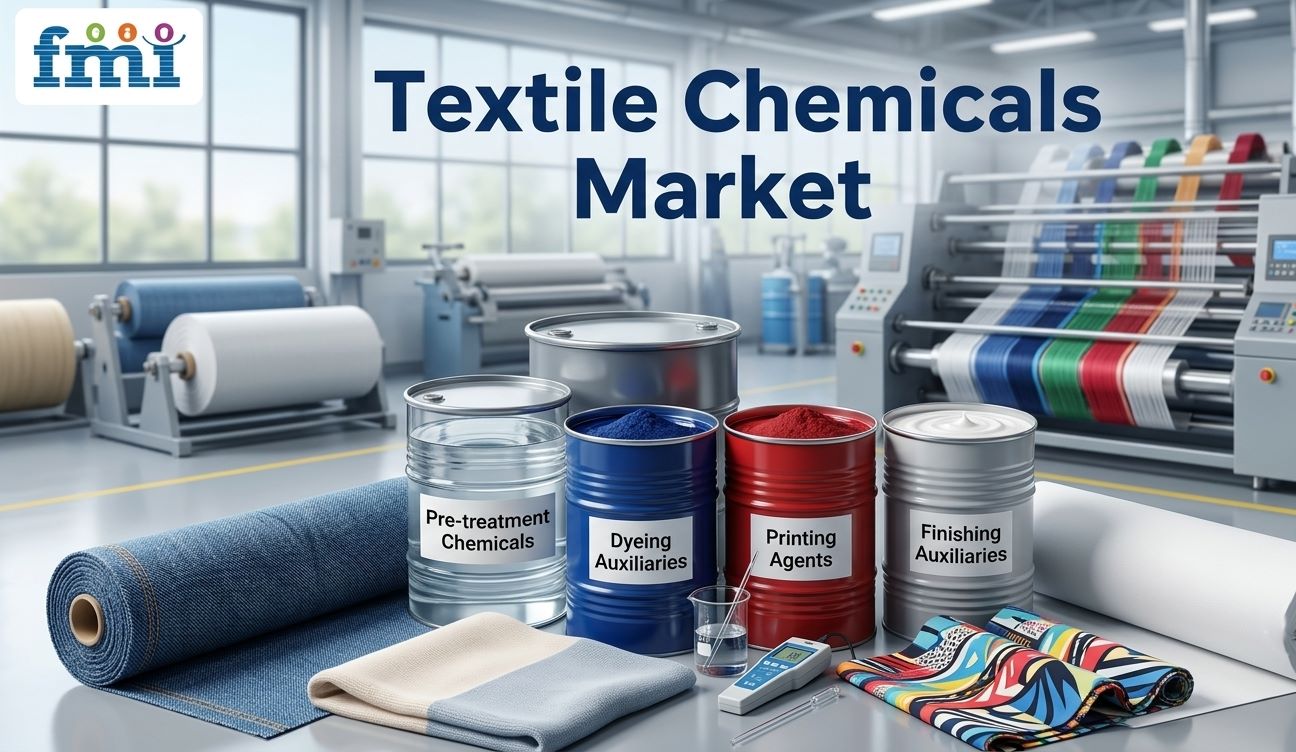
The textile chemicals market is growing as textile manufacturers use chemicals to improve durability, flexibility, colour, and product performance. Textile chemicals support a wide range of applications, including clothing, furniture, home furnishings, and floor coverings.
However, concerns about hazardous chemicals have increased pressure on textile manufacturers to adopt safer alternatives. As a result, companies are placing greater focus on approved chemicals, safer dyes, and better supply chain controls.
Market Outlook
The textile chemicals market continues to benefit from the large-scale production of textiles in developing countries. China, India, Indonesia, Bangladesh, and Vietnam are important manufacturing hubs for global textile and apparel brands.
Textile chemicals are used throughout textile production to meet different product requirements. In addition, growing textile consumption in apparel and home furnishing applications supports demand for these chemicals.
Growing Focus on Safer Textile Chemicals
Concerns about hazardous substances have become an important issue for the textile industry. Investigations into the use of hazardous chemicals in clothing have increased public awareness of chemical safety.
The Greenpeace investigation into children’s clothing highlighted concerns about hazardous chemicals in textile products. The investigation also drew attention to the involvement of major international brands in textile chemical use.
Major textile companies are now focusing on approved chemicals and dyes. Moreover, multinational brands have introduced stricter controls across their supply chains to improve chemical management.
Supply Chain Controls Support Market Changes
Textile manufacturing is often carried out through production facilities in developing countries. Therefore, brands need effective systems to monitor chemical use across their manufacturing networks.
Many companies are working more closely with textile manufacturers to gain greater control over production processes. This includes monitoring the chemicals and dyes used to manufacture textile products.
Asia Remains a Major Demand Center
Asia is an important market for textile chemicals because of its large textile manufacturing base. China, India, Indonesia, Bangladesh, and Vietnam host major textile and apparel production activities.
China and India also have large domestic consumer markets. As a result, textile production and chemical demand remain significant across these countries.
Apparel and Home Furnishing Applications Drive Demand
The use of textile chemicals extends beyond clothing. Textile products are widely used in home furnishings, furniture, carpets, and floor coverings.
Therefore, demand from these applications adds to the overall requirement for textile chemicals.
Textiles are also finding applications in areas such as construction and healthcare. As a result, new end-use opportunities could broaden the market for textile chemicals.
Growth Opportunities
The textile chemicals market offers opportunities as manufacturers seek chemicals that combine performance with improved safety.
Key opportunities include textile chemicals used for:
- Apparel
- Home furnishings
- Furniture
- Floor coverings
- Construction textiles
- Medical textiles
- Textile colouring and dyeing
- Textile durability and finishing
Market Challenges
The textile chemicals market also faces challenges related to chemical safety and environmental concerns. Certain chemicals used in textile manufacturing can create health and environmental concerns.
Supply chain management is another important challenge. Global textile brands often depend on manufacturing facilities across several countries. Therefore, maintaining consistent chemical standards across suppliers can require stronger monitoring and quality control.
Competitive Landscape and Future Outlook
Competition in the textile chemicals market is increasingly shaped by product safety, chemical performance, environmental considerations, and the ability to meet textile manufacturers’ changing requirements.
Textile and chemical companies are expected to focus more on developing safer alternatives. In addition, stronger collaboration between global brands and manufacturing facilities can improve control over chemical use.
Conclusion
The textile chemicals market is closely linked to the growth of textile manufacturing across apparel, home furnishings, floor coverings, and emerging applications.
Growing awareness of hazardous chemicals has changed how textile brands and manufacturers approach chemical selection and supply chain management. As a result, safer chemicals and approved dyes are receiving greater attention.
Explore More Related Studies Published by FMI Research:
E-Coat Pretreatment Chemicals Market
Ore Agglomeration Binders Market
FMI Custom Research: Strategic Intelligence for Confident Decision-Making
In today’s rapidly evolving business environment, leadership teams need more than market data—they need clear, actionable intelligence tailored to their strategic objectives. FMI’s Custom Research solutions are designed around the specific business questions organizations need answered, enabling executives to evaluate growth opportunities, validate investments, assess competitive dynamics, and reduce uncertainty before making critical decisions. By combining deep industry expertise, primary research, and proprietary market intelligence, FMI delivers insights that help organizations move from assumptions to evidence-based strategies with greater speed and confidence.
Key Executive Benefits
- Decision-Ready Insights: Research tailored to your specific business challenges, growth plans, and investment priorities.
- Reduced Strategic Risk: Validate market opportunities, customer demand, and competitive positioning before committing resources.
- Market Entry Confidence: Assess opportunity size, regulatory barriers, channel dynamics, and competitive landscapes with precision.
- Competitive Advantage: Gain proprietary intelligence unavailable through syndicated reports or internal datasets.
- Faster Growth Decisions: Accelerate expansion, product development, portfolio optimization, and investment planning.
- Primary Market Validation: Access real-world customer, buyer, and stakeholder insights that support high-confidence decision-making.
- Global Industry Expertise: Powered by 100+ analysts, 20,000+ published reports, and 1.6 million+ hours of research experience.
- Proven Track Record: Over 7,000 market-entry engagements completed across six regions and 14 industry sectors with strong client retention.
Business Impact
FMI helps organizations transform market complexity into strategic clarity, enabling leadership teams to identify growth opportunities faster, optimize resource allocation, strengthen competitive positioning, and make high-stakes business decisions with confidence.
To explore how FMI Custom Research can support your strategic priorities, please connect with our team at – sales@futuremarketinsights.com
About Future Market Insights (FMI)
Future Market Insights is a leading provider of market intelligence, consulting services, and syndicated research reports. FMI delivers actionable insights across food and beverage, healthcare, consumer goods, biotechnology, chemicals, industrial products, and emerging technologies, helping organizations identify growth opportunities and make informed strategic decisions in evolving global markets.
Contact Us:
Future Market Insights Inc.
Christiana Corporate, 200 Continental Drive,
Suite 401, Newark, Delaware – 19713, USA
T: +1-347-918-3531
Why FMI: https://www.futuremarketinsights.com/why-fmi
For Sales Enquiries: sales@futuremarketinsights.com
Website: https://www.futuremarketinsights.com