

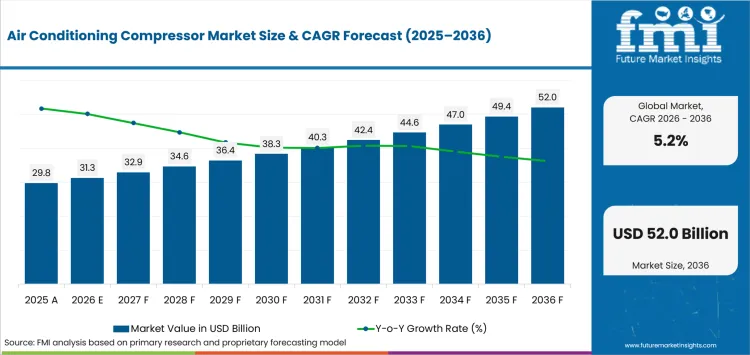
According to Future Market Insights (FMI), the global air conditioning compressor market is projected to grow from USD 31.3 billion in 2026 to USD 52.0 billion by 2036, expanding at a 5.2% CAGR during the forecast period. Rising demand for cooling access, stricter equipment efficiency requirements, and ongoing refrigerant transitions are supporting compressor qualification and replacement activity across residential, commercial, and other air conditioning applications.
Rotary compressors are estimated to account for 51.0% of the market by type in 2026, while R32 is projected to represent 31.0% by refrigerant. Compressors with cooling capacities below 5 kW are expected to account for 38.0% of demand by cooling capacity, reflecting the continued importance of smaller-capacity air conditioning systems.
Get Detailed Market Forecasts, Competitive Benchmarking, and Pricing Trends: https://www.futuremarketinsights.com/reports/sample/rep-gb-15866
Key Market Highlights
- The Air Conditioning Compressor Market is valued at USD 31.3 billion in 2026.
- Market revenue is forecast to reach USD 52.0 billion by 2036.
- The market is projected to expand at a 2% CAGR from 2026 to 2036.
- Rotary compressors account for an estimated 0% of demand by type in 2026.
- R32 is projected to represent 0% of demand by refrigerant.
- Compressors with cooling capacity below 5 kW account for an estimated 0% of demand.
- Expanding cooling access is creating additional demand for air conditioning equipment and compressors.
- Refrigerant transitions are increasing the importance of validated compressor-refrigerant operating envelopes.
Analyst Viewpoint
Air conditioning compressor demand is increasingly influenced by two parallel requirements: expanding access to cooling and improving the efficiency of installed equipment. OEMs need compressor platforms that can meet seasonal efficiency expectations while remaining compatible with refrigerants undergoing regulatory and market transitions.
This creates qualification opportunities for compressor manufacturers but also increases engineering complexity. Changes in refrigerants can require redesign, validation, and testing to ensure that compressor performance remains reliable across the intended operating envelope.
Why Is the Air Conditioning Compressor Market Growing?
The market is expanding as more households, commercial buildings, and other facilities seek reliable cooling capacity. At the same time, energy efficiency is becoming a more important design constraint for air conditioning equipment.
The International Energy Agency reported in July 2025 that only about 15% of people living in hot regions own an air conditioner. The relatively low ownership rate indicates substantial room for additional cooling-system adoption, particularly in regions where temperatures and cooling requirements are increasing.
As new air conditioning systems are installed, compressor manufacturers must address both cooling demand and evolving efficiency requirements.
Key Growth Drivers
Expanding Access to Air Conditioning
Limited air conditioner ownership across hot regions leaves considerable potential for new equipment installations. Growth in cooling access creates corresponding demand for compressors used in residential and commercial air conditioning systems.
Increasing Efficiency Requirements
Higher efficiency requirements are encouraging OEMs to evaluate compressor performance more closely. Compressor efficiency, operating characteristics, and compatibility with complete air conditioning systems increasingly influence product qualification.
Refrigerant Transition
The transition toward lower-global-warming-potential refrigerants is affecting compressor design and qualification. Compressor-refrigerant combinations need to be validated across operating conditions before they can be deployed in commercial equipment platforms.
Demand for Smaller-Capacity Systems
Compressors below 5 kW account for an estimated 38.0% of demand by cooling capacity in 2026. This reflects the continued importance of compact air conditioning systems and applications requiring relatively lower cooling capacities.
Methodology: https://www.futuremarketinsights.com/methodology
Segment Analysis
Rotary Compressors Lead by Type
Rotary compressors are estimated to account for 51.0% of market demand by type in 2026. Their position reflects their importance across air conditioning systems where compact design, efficiency, and application-specific operating characteristics are important considerations.
R32 Gains Importance Among Refrigerants
R32 is projected to represent 31.0% of demand by refrigerant in 2026. Refrigerant selection is increasingly connected to efficiency requirements and environmental considerations, making compressor compatibility and validated operating envelopes important to OEM engineering programs.
Below 5 kW Leads Cooling Capacity
Compressors with cooling capacities below 5 kW are estimated to represent 38.0% of demand by cooling capacity in 2026. Smaller-capacity systems remain important for applications where compact cooling equipment is required.
Market Dynamics
Drivers
- Expansion of cooling access
- Increasing air conditioning installations
- Stricter equipment efficiency requirements
- Growing compressor qualification activity
- Adoption of lower-GWP refrigerants
Restraints
- Higher redesign and validation costs associated with refrigerant transitions
- Engineering requirements for compressor-refrigerant compatibility
- Qualification timelines for new compressor platforms
- Performance optimization across varying operating conditions
Trends
- Increasing use of rotary compressor technologies
- Greater emphasis on seasonal efficiency
- Growing adoption of lower-GWP refrigerants
- Greater engineering focus on validated operating envelopes
- Continued demand for compact, lower-capacity air conditioning systems
Regional and Industry Outlook
Demand for air conditioning compressors varies according to climate, cooling access, household and commercial air conditioning penetration, equipment replacement cycles, and efficiency requirements.
Hot regions with relatively low air conditioner ownership provide opportunities for first-time cooling-system installations. Meanwhile, mature cooling markets are increasingly influenced by equipment replacement, efficiency improvements, and refrigerant transitions.
Across the industry, OEM engineering teams are placing greater emphasis on compressor performance within complete system designs. Refrigerant compatibility, seasonal efficiency, operating reliability, and system qualification are becoming increasingly important when selecting compressor technologies.
Competitive Landscape
The Air Conditioning Compressor Market remains competitive, with manufacturers focusing on compressor efficiency, refrigerant compatibility, operating reliability, capacity ranges, and system integration.
Companies are also responding to refrigerant transitions by developing and qualifying compressor platforms capable of operating with newer refrigerant configurations. Product development increasingly involves validating compressor performance across the intended pressure, temperature, and load conditions.
Future Outlook
The Air Conditioning Compressor Market is expected to maintain steady growth through 2036 as cooling access expands and efficiency requirements become increasingly important in air conditioning system design.
With the market projected to reach USD 52.0 billion by 2036, compressor manufacturers are expected to focus on technologies that combine efficient operation with refrigerant flexibility and reliable system performance. Rotary compressors, R32-compatible platforms, and lower-capacity compressor systems will remain important areas of market activity.
At the same time, refrigerant transitions will continue to require investment in redesign, testing, and qualification. Successful compressor platforms will need to demonstrate validated performance across their intended operating envelopes while meeting evolving air conditioning efficiency requirements.
Read Full Report: https://www.futuremarketinsights.com/reports/air-conditioning-compressor-market
Frequently Asked Questions
- How big is the Air Conditioning Compressor Market in 2026?
The Air Conditioning Compressor Market is estimated at USD 31.3 billion in 2026. - What is the forecast for the Air Conditioning Compressor Market by 2036?
The market is projected to reach USD 52.0 billion by 2036. - What is the CAGR of the Air Conditioning Compressor Market?
The market is expected to expand at a 5.2% CAGR between 2026 and 2036. - Which compressor type leads the market?
Rotary compressors are estimated to account for 51.0% of demand by type in 2026. - What refrigerant is projected to hold a significant share of the market?
R32 is projected to account for 31.0% of demand by refrigerant in 2026.
Related Reports:
Process Automation and Instrumentation Market Share Analysis- https://www.futuremarketinsights.com/reports/process-automation-and-instrumentation-market-share-analysis
Demand for Process Automation and Instrumentation in USA- https://www.futuremarketinsights.com/reports/united-states-process-automation-and-instrumentation-market
Process Instrumentation Market- https://www.futuremarketinsights.com/reports/process-instrumentation-equipment-market
Have a specific Requirements and Need Assistant on Report Pricing or Limited Budget please contact us – sales@futuremarketinsights.com
About Future Market Insights (FMI)
Future Market Insights, Inc. (FMI) is an ESOMAR-certified, ISO 9001:2015 market research and consulting organization, trusted by Fortune 500 clients and global enterprises. With operations in the U.S., UK, India, and Dubai, FMI provides data-backed insights and strategic intelligence across 30+ industries and 1200 markets worldwide.
Contact Us:
Future Market Insights Inc.
Christiana Corporate, 200 Continental Drive,
Suite 401, Newark, Delaware – 19713, USA
T: +1-347-918-3531
Why FMI: https://www.futuremarketinsights.com/why-fmi
For Sales Enquiries: sales@futuremarketinsights.com
Website: https://www.futuremarketinsights.com
LinkedIn| Twitter| Blogs | YouTube