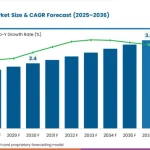


The global advanced driver assist-compatible windshield replacement services market was valued at USD 9.5 billion in 2025 and is poised to cross USD 10.3 billion in 2026. Expanding at a steady Compound Annual Growth Rate (CAGR) of 8.0% between 2026 and 2036, total market revenue is anticipated to scale to USD 22.2 billion by 2036. According to dedicated industry intelligence from Future Market Insights (FMI), the sector will generate an absolute incremental opportunity of USD 11.9 billion over the ten-year forecast period. As front-facing cameras for Automatic Emergency Braking (AEB) and Lane Keep Assist (LKA) become standard equipment across passenger vehicles, automotive glass repair is rapidly transitioning from traditional glass fitting into a technical, highly documented calibration service.
Get detailed market forecasts, competitive benchmarking, and pricing trends:
https://www.futuremarketinsights.com/reports/sample/rep-gb-33142
Key Market Highlights at a Glance
• 2025 Baseline Market Size: USD 9.5 billion
• 2026 Estimated Market Size: USD 10.3 billion
• 2036 Forecasted Market Size: USD 22.2 billion
• Ten-Year Compound Annual Growth Rate (CAGR 2026-2036): 8.0%
• Absolute Incremental Opportunity: USD 11.9 billion
• Leading Vehicle Type Segment (2026 Share): Passenger cars, accounting for a 68.3% market share
• Leading Service Location Segment (2026 Share): Service centers, holding a 58.7% market share
• Leading Service Type Segment (2026 Share): Replacement calibration services, commanding a 47.6% market share
• Fastest-Growing Country Market: India, leading global expansion with a 9.7% CAGR
• Second Fastest-Growing Country Market: China, expanding at an 8.9% CAGR
Why Is the Advanced Driver Assist-Compatible Windshield Replacement Services Market Growing?
Market expansion across the driver assist-compatible windshield replacement ecosystem is driven by three core regulatory, commercial, and technical factors:
• Regulatory Mandates for Front-Facing Safety Cameras: Safety rules like NHTSA’s FMVSS No. 127 mandate AEB on all new passenger cars by September 2029, turning windshield replacement into a controlled repair process with strict target placement standards.
• Insurer Liability and Scrutiny on Calibration Proof: Insurance carriers are tightening claim approvals and requiring verified, post-repair diagnostic scan records to confirm camera calibration before settling glass claims.
• Fleet Uptime Requirements and Camera-Supported Safety: Commercial and logistics fleet operators require standardized calibration workflows to minimize downtime while ensuring delivery vehicles maintain functional active safety features.
“Windshield replacement is no longer a simple glass change for ADAS-ready vehicles,” stated Nikhil Kaitwade, Principal Consultant for Industrial Automation at FMI. “Service providers are required to prove camera aim and glass compatibility in one job record. Chain networks gain a commercial edge once calibration bays and trained technicians are available at claim intake. Independent providers can defend share by building procedure discipline and fast documentation for insurers.”
Advanced Driver Assist-Compatible Windshield Replacement Services Market Segmentation Analysis
Which Vehicle Type Segment Leads Market Revenue?
The passenger cars segment represents the primary vehicle category, projected to account for a 68.3% market share in 2026. High glass replacement frequency paired with rapid fitment of front-facing cameras across mid-segment passenger cars underpins this dominant share. OEM repair guidelines are accelerating this trend; for example, Honda’s 2024 CR-V service instructions specify that any windshield damage within the camera field of view can trigger abnormal safety operations and requires mandatory dealer-level recalibration following glass replacement.
• Passenger Cars: Projected to capture 68.3% share in 2026, driven by high claim volumes and widespread AEB camera adoption.
• Commercial & Light Utility Vehicles: Represent the remaining 31.7% share, supported by expanding camera-equipped delivery fleets.
Which Service Location Segment Commands Highest Market Share?
Dedicated service centers dominate the service location category, forecast to capture a 58.7% market share in 2026. Static camera calibration procedures demand controlled environments with level flooring, precise target distances, and uniform lighting conditions that cannot easily be replicated in mobile setups. While mobile calibration units serve specific dynamic recalibration needs, fixed brick-and-mortar facilities remain the preferred destination for comprehensive static target setups.
• Service Centers: Forecast to hold 58.7% share in 2026 due to controlled environmental conditions required for static camera alignment.
• Mobile Repair Units: Account for the remaining 41.3% share, catering to on-site dynamic road-test calibrations.
Which Service Type Segment Drives Primary Activity?
Replacement calibration services constitute the largest service type, expected to hold a 47.6% market share in 2026. Modern vehicle work orders increasingly combine mechanical glass installation with diagnostic pre-scans, camera alignment, and post-repair verification. Technical mandates reinforce this single-order trend; for instance, official Tesla repair guidelines require calibration data to be cleared and relearned whenever a windshield or front camera assembly is detached.
• Replacement Calibration: Projected to secure 47.6% share in 2026, combining glass refitting with sensor reset labor.
• Standalone Diagnostic & Recalibration Services: Account for the remaining 52.4% combined market share across post-repair checks and standalone camera alignments.
Speak to Analyst: Customize insights for your business strategy:
https://www.futuremarketinsights.com/customization-available/rep-gb-33142
Market Dynamics: Drivers, Restraints, and Trends
Key Market Drivers
Mandatory integration of safety systems, rising insurer requirements for documented repair records, and increasing consumer awareness regarding camera alignment accuracy are primary market drivers.
Key Market Restraints
High initial capital expenditures for multi-brand calibration rigs, ongoing technician training requirements, and spatial limitations in traditional glass repair shops present key operational barriers.
Key Market Trends
Automotive glass service networks are investing heavily in integrated diagnostic scanning tools and digital cloud documentation to provide instant post-calibration certification directly to auto insurers and fleet managers.
Regional Outlook: India and China Lead Global Market Acceleration
• India: Projected CAGR of 9.7% (2026-2036)
• China: Projected CAGR of 8.9% (2026-2036)
• North America & Europe: Mature markets experiencing steady growth driven by regulatory AEB mandates and high insurer penetration.
India Market Dynamics
India leads global country-level expansion with a 9.7% CAGR. Growth is propelled by the rapid urbanization of organized automotive service chains, rising adoption of ADAS features in mass-market passenger cars, and increasing insurer integration with certified repair centers.
China Market Dynamics
China follows closely as the second fastest-growing market, expanding at an 8.9% CAGR. China’s expansion is driven by high connected passenger vehicle sales volume, an expanding domestic fleet of electric vehicles equipped with advanced camera suites, and rising demand for certified glass recalibration.
Latest Automotive Industry Analysis Reports:
https://www.futuremarketinsights.com/industry-analysis/automotive
Competitive Landscape
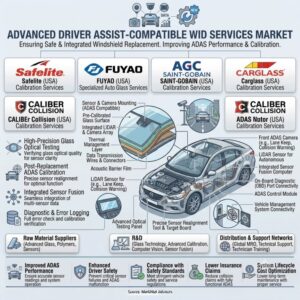
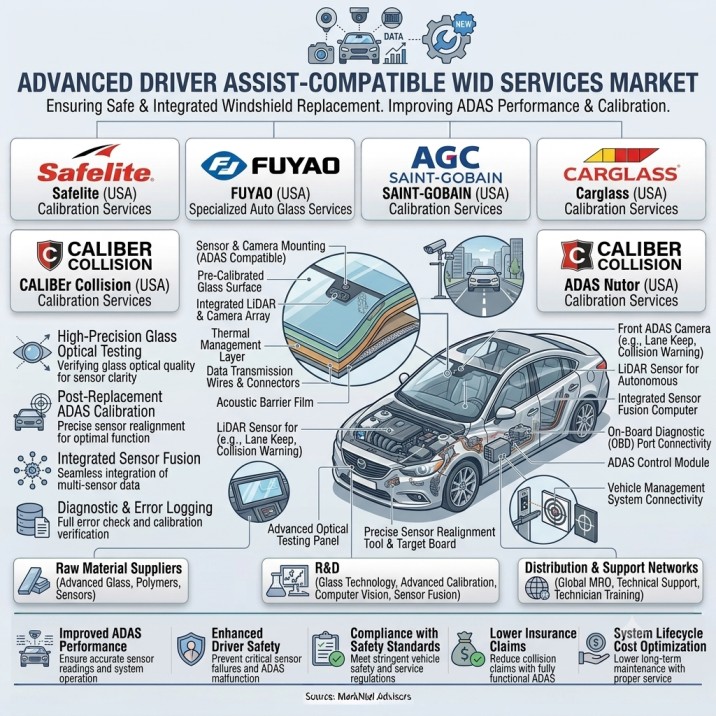
The global advanced driver assist-compatible windshield replacement services market is characterized by consolidated auto glass chains, dealership networks, and specialized calibration service franchisors. Key players maintain competitive advantages by establishing direct insurer billing integration, multi-brand diagnostic capability, and certified technician training programs. Prominent companies in this sector include:
• Belron Group (Safelite AutoGlass / Autoglass): Global leader in vehicle glass repair and replacement, featuring specialized in-house ADAS calibration bays across its nationwide facility network.
• Fuyao Glass Industry Group: Major international automotive glass manufacturer providing OEM-compliant replacement windshields designed for precise camera optical clarity.
• AGC Inc.: Premier global glass producer developing high-transmittance windshield technologies tailored for front-facing sensor suites.
• NSG Group (Pilkington): Leading automotive glass supplier offering comprehensive replacement glass solutions paired with calibration support tools.
• Boyd Group Services Inc. (Gerber Collision & Glass): Major North American operator of collision repair and auto glass centers equipped with integrated ADAS scanning technology.
• Caliber Collision (Caliber Auto Glass): Expansive collision and glass service network delivering centralized, documented ADAS calibration services.
Market competition centers on reducing turnaround times, ensuring flawless camera optical alignment, and offering seamless digital documentation to insurance claims managers.