

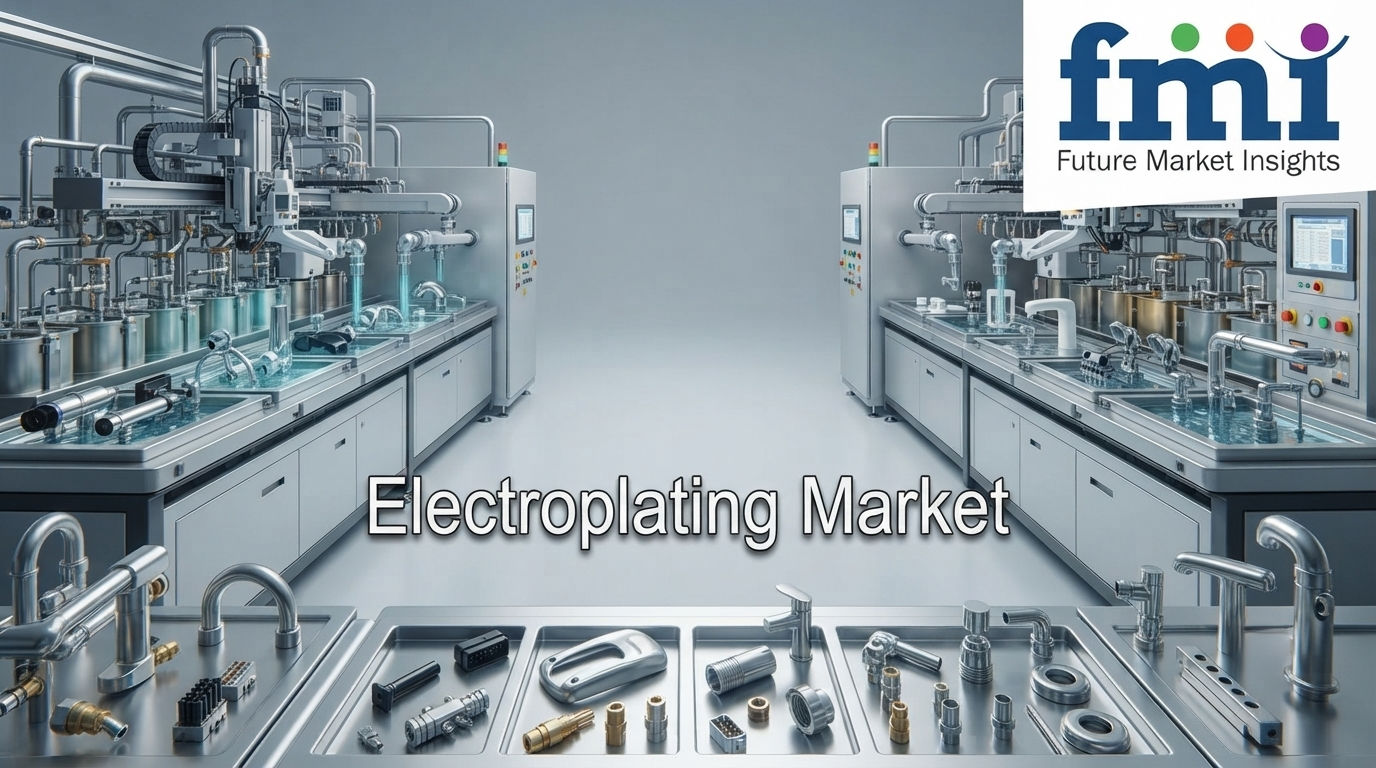
The global electroplating market continues to strengthen its position as an essential segment of modern manufacturing, driven by rising demand for corrosion-resistant components, enhanced product durability, and cost-efficient metal finishing technologies. Electroplating has become a fundamental process across automotive, consumer electronics, industrial machinery, aerospace, and precision engineering industries by enabling manufacturers to improve surface performance while reducing production costs through the selective use of premium metals.
Automotive applications remain one of the strongest demand centers, where corrosion protection has become increasingly important due to stringent durability standards, extended vehicle life cycles, and growing consumer expectations. Metal plating technologies such as zinc-nickel alloy plating and palladium plating are increasingly being adopted to protect critical vehicle components from corrosion, wear, and environmental degradation. At the same time, continuous investments in research and development are encouraging innovation in plating materials, rack designs, and microfabrication technologies.
Market Overview
Electroplating has evolved into one of the most widely used surface engineering technologies across global manufacturing. The process deposits a thin layer of metal onto another substrate using an electrolytic solution and direct current, significantly improving corrosion resistance, electrical conductivity, wear resistance, and product appearance.
Its widespread adoption reflects the growing need for lightweight yet durable products across industries. Rather than manufacturing entire components from expensive metals, manufacturers increasingly use affordable base materials while applying premium metallic coatings only where performance enhancement is required. This approach reduces production costs without compromising product quality or engineering performance.
Key Growth Drivers
- Rising demand for corrosion-resistant automotive components.
- Growing use of electroplating in consumer electronics manufacturing.
- Increasing adoption of zinc-nickel alloy plating for superior corrosion protection.
- Expanding use of palladium plating in catalytic converter production.
- Cost-effective manufacturing through selective use of premium metals.
- Continuous R&D investments in advanced plating materials and processes.
- Growing demand for decorative finishes with enhanced mechanical performance.
- Increasing industrial requirement for customized electroplating rack solutions.
Technology & Innovation Trends
Technological innovation continues to reshape the electroplating market as manufacturers seek higher performance coatings with improved durability and environmental compatibility.
One of the most significant developments is the growing use of zinc-nickel alloy plating, which has become an industry benchmark for automotive corrosion protection. Typical alloy compositions containing approximately 80–94% zinc and 6–20% nickel create a highly protective barrier that significantly delays corrosion. Salt spray testing demonstrates the effectiveness of these coatings, preventing white rust formation for up to 500 hours and red rust for approximately 1,000 hours, making them suitable for brake systems, chassis hardware, steering assemblies, and under-the-hood components.
Market Challenges & Restraints
Despite its expanding applications, the electroplating industry faces several operational and regulatory challenges.
Environmental regulations governing wastewater treatment, hazardous chemicals, and metal waste disposal continue to increase compliance costs for plating facilities. Manufacturers must invest in cleaner production technologies and improved waste management systems while maintaining operational efficiency.
Raw material price volatility, particularly for precious metals such as palladium, also affects production economics. Additionally, maintaining consistent coating thickness, adhesion quality, and process uniformity remains technically demanding for high-precision industrial applications.
Balancing performance, sustainability, and cost efficiency will remain a defining challenge for market participants.
Segment Analysis
The automotive industry continues to dominate electroplating applications due to increasing emphasis on vehicle durability, corrosion prevention, and component longevity.
Zinc-nickel alloy plating represents one of the fastest-growing product categories because it delivers outstanding corrosion protection while providing an attractive chrome-like finish. These coatings are widely used across steering systems, brake components, chassis hardware, and underbody assemblies exposed to aggressive operating environments.
Palladium plating remains indispensable for catalytic converter manufacturing owing to its excellent oxidation resistance and catalytic efficiency. Beyond emissions control systems, palladium also provides exceptional wear resistance for specialized automotive components.
Regional Analysis
North America continues to represent an important electroplating market, supported by advanced automotive manufacturing and stringent corrosion protection requirements. The widespread use of de-icing salts across snow-prone regions has historically accelerated demand for high-performance protective coatings.
Europe maintains strong market demand through its focus on engineering excellence, premium vehicle manufacturing, and environmental compliance. Automotive suppliers continue investing in advanced plating technologies to meet stringent durability standards.
Asia-Pacific is emerging as the fastest-growing regional market, driven by expanding automotive production, consumer electronics manufacturing, industrial automation, and rising investments in advanced manufacturing infrastructure. Countries across the region continue strengthening their position as global manufacturing hubs, creating sustained demand for electroplating services.
Competitive Landscape
Competition within the electroplating market increasingly centers on technological innovation, customized plating solutions, process efficiency, and sustainable manufacturing practices.
Manufacturers are investing heavily in research and development to improve coating performance, expand plating material options, and enhance operational productivity. Custom-designed electroplating racks capable of handling sophisticated industrial components have become an important competitive differentiator, particularly for precision engineering applications.
Strategic partnerships with automotive manufacturers, electronics producers, and industrial equipment companies continue shaping competitive dynamics across the global market.
Leading Companies Analysis
Leading electroplating solution providers are focusing on innovation rather than volume expansion alone. Research efforts increasingly target advanced alloy development, environmentally responsible plating chemistries, automation, and precision coating technologies.
Companies are also expanding their engineering capabilities to deliver application-specific plating services tailored for automotive, electronics, aerospace, medical devices, and industrial manufacturing. Investments in digital process monitoring and quality control systems are further improving coating consistency and operational efficiency.
Investment & Strategic Developments
Industry investment continues to focus on expanding production capabilities, improving plating chemistry, and developing next-generation coating technologies. Manufacturers are allocating greater resources toward advanced alloy experimentation, aluminum electroplating, microfabrication techniques, and customized rack plating systems.
Growing demand from automotive and consumer electronics manufacturers is encouraging suppliers to strengthen production capacity while improving sustainability and manufacturing flexibility.
Future Outlook
The electroplating market is expected to experience sustained long-term growth as manufacturers prioritize corrosion protection, extended component life, lightweight engineering, and cost-effective production strategies.
Future innovation is likely to focus on environmentally responsible plating processes, advanced alloy formulations, precision microstructures, and intelligent manufacturing systems. Increasing adoption across electric vehicles, advanced electronics, industrial automation, and high-performance engineering applications will continue expanding the industry’s addressable market.
As manufacturers seek greater durability, improved aesthetics, and enhanced material performance without significantly increasing production costs, electroplating will remain an indispensable technology across modern manufacturing ecosystems.
FMI Custom Research: Strategic Intelligence for Confident Decision-Making
In today’s rapidly evolving business environment, leadership teams need more than market data—they need clear, actionable intelligence tailored to their strategic objectives. FMI’s Custom Research solutions are designed around the specific business questions organizations need answered, enabling executives to evaluate growth opportunities, validate investments, assess competitive dynamics, and reduce uncertainty before making critical decisions. By combining deep industry expertise, primary research, and proprietary market intelligence, FMI delivers insights that help organizations move from assumptions to evidence-based strategies with greater speed and confidence.
Key Executive Benefits
- Decision-Ready Insights: Research tailored to your specific business challenges, growth plans, and investment priorities.
- Reduced Strategic Risk: Validate market opportunities, customer demand, and competitive positioning before committing resources.
- Market Entry Confidence: Assess opportunity size, regulatory barriers, channel dynamics, and competitive landscapes with precision.
- Competitive Advantage: Gain proprietary intelligence unavailable through syndicated reports or internal datasets.
- Faster Growth Decisions: Accelerate expansion, product development, portfolio optimization, and investment planning.
- Primary Market Validation: Access real-world customer, buyer, and stakeholder insights that support high-confidence decision-making.
- Global Industry Expertise: Powered by 100+ analysts, 20,000+ published reports, and 1.6 million+ hours of research experience.
- Proven Track Record: Over 7,000 market-entry engagements completed across six regions and 14 industry sectors with strong client retention.
Business Impact
FMI helps organizations transform market complexity into strategic clarity, enabling leadership teams to identify growth opportunities faster, optimize resource allocation, strengthen competitive positioning, and make high-stakes business decisions with confidence.
Related Report:
https://www.openpr.com/news/4402592/moisture-detection-stickers-market-forecast-2026-2036-market
https://www.openpr.com/news/4402599/stainless-steel-turning-inserts-market-forecast-2026-2036
About Future Market Insights (FMI)
Future Market Insights, Inc. (FMI) is an ESOMAR-certified, ISO 9001:2015 market research and consulting organization, trusted by Fortune 500 clients and global enterprises. With operations in the U.S., UK, India, and Dubai, FMI provides data-backed insights and strategic intelligence across 30+ industries and 1200 markets worldwide.
Contact Us:
Future Market Insights Inc.
Christiana Corporate, 200 Continental Drive,
Suite 401, Newark, Delaware – 19713, USA
T: +1-347-918-3531
For Sales Enquiries: sales@futuremarketinsights.com
Website: https://www.futuremarketinsights.com