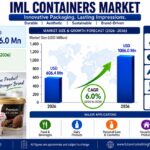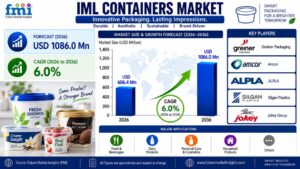


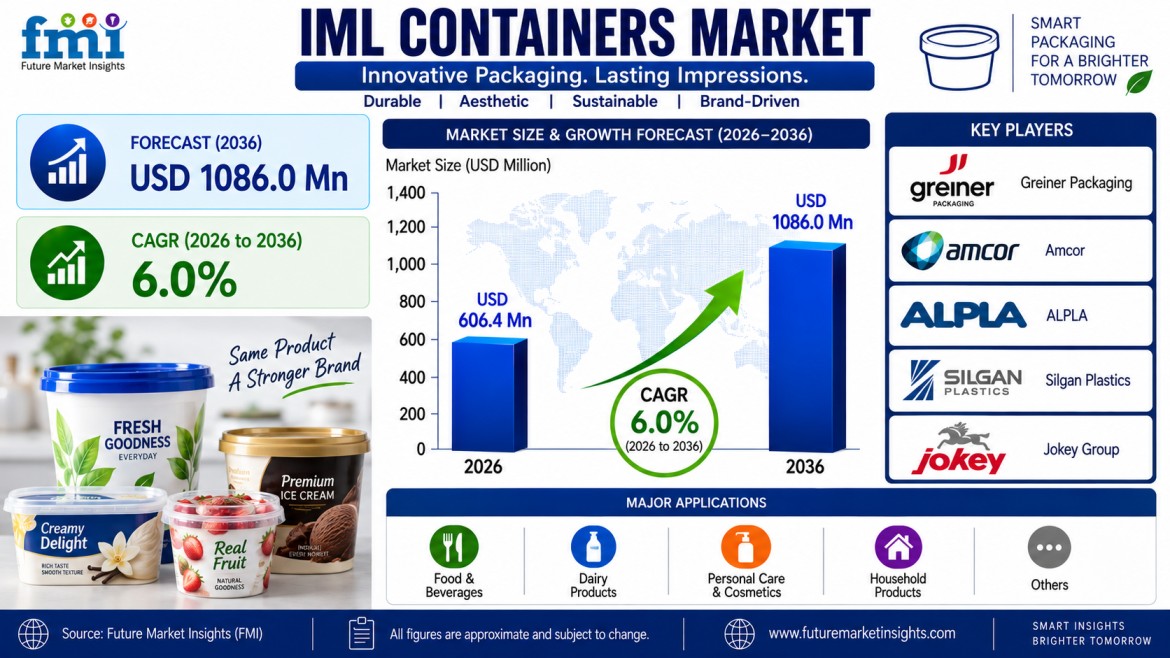
The IML Containers Market is valued at USD 606.4 million in 2026 and is projected to reach USD 1.086 billion by 2036, expanding at a 6.0% CAGR.
Amcor completed its all-stock combination with Berry Global on April 30, 2025, creating a broader packaging platform spanning containers, closures, films and other packaging solutions. Against this changing competitive backdrop
👉 Get Detailed Market Forecasts, Competitive Benchmarking, and Pricing Trends: https://www.futuremarketinsights.com/reports/sample/rep-gb-35275
Why is IML becoming a broader packaging specification issue?
In-mold labeling combines container forming and decoration into an integrated manufacturing process, reducing the need for a separate labeling operation in suitable applications. But the commercial decision increasingly extends beyond decoration efficiency.
Brands evaluating IML containers must consider the complete decorated package: resin selection, label material, inks, molding performance, filling-line compatibility and end-of-life behavior.
FMI estimates that the market will add USD 479.6 million between 2026 and 2036. Standard formats are projected to represent 42.0% of product demand in 2026, while PET & rPET are expected to account for 31.0% of material demand.
The competitive landscape includes Greiner Packaging, Amcor, ALPLA, Silgan Plastics, Jokey Group and Polytainers, with different positions across molded-container production, customer design support, material options and geographic coverage.
Amcor’s combination with Berry Global illustrates the broader scale trend. The transaction, completed April 30, 2025, brought together complementary packaging businesses and was announced with $650 million in identified synergies.
What is changing in IML container qualification?
Recyclability is increasingly evaluated at the package level rather than by looking only at the base resin.
The label and inks can influence the quality and appearance of recycled material, meaning a container that uses a recyclable resin does not automatically provide a straightforward recycling outcome once decoration is added.
That creates a stronger role for joint approval of the container, label construction and artwork. For brands, the qualification process can begin before tooling is committed because changes to resin, decoration or label compatibility can affect production economics later.
The 250–750 ml capacity range is projected to hold 35.0% of capacity demand in 2026. Its position reflects the broad applicability of mid-sized containers across food, spreads, sauces, seasonings and selected household and personal-care products.
Analyst Perspective
“A resin name alone does not establish recyclability. The label, inks and container need to be assessed as one package before the brand commits to production tooling.”
— Nandini Roy Choudhury, Principal Consultant, Future Market Insights
Access detailed market insights: https://www.futuremarketinsights.com/reports/brochure/rep-gb-35275
Where are the commercial opportunities emerging?
Direct brand contracts are projected to account for 51.0% of sales in 2026, reflecting the technical coordination required between container manufacturers, brand owners and filling operations.
An IML program can involve artwork control, mold geometry, label placement, resin selection and filling-line validation in one development process. That makes direct collaboration more valuable than conventional stock-container purchasing for technically demanding applications.
PET & rPET are projected to represent 31.0% of material demand. Transparency, stiffness and access to recycled grades can support retail applications, although each container-label combination still requires qualification.
Greiner Packaging’s February 2025 spice-cup development illustrates the convergence of material choice and decoration. The company’s concepts can be produced through injection molding or thermoforming, use materials including up to 100% rPET, and offer decoration options including IML.
Regional growth also varies considerably. UAE demand is forecast to expand at 7.4% CAGR through 2036, followed by Saudi Arabia at 7.1% and South Korea at 6.8%. Japan is projected to grow at 5.3%, showing a 2.1-percentage-point spread between the fastest and slowest markets in the reported country set.
About the Report
Future Market Insights’ IML Containers Market assessment covers format type, material, capacity, end use and sales channel. The study provides market sizing and forecasts for 2026 to 2036, alongside country-level analysis and competitive assessment.