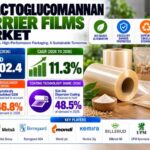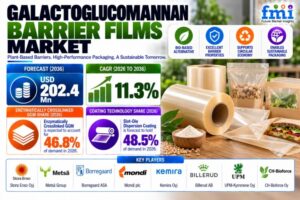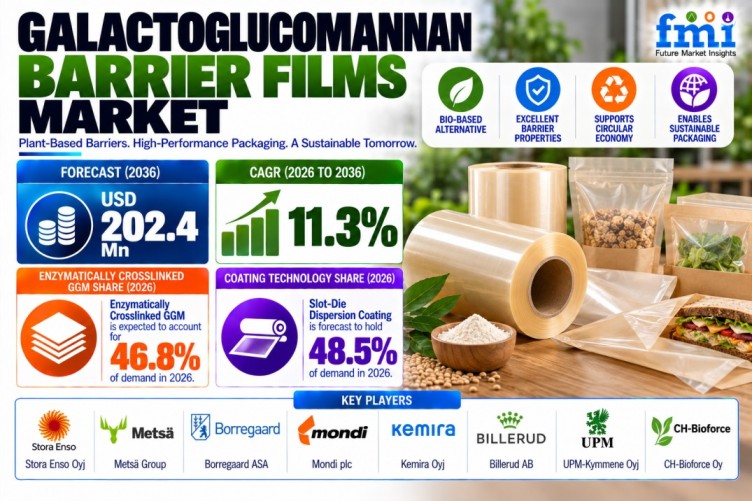
The global Galactoglucomannan Barrier Films Market is projected to grow from US$69.4 million in 2026 to US$202.4 million by 2036, registering a compound annual growth rate (CAGR) of 11.3%, according to Future Market Insights (FMI). The market was valued at US$62.5 million in 2025. The forecast represents an increase of US$133.0 million in annual market value between 2026 and 2036.
Galactoglucomannan (GGM) is a hemicellulose found in softwood, including Norway spruce. Extracted GGM can be formulated into barrier coatings for paper and paperboard packaging. Interest in these materials is growing as packaging producers assess alternatives to conventional plastic laminations and fluorinated grease-resistant treatments, particularly for food packaging that must meet demanding barrier and recyclability requirements.
Galactoglucomannan Barrier Films Market: Key Forecast Highlights
- Market size in 2026: US$69.4 million
- Forecast market size by 2036: US$202.4 million
- CAGR (2026–2036): 11.3%
- Market size in 2025: US$62.5 million
- Leading modification chemistry: Enzymatically crosslinked GGM, projected at 46.8% in 2026
- Leading processing technology: Slot-die dispersion coating, estimated at 48.5% in 2026
- Leading packaging application: Greaseproof bakery wraps, projected at 39.5% in 2026
- Leading substrate: Folding boxboard cartons, forecast at 44.0% in 2026
- Leading sales channel: Direct integrated mill supply, anticipated at 54.0% in 2026
- Fastest-growing profiled country: China, with a projected 12.5% CAGR through 2036
>> Get Detailed Market Forecasts, Competitive Benchmarking, and Pricing Trends: https://www.futuremarketinsights.com/reports/sample/rep-gb-36088
What Is Driving the Galactoglucomannan Barrier Films Market?
Packaging manufacturers are looking for ways to improve the barrier performance of paper-based packaging without compromising recyclability. Conventional plastic laminations can complicate fiber recovery, while certain grease-resistant treatments face increasing regulatory scrutiny. GGM-based coatings offer a potential alternative for selected paper and board applications.
Access to forestry and pulp-processing by-products is another growth driver. Integrated mills can recover hemicellulose from process streams and explore its use as a value-added coating ingredient. This approach creates an opportunity to connect biorefinery operations with paperboard manufacturing, potentially reducing the need to transport and process feedstock at separate facilities.
The commercial opportunity depends on balancing barrier performance with production economics. Coatings must provide suitable resistance to oxygen, oil, and moisture while running reliably on existing paper-coating equipment. Formulation consistency, drying requirements, and performance under elevated humidity remain important considerations for packaging converters.
Enzymatically Crosslinked GGM and Slot-Die Coating Lead Key Segments
Enzymatically crosslinked GGM is projected to account for 46.8% of modification-chemistry demand in 2026. Enzymatic crosslinking can strengthen the polymer network and help improve barrier performance under conditions where untreated hemicellulose films may be more vulnerable to moisture.
Slot-die dispersion coating is estimated to represent 48.5% of processing-technology demand in 2026. The technology enables controlled application of liquid coatings to paper and board, making it relevant for manufacturers seeking to integrate barrier layers into established converting operations.
Greaseproof bakery wraps are forecast to account for 39.5% of packaging end-use demand in 2026. Folding boxboard cartons are expected to represent 44.0% of substrate demand, reflecting the importance of fiber-based formats for dry foods, confectionery, and other packaged products.
Direct integrated mill supply is projected to capture 54.0% of sales-channel demand in 2026. This model can link GGM recovery and coating operations more closely, potentially improving feedstock utilization and reducing intermediate processing requirements.
Regional Opportunities: China and Europe Lead Growth Prospects
FMI’s country-level outlook identifies China and several European markets as important opportunities for GGM barrier films.
- China: Projected CAGR of 12.5% through 2036, supported by demand for alternative packaging materials and potential applications in takeaway food, tea, and coffee packaging.
- Germany: 12.1%, with paper-recycling requirements and food-packaging redesign supporting demand.
- Japan: 11.5%, with opportunities in lightweight packaging for confectionery, tea, and specialty foods.
- Finland: 11.4%, benefiting from its forest-products industry and integrated pulp and paper infrastructure.
- Sweden: 11.2%, supported by softwood processing and interest in converting forestry side streams into higher-value materials.
For suppliers, these forecasts can guide investment screening and partnership development. Integrated mills may be well placed to evaluate extraction and inline coating, while independent converters may benefit from sourcing formulated dispersions from specialty chemical partners.
Top Players in the Galactoglucomannan Barrier Films Market
FMI identifies the following notable companies in the market:
- Stora Enso Oyj
- Metsä Group (Metsä Board / Metsä Spring)
- Borregaard ASA
- Mondi plc
- Kemira Oyj
- Billerud AB
- UPM-Kymmene Oyj (UPM Specialty Papers)
- CH-Bioforce Oy
The competitive landscape spans integrated forest biorefineries, paperboard manufacturers, specialty chemical formulators, and biomass fractionation technology providers. Their roles differ across feedstock recovery, polymer modification, coating formulation, and finished paper production. The list is not a ranking by market share, and inclusion does not imply that every company currently sells a commercial GGM barrier-film product.
FMI highlights investments and development initiatives relevant to the broader wood-based bioproducts ecosystem. These include Stora Enso’s Oulu packaging-board capacity ramp-up, a Metsä Group–Valmet demonstration initiative at Äänekoski, and Borregaard’s approved investment in its Sarpsborg biorefinery. Such developments illustrate the industry’s interest in expanding board production and extracting additional value from forestry resources.
>> Access Detailed Market Insights: https://www.futuremarketinsights.com/reports/galactoglucomannan-barrier-films-market
Strategic Priorities for Packaging Decision-Makers
Three priorities stand out for companies evaluating GGM-based coatings.
First, validate barrier performance under real operating conditions. Oxygen transmission, grease resistance, humidity tolerance, and repulpability should be tested against the specifications of each target application.
Second, evaluate the economics of integration. Mills with access to suitable process streams may be able to reduce intermediate handling, but extraction equipment, purification, formulation, and drying costs must be assessed together.
Third, qualify materials against local recycling and food-contact requirements. Packaging companies should verify the performance of the complete coated structure, including the base substrate, coating weight, additives, and converting processes.
Nandini Roy Choudhury, Principal Analyst at Future Market Insights, said: “Paperboard converters can no longer rely on 15-gram polyethylene extrusion layers or fluorinated grease treatments under European recyclability rules. Biorefineries supplying laccase-crosslinked galactoglucomannan dispersions that run at 45% solids on existing slot-die coaters will capture multi-year supply agreements with multinational food brands.”
MEDIA CONTACT
Contact Person: Media Relations Team
Designation: Corporate Communications
Email: sales@futuremarketinsights.com
Phone: +1-347-918-3531
Website: https://www.futuremarketinsights.com/
ABOUT FUTURE MARKET INSIGHTS
Future Market Insights, Inc. (FMI) is an ESOMAR-certified market research and consulting firm headquartered in Delaware, USA, with offices in the United Kingdom, the United Arab Emirates, and India. FMI delivers syndicated and custom research across food and beverage, healthcare, chemicals, technology, packaging, consumer goods, and industrial sectors. Its research helps organizations assess market opportunities, understand industry developments, and make informed strategic decisions.