

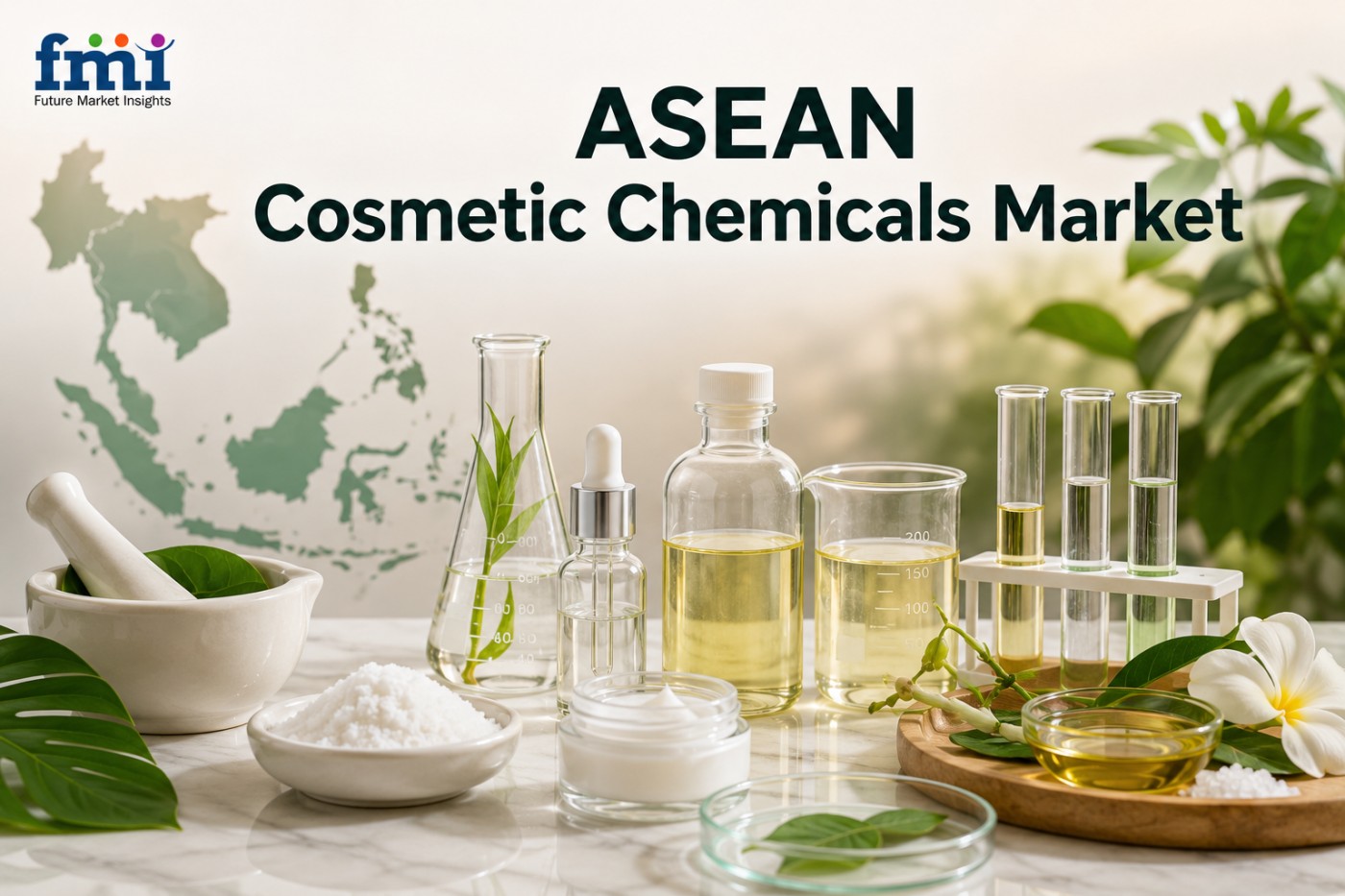
The ASEAN cosmetic ingredients market is entering a critical transformation phase as the region strengthens its position as a global manufacturing and feedstock hub while remaining heavily dependent on imported specialty actives, fragrances, and performance-enhancing ingredient systems.
Across Southeast Asia, abundant palm oil, coconut derivatives, oleochemicals, and contract manufacturing capabilities have enabled countries such as Indonesia, Malaysia, Thailand, and Vietnam to become major suppliers and production centers for personal care and beauty products. However, despite strong upstream advantages, much of the value creation within cosmetic formulations continues to reside with global specialty ingredient suppliers that control high-performance actives, proprietary technologies, formulation systems, and intellectual property.
Market Outlook
Between 2025 and 2035, ASEAN is expected to remain one of the fastest-growing beauty and personal care regions globally, driven by rising disposable incomes, increasing skincare penetration, premiumization trends, e-commerce expansion, and growing consumer focus on wellness and self-care.
However, the industry’s value chain reveals a significant structural imbalance. While base chemistry—including surfactants, fatty alcohols, glycerin, vegetable oils, and oleochemical derivatives—is largely sourced within the region, performance chemistry remains concentrated among multinational suppliers. As a result, a substantial portion of ingredient margins continues to flow outside ASEAN despite growing local manufacturing volumes.
ASEAN Remains a Feedstock and OEM Powerhouse
The region’s competitive advantage continues to stem from its abundant natural resources and manufacturing capabilities.
Indonesia and Malaysia dominate palm-derived feedstocks and oleochemical production, while Thailand and Vietnam have established themselves as major OEM and contract manufacturing hubs serving both regional and international beauty brands.
Yet the economic reality remains clear: many of the ingredients that define product efficacy—including anti-aging actives, skin brightening compounds, specialty polymers, preservation systems, fragrance technologies, and sensory modifiers—are still imported from Europe, North America, Japan, and South Korea.
This creates a persistent value gap where ASEAN supplies volume while global ingredient innovators capture premium margins.
Thailand: OEM Backbone and Imported Innovation
Thailand represents one of the most sophisticated cosmetic manufacturing ecosystems within ASEAN.
Supported by strong domestic consumption, a thriving tourism sector, advanced retail infrastructure, and extensive OEM capabilities, the country has become a major production hub for skincare, haircare, and personal care products.
Despite these strengths, Thailand remains heavily dependent on imported specialty ingredients. While packaging materials, oils, and certain surfactants can be sourced regionally, many of the ingredients responsible for product differentiation continue to originate overseas.
As a result, Thai manufacturers frequently operate as highly efficient assemblers rather than owners of the highest-margin technologies.
Over the next decade, Thailand’s opportunity lies in developing localized ingredient systems tailored to regional skin concerns, climate conditions, and consumer preferences while strengthening domestic testing, validation, and claims-generation capabilities.
Indonesia: Oleochemical Leader and Halal Growth Engine
Indonesia combines one of the world’s largest palm and coconut feedstock bases with a rapidly expanding beauty and personal care market.
The country’s oleochemical industry provides significant cost advantages in fatty acids, fatty alcohols, surfactants, and related base ingredients. However, similar to other ASEAN markets, dependence on imported active ingredients remains substantial.
What differentiates Indonesia is the growing strategic importance of halal certification.
As halal compliance becomes increasingly integrated into product development, ingredient sourcing, and regulatory frameworks, suppliers capable of offering pre-certified ingredient systems gain a competitive advantage.
Halal-compliant surfactants, preservative systems, fragrances, and formulation packages increasingly represent a higher-value segment where compliance expertise becomes as important as chemistry itself.
Indonesia’s long-term opportunity lies not only in expanding oleochemical capacity but in becoming ASEAN’s leading halal-functional ingredient hub.
Malaysia: From Commodity Feedstocks to Functional Ingredient Systems
Malaysia continues to play a pivotal role within the regional ingredient supply chain through its highly integrated oleochemical infrastructure.
The country exports significant volumes of palm-derived fatty alcohols, glycerin, esters, and surfactants into global personal care markets. While this provides scale advantages, profitability often remains tied to commodity pricing cycles, feedstock costs, and sustainability requirements.
Potential growth areas include:
- Mild surfactant systems
- Sensory emollient blends
- Specialty esters
- Preservative enhancement technologies
- Climate-specific skincare ingredients
Vietnam and the Philippines: Fast-Growth Beauty Markets Facing Margin Pressure
Vietnam and the Philippines are emerging as some of the region’s fastest-growing beauty consumption markets.
Growing middle-class populations, increasing digital commerce penetration, expanding retail networks, and rising demand for skincare products continue supporting strong market expansion.
However, both markets remain highly dependent on imported specialty ingredients and advanced packaging systems.
OEM manufacturers frequently operate within narrow margin structures while competing against multinational brands possessing greater marketing resources and stronger formulation technologies.
Singapore: The Region’s Regulatory and Commercial Command Center
Singapore occupies a unique position within the ASEAN cosmetic ingredients ecosystem.
Although it is not a major manufacturing location, the city-state serves as the regional headquarters, regulatory management center, trading hub, and technical coordination platform for many global specialty ingredient companies.
Commercial pricing decisions, regulatory compliance strategies, technical support programs, and ingredient approval processes often originate from Singapore-based teams.
As a result, Singapore captures value through intellectual property, regulatory expertise, commercial management, and technical services rather than production volume.
Product Innovation and Emerging Opportunities
The most attractive growth opportunities within ASEAN’s cosmetic ingredients sector are increasingly concentrated in highly specialized niches rather than broad commodity categories.
Key innovation opportunities include:
- Problem-specific ingredient systems designed for tropical climates
- Halal-certified formulation platforms
- ESG-compliant ingredient documentation services
- Regional efficacy and stability testing databases
- Digital formulation and ingredient selection tools
- Functional emollient and surfactant systems
- Localized claim-supported active ingredient blends
These categories offer significantly higher margins than traditional feedstock-based products while addressing growing regulatory and consumer requirements.
Challenges Facing the Industry
Despite favorable growth prospects, several challenges continue to influence ASEAN’s cosmetic ingredient landscape.
Dependence on imported specialty actives exposes manufacturers to exchange-rate volatility, supply chain disruptions, and pricing fluctuations.
Regulatory complexity across multiple ASEAN markets increases compliance costs, while evolving sustainability expectations require greater investment in traceability, certification, and environmental reporting.
Regional Value Chain Dynamics
The ASEAN cosmetic ingredients market increasingly operates through a multi-layered value structure:
- Indonesia and Malaysia dominate feedstock and oleochemical production.
- Thailand and Vietnam serve as major OEM and manufacturing hubs.
- The Philippines acts as a rapidly expanding consumption market.
- Singapore functions as the region’s regulatory, commercial, and technical coordination center.
Competitive Landscape and Future Outlook
The competitive environment is expected to evolve significantly through 2035 as ASEAN participants seek greater control over formulation technologies, compliance services, and ingredient innovation.
Future winners are likely to be organizations that successfully bridge the gap between commodity feedstocks and premium specialty ingredients.
Rather than competing directly with multinational ingredient giants across entire portfolios, successful regional players will focus on targeted opportunities where local expertise, climate-specific formulations, halal capabilities, regulatory knowledge, and application support create sustainable differentiation.
Conclusion: Specialty Systems, Compliance Platforms, and Local IP Will Define ASEAN’s Next Growth Phase
The ASEAN cosmetic ingredients market is moving beyond its traditional role as a low-cost manufacturing and feedstock base.
While palm-derived oleochemicals, contract manufacturing, and export-oriented production will remain essential foundations of the industry, future value creation will increasingly depend on functional ingredient systems, regulatory capabilities, compliance infrastructure, localized innovation, and proprietary intellectual property.
Companies that successfully develop halal-ready ingredient platforms, climate-specific formulation systems, regional testing capabilities, and specialized application expertise will be best positioned to capture higher-margin opportunities throughout the next decade.
Explore More Related Studies Published by FMI Research:
https://www.einpresswire.com/shareable-preview/8lyRi7KtCAFNkLWTx1ZbLg
https://www.einpresswire.com/shareable-preview/IGwBlSadllm0o1Dnbj9Plw
https://www.einpresswire.com/shareable-preview/DvQ05S9htXr52ZVIbydt4g
FMI Custom Research: Strategic Intelligence for Confident Decision-Making
In today’s rapidly evolving business environment, leadership teams need more than market data—they need clear, actionable intelligence tailored to their strategic objectives. FMI’s Custom Research solutions are designed around the specific business questions organizations need answered, enabling executives to evaluate growth opportunities, validate investments, assess competitive dynamics, and reduce uncertainty before making critical decisions. By combining deep industry expertise, primary research, and proprietary market intelligence, FMI delivers insights that help organizations move from assumptions to evidence-based strategies with greater speed and confidence.
Key Executive Benefits
- Decision-Ready Insights: Research tailored to your specific business challenges, growth plans, and investment priorities.
- Reduced Strategic Risk: Validate market opportunities, customer demand, and competitive positioning before committing resources.
- Market Entry Confidence: Assess opportunity size, regulatory barriers, channel dynamics, and competitive landscapes with precision.
- Competitive Advantage: Gain proprietary intelligence unavailable through syndicated reports or internal datasets.
- Faster Growth Decisions: Accelerate expansion, product development, portfolio optimization, and investment planning.
- Primary Market Validation: Access real-world customer, buyer, and stakeholder insights that support high-confidence decision-making.
- Global Industry Expertise: Powered by 100+ analysts, 20,000+ published reports, and 1.6 million+ hours of research experience.
- Proven Track Record: Over 7,000 market-entry engagements completed across six regions and 14 industry sectors with strong client retention.
Business Impact
FMI helps organizations transform market complexity into strategic clarity, enabling leadership teams to identify growth opportunities faster, optimize resource allocation, strengthen competitive positioning, and make high-stakes business decisions with confidence.
About Future Market Insights (FMI)
Future Market Insights, Inc. (ESOMAR certified, recipient of the Stevie Award, and a member of the Greater New York Chamber of Commerce) provides deep insights into governing factors elevating demand in the market. FMI stands as a leading global provider of market intelligence, consulting services, and syndicated research reports across chemicals, materials, energy, industrial automation, sustainability, and renewable energy sectors.
Contact
Future Market Insights Inc.
Christiana Corporate, 200 Continental Drive, Suite 401, Newark, Delaware 19713, USA