

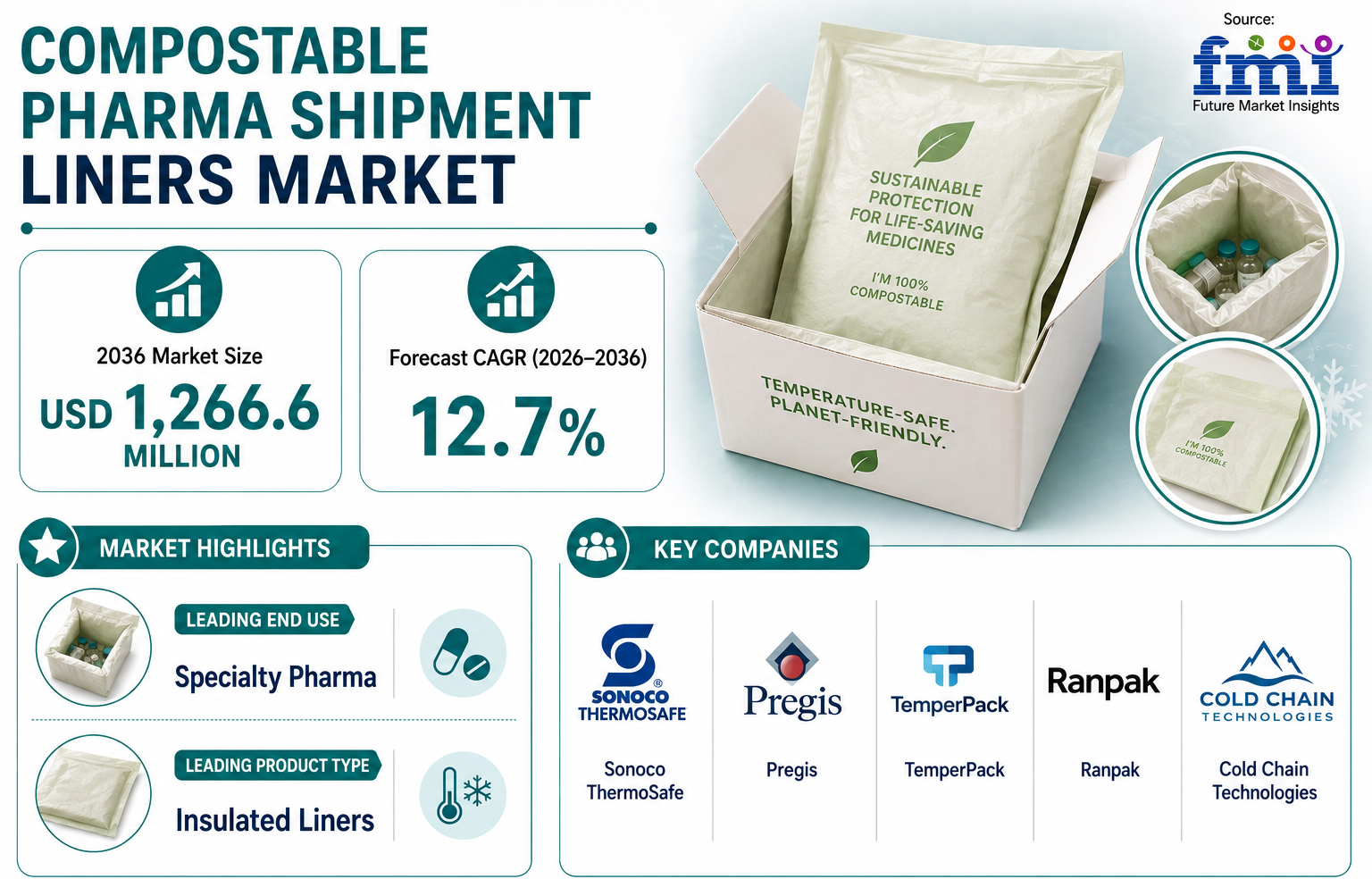
The Compostable Pharma Shipment Liners Market is poised for substantial growth as the pharmaceutical industry increasingly prioritizes sustainable cold-chain packaging solutions without compromising product safety and temperature control. According to Future Market Insights (FMI), the market is projected to grow from USD 383.2 million in 2026 to USD 1,266.6 million by 2036, registering a strong CAGR of 12.7% during the forecast period. Rising pharmaceutical exports, stricter environmental regulations, and the growing demand for biologics, vaccines, and specialty medicines are accelerating the adoption of compostable shipment liners worldwide.
Compostable Pharma Shipment Liners Market Driven by Sustainable Cold-Chain Logistics
Pharmaceutical products often require strict temperature-controlled transportation to preserve their efficacy and comply with regulatory standards. Traditionally, insulated shipping systems have relied heavily on plastic foams and synthetic insulation materials. However, increasing environmental concerns and government regulations are encouraging pharmaceutical manufacturers and logistics providers to shift toward compostable packaging alternatives.
Compostable pharma shipment liners provide reliable thermal insulation while significantly reducing plastic waste. Manufactured using renewable materials such as cellulose wadding, molded pulp, recycled paper, and compostable coated fibers, these liners support sustainable pharmaceutical logistics without sacrificing packaging performance. As global pharmaceutical companies strengthen their environmental commitments, demand for compostable shipment solutions continues to rise across both developed and emerging markets.
Rising Biopharmaceutical Shipments Create New Growth Opportunities
The rapid expansion of biologics, specialty pharmaceuticals, vaccines, and clinical trial products has increased the need for high-performance insulated packaging. Many of these products require consistent temperature control throughout transportation, making advanced shipment liners essential for maintaining product quality.
In addition, pharmaceutical companies are facing increasing pressure to reduce the environmental footprint of their supply chains. Compostable shipment liners offer an effective solution by combining reliable thermal protection with environmentally responsible materials. Buyers are increasingly evaluating packaging solutions based on thermal efficiency, compression strength, drop performance, material certification, and waste reduction capabilities before approving large-scale procurement.
The continued growth of direct-to-patient drug delivery, specialty pharmacy services, and international pharmaceutical distribution is expected to further strengthen market demand throughout the forecast period.
Insulated Liners Continue to Lead Product Demand
Among product categories, Insulated Liners are expected to account for 32.8% of the global market in 2026, making them the dominant product segment. Their widespread adoption is driven by excellent insulation performance, lightweight construction, ease of integration into existing shipping systems, and compatibility with pharmaceutical cold-chain operations.
Insulated liners provide consistent temperature stability for sensitive healthcare products while reducing reliance on petroleum-based insulation materials. Manufacturers continue investing in innovative fiber technologies and multi-layer insulation systems to improve thermal efficiency while maintaining compostability.
Other product categories, including panel liners, validated liners, wrap liners, and multi-layer liners, are also witnessing increased demand for specialized pharmaceutical packaging applications requiring enhanced protection.
Cellulose Wadding Emerges as the Leading Material
Material innovation remains a major focus area within the compostable pharma shipment liners market. Cellulose wadding is projected to capture 32.2% of the global market in 2026, making it the leading material segment.
Cellulose-based insulation offers excellent thermal resistance, high cushioning performance, biodegradability, and renewable sourcing advantages. Pharmaceutical companies increasingly prefer cellulose materials because they support sustainability initiatives while meeting demanding transportation performance requirements. Recycled paper, molded pulp, paper-faced insulation, and compostable coated materials are also gaining popularity as manufacturers diversify their environmentally friendly packaging portfolios.
Temperature-Controlled Shipments Drive Demand for 2–8°C Packaging
By thermal performance, the 2–8°C temperature range is expected to account for 33.1% of the market in 2026, making it the largest thermal performance segment. This range is widely used for vaccines, biologics, insulin, specialty medicines, and numerous temperature-sensitive pharmaceutical products.
Maintaining consistent temperatures during transportation remains critical for regulatory compliance and product integrity. Compostable shipment liners designed for 2–8°C applications help pharmaceutical companies minimize spoilage risks while supporting sustainability objectives. Continuous advancements in insulation technology are enabling compostable materials to deliver thermal performance comparable to conventional plastic-based packaging systems.
Specialty Pharmaceuticals Generate Strong Market Demand
Among end-use segments, Specialty Pharma is projected to hold 35.6% of the global market in 2026. Specialty medicines often involve high-value therapies that require strict temperature management and secure transportation throughout the supply chain.
Any shipment failure can result in substantial financial losses, regulatory complications, and potential risks to patient health. Consequently, pharmaceutical companies are increasingly investing in validated compostable packaging systems that provide consistent thermal protection while reducing environmental impact.
Demand is also expanding across vaccine distribution, biologics, diagnostic products, and clinical trial logistics as healthcare providers strengthen cold-chain infrastructure worldwide.
India Leads Future Market Growth
Geographically, India is expected to be the fastest-growing market, registering a CAGR of 11.7% through 2036. Rapid pharmaceutical manufacturing expansion, increasing vaccine production, and government support for healthcare infrastructure are driving adoption of sustainable shipment packaging across the country.
China is also expected to experience significant growth as pharmaceutical exports continue expanding alongside domestic healthcare investments. Meanwhile, North America and Europe remain major revenue-generating markets due to strict pharmaceutical regulations, advanced cold-chain logistics, and increasing sustainability commitments among global healthcare companies.
Countries including Germany, the United Kingdom, Japan, and South Korea continue investing in environmentally responsible pharmaceutical packaging while maintaining stringent quality and regulatory standards.
Competitive Landscape
Competition within the Compostable Pharma Shipment Liners Market is focused on insulation performance, regulatory compliance, sustainability, and global supply capabilities. Leading manufacturers are investing in advanced fiber technologies, validated thermal packaging systems, and expanded production capacity to strengthen their market positions.
Major companies operating in the market include Sonoco ThermoSafe, Pregis, TemperPack, Ranpak, Cold Chain Technologies, Smurfit Westrock, DS Smith, and Stora Enso. These companies continue to develop innovative compostable packaging solutions that combine temperature control with reduced environmental impact while supporting pharmaceutical manufacturers across global supply chains.
Strategic collaborations, product innovation, manufacturing expansion, and sustainable material development remain key competitive strategies as demand for eco-friendly pharmaceutical packaging accelerates.
Future Outlook
The Compostable Pharma Shipment Liners Market is entering a period of sustained expansion as pharmaceutical companies seek packaging solutions that balance product protection with environmental responsibility. With the market expected to reach USD 1,266.6 million by 2036, manufacturers are increasingly focused on improving insulation efficiency, validating packaging performance, and meeting evolving global sustainability regulations.
Growing adoption across vaccines, biologics, specialty pharmaceuticals, diagnostics, and clinical trial logistics is expected to generate significant long-term opportunities. As healthcare organizations continue reducing their environmental footprint while maintaining strict cold-chain standards, compostable pharma shipment liners are likely to become an integral part of the next generation of pharmaceutical packaging solutions.
Related Research Reports
Pharmaceutical Contract Packaging Market: The Pharmaceutical Contract Packaging Market is projected to reach USD 14.0 billion by 2035, registering a compound annual growth rate (CAGR) of 7.1% over the forecast period.
Pharmaceuticals Pouch Market: The pharmaceuticals pouch market is set to reach USD 7.7 billion by 2026-end and grow at a CAGR of 7.5% between 2026-2036 to reach USD 16.0 billion by 2036.
Pharmaceutical Plastic Pots Market: The Pharmaceutical Plastic Pots Market is projected to reach USD 3.3 billion by 2035, registering a compound annual growth rate (CAGR) of 7.5% over the forecast period.
About Future Market Insights (FMI)
Future Market Insights is a leading provider of market intelligence, consulting services, and syndicated research reports. FMI delivers actionable insights across packaging, logistics, industrial manufacturing, food and beverage, healthcare, chemicals, and emerging technologies, helping organizations identify growth opportunities and make informed strategic decisions in rapidly evolving markets.
Economics
Contact
Future Market Insights Inc.
Christiana Corporate
200 Continental Drive, Suite 401
Newark, Delaware 19713, USA
Email: sales@futuremarketinsights.com
Website: www.futuremarketinsights.com