

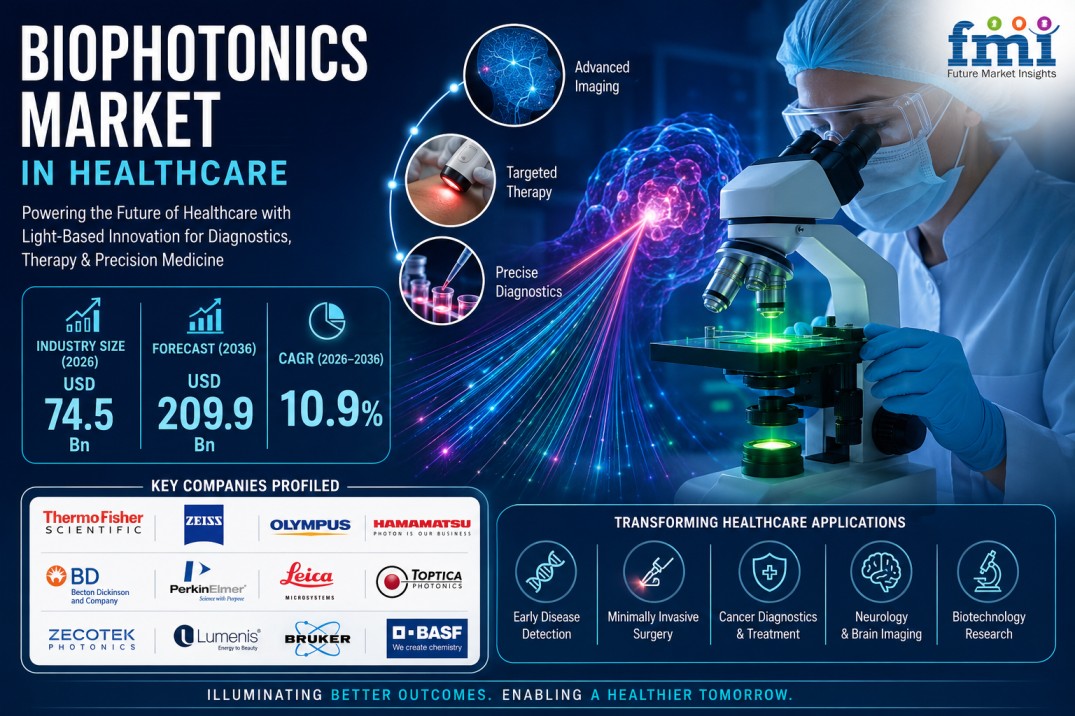
NEWARK, Del., July 13, 2026 — The global Chemicals & Materials industry is rapidly embracing next-generation optical technologies, with the Biophotonics Market emerging as a cornerstone of precision diagnostics, image-guided therapies, and non-invasive disease detection. According to Future Market Insights (FMI), the global Biophotonics Market is projected to grow from USD 74.5 billion in 2026 to USD 209.9 billion by 2036, registering a robust 10.9% CAGR during the forecast period. Increasing adoption of AI-enhanced imaging platforms, rapid advances in biosensor miniaturization, expanding applications of optical coherence tomography (OCT), and growing demand for minimally invasive diagnostics are expected to accelerate market growth worldwide.
The market is expected to create an absolute dollar opportunity of USD 135.4 billion between 2026 and 2036. Rising regulatory approvals for photonic diagnostic systems, increasing investments in cancer detection technologies, expanding point-of-care testing capabilities, and continuous innovation in fluorescence imaging and optical biosensors continue to strengthen long-term industry growth.
Key Biophotonics Market Highlights at a Glance
- Market Size (2026): USD 74.5 Billion
- Forecast Market Size (2036): USD 209.9 Billion
- Forecast Period: 2026–2036
- CAGR (2026–2036):9%
- Absolute Dollar Opportunity: USD 135.4 Billion
- Leading Application: See-Through Imaging and Biosensors (Combined 60% Market Share)
- Leading Technology: In-vivo Imaging
- Leading Region: North America (40% Market Share)
- Key Segments Covered: Application, Technology, End User, Region
- Report Pages: 342
- Last Updated: February 20, 2026
- Reviewed by: Nikhil Kaitwade
Why Is the Biophotonics Market Growing?
The market is experiencing transformational growth as healthcare providers, research institutions, and life science companies increasingly adopt advanced optical technologies for early disease detection, precision imaging, and minimally invasive therapeutic procedures.
Key Growth Drivers
- Growing adoption of AI-powered optical imaging systems.
- Rising demand for non-invasive diagnostic technologies.
- Increasing applications of optical coherence tomography (OCT).
- Expansion of fluorescence-guided surgical procedures.
- Miniaturization of photonic biosensors for point-of-care testing.
- Rising investments in cancer diagnostics and precision medicine.
- Accelerating regulatory approvals for photonic medical devices.
- Growing healthcare and life sciences research funding globally.
As healthcare systems prioritize earlier diagnosis and personalized treatment, biophotonics technologies continue expanding across diagnostics, therapeutics, and biomedical research.
According to Nikhil Kaitwade, Principal Consultant for Chemicals and Materials Industry at Future Market Insights, “The biophotonics market is evolving from conventional imaging hardware toward AI-integrated optical platforms that combine advanced image reconstruction, biosensing, and precision diagnostics. Companies that establish multi-jurisdictional regulatory pathways while developing modular and upgradeable systems are expected to capture significant competitive advantages over the coming decade.”
Which Application Segment Leads the Biophotonics Market?
See-Through Imaging and Biosensors together account for nearly 60% of global market demand, supported by their expanding use in disease diagnosis, precision imaging, molecular detection, and real-time biological analysis.
Increasing adoption across oncology, ophthalmology, neurology, and cardiovascular diagnostics continues strengthening demand for advanced optical technologies.
Application Segment Highlights
- See-through imaging remains a key diagnostic application.
- Biosensors expand point-of-care testing capabilities.
- Non-invasive imaging improves diagnostic accuracy.
- Molecular imaging supports precision medicine initiatives.
Why Does In-vivo Imaging Dominate the Technology Segment?
In-vivo imaging remains the leading technology due to its widespread adoption in real-time surgical navigation, neuroscience research, oncology diagnostics, and minimally invasive medical procedures.
Advancements in fluorescence imaging, OCT, and multimodal optical systems continue improving image quality while enhancing clinical decision-making.
Technology Segment Highlights
- In-vivo imaging leads technology adoption.
- Real-time imaging supports precision surgery.
- AI-assisted reconstruction enhances image interpretation.
- Integration with robotic surgery improves workflow efficiency.
How Is Artificial Intelligence Transforming Biophotonics?
Artificial intelligence is reshaping the biophotonics ecosystem by enabling automated image reconstruction, faster disease detection, enhanced tissue classification, predictive analytics, and improved clinical workflow integration across diagnostic and therapeutic applications.
Technology Highlights
- AI improves image reconstruction and analysis.
- Optical coherence tomography enables high-resolution diagnostics.
- Fluorescence imaging supports image-guided surgery.
- Biosensor miniaturization expands decentralized healthcare.
- Cloud-connected imaging platforms improve clinical collaboration.
- Multimodal imaging enhances diagnostic confidence.
Market Dynamics
Market Drivers
Growing investments in precision medicine, increasing adoption of AI-enabled optical diagnostics, expanding cancer screening programs, rising demand for minimally invasive procedures, and continuous advancements in biosensor technologies continue driving market growth.
Market Restraints
High capital investment requirements, reimbursement variability, regulatory complexity, hospital budget constraints, and lengthy clinical validation timelines continue posing challenges for manufacturers.
Market Trends
Innovation continues redefining the global biophotonics industry.
Major trends include:
- AI-enhanced optical imaging systems.
- Expansion of point-of-care photonic diagnostics.
- Miniaturized wearable biosensors.
- Growth of fluorescence-guided surgery.
- Integration of multimodal imaging technologies.
- Development of modular and upgradeable imaging platforms.
Regional and Country Outlook
North America continues to dominate the global Biophotonics Market with approximately 40% market share, supported by strong research funding, advanced healthcare infrastructure, favorable regulatory pathways, and rapid adoption of precision diagnostic technologies.
Europe remains an important market due to increasing investments in medical imaging research and regulatory harmonization between FDA and EMA standards.
Asia-Pacific is expected to experience strong growth driven by expanding healthcare infrastructure, increasing biomedical research investments, growing medical device manufacturing, and rising adoption of advanced diagnostic technologies.
Emerging markets continue creating new opportunities as governments invest in decentralized healthcare systems and point-of-care diagnostic solutions.
Competitive Landscape
Competition remains highly innovation-driven, with leading companies focusing on AI-enabled imaging platforms, biosensor development, optical diagnostics, strategic acquisitions, regulatory expansion, and next-generation photonic technologies to strengthen their global market positions.
Key Companies
- Thermo Fisher Scientific Inc.
- Carl Zeiss AG
- Olympus Corporation
- Hamamatsu Photonics K.K.
- BD (Becton Dickinson and Company)
- PerkinElmer Inc.
- Leica Microsystems
- Toptica Photonics AG
- Zecotek Photonics Inc.
- Lumenis Ltd.
- Bruker Corporation
- BASF SE
Frequently Asked Questions
- What is the projected size of the Biophotonics Market by 2036?
The global Biophotonics Market is projected to reach USD 209.9 billion by 2036, growing from USD 74.5 billion in 2026.
- What is the expected CAGR of the Biophotonics Market?
The market is forecast to expand at a 10.9% CAGR between 2026 and 2036.
- Which application segment dominates the market?
See-Through Imaging and Biosensors collectively account for nearly 60% of total market demand.
- Which technology leads the market?
In-vivo imaging remains the leading technology owing to its broad use in real-time diagnostics and image-guided surgical procedures.
- What factors are driving market growth?
Growing adoption of AI-powered optical imaging, increasing demand for non-invasive diagnostics, biosensor miniaturization, rising investments in precision medicine, expanding fluorescence-guided surgery, and accelerating regulatory approvals continue driving global market growth.
Related Reports
- The demand for massoia bark essential oil in united kingdom is projected to grow from USD 76.6 million in 2026 to USD 112.3 million by 2036, at a CAGR of 3.9%.
- The linear alpha olefin market is forecast to rise from USD 8.0 billion in 2025 to USD 15.2 billion by 2036 at 6.0% CAGR.
- The portfolio-wide PVC decarbonization solutions for building product brands market is projected to grow from USD 6.5 billion in 2026 to USD 17.6 billion by 2036, at a CAGR of 10.5%.
About Future Market Insights (FMI)
Future Market Insights, Inc. (ESOMAR certified, recipient of the Stevie® Award, and a member of the Greater New York Chamber of Commerce) provides deep insights into governing factors elevating demand in global markets.
FMI delivers market intelligence, consulting services, and syndicated research reports across healthcare, pharmaceuticals, chemicals, materials, food ingredients, industrial manufacturing, sustainability, and advanced materials sectors.
With global expertise and industry-focused research capabilities, FMI provides actionable insights that help organizations understand market dynamics and identify emerging opportunities.
Contact
Future Market Insights Inc.
Christiana Corporate, 200 Continental Drive, Suite 401, Newark, Delaware 19713, USA
Rahul Singh
AVP – Marketing and Growth Strategy
Future Market Insights, Inc.
Phone: +91 8600020075
For Sales – sales@futuremarketinsights.com
For Media – Rahul.singh@futuremarketinsights.com
Website: www.futuremarketinsights.com