

According to the latest insights by Future Market Insights, the global Wearable Blood Pressure Monitor industry is witnessing rapid expansion as healthcare providers, remote monitoring programs, and digital health ecosystems increasingly prioritize continuous monitoring, preventive intervention, and value-based care delivery. In 2026, rising demand for scalable chronic disease management solutions is driving strong market growth worldwide.
Industry analysts indicate that while wearable blood pressure monitors initially gained traction as convenient monitoring devices, long-term market growth is increasingly shaped by remote patient management, reimbursement alignment, clinical outcome improvement, and digital ecosystem integration. Companies capable of delivering highly accurate, connected, and outcome-driven monitoring solutions are expected to strengthen their competitive positioning in the evolving healthcare technology landscape.
Rising Demand for Continuous Cardiovascular Monitoring Drives Market Growth
Wearable blood pressure monitoring is becoming a critical component of chronic disease management, supporting preventive care, telehealth programs, and long-term cardiovascular risk reduction.
Growing demand contributes to:
- Increased remote hypertension management
• Higher adoption in preventive care programs
• Rising investments in digital health infrastructure
• Greater focus on reducing hospitalizations
• Increased demand for continuous patient monitoring
Hypertension remains one of the leading risk factors for cardiovascular disease globally, creating strong demand for technologies that enable continuous and real-time monitoring outside traditional clinical settings.
As healthcare systems shift toward proactive intervention, providers increasingly prioritize technologies that improve long-term patient visibility and treatment adherence.
Traditional Blood Pressure Monitoring Limitations Accelerate Wearable Adoption
Conventional blood pressure monitoring methods often provide limited episodic readings and fail to capture fluctuations throughout the day.
Key challenges include:
- Infrequent measurements
• White-coat hypertension effects
• Poor patient compliance
• Limited longitudinal data
• Delayed intervention opportunities
Periodic office-based measurements may miss critical blood pressure variations, reducing the ability of clinicians to identify emerging cardiovascular risks early.
In value-based healthcare environments, limited monitoring creates operational inefficiencies, delayed care adjustments, and increased hospitalization risks.
As providers seek improved clinical visibility, demand is rising for wearable solutions that enable continuous monitoring and early intervention.
Wearable Monitors Improve Monitoring Continuity and Clinical Visibility
Wearable blood pressure monitors address traditional monitoring limitations by enabling real-time and longitudinal physiological tracking.
Key wearable benefits include:
- Continuous blood pressure measurement
• Real-time alerts and trend detection
• Improved patient adherence
• Remote clinician oversight
• Better longitudinal health insights
These devices improve hypertension management by providing continuous datasets that allow clinicians to detect abnormalities earlier and adjust therapies more effectively.
Integrated connectivity and automated data transmission reduce manual reporting burdens and improve patient-provider engagement.
Wearable monitoring is particularly valuable for chronic disease populations requiring ongoing observation and intervention.
Value-Based Care Strengthens Market Demand
Value-based healthcare models are increasingly driving demand for monitoring technologies that improve outcomes while reducing care costs.
Healthcare organizations are prioritizing:
- Preventive intervention strategies
• Reduced emergency admissions
• Improved hypertension control rates
• Better patient engagement
• Outcome-driven reimbursement alignment
Wearable blood pressure monitors directly support these goals by enabling earlier detection of blood pressure changes and facilitating timely therapeutic adjustments.
Healthcare providers are increasingly evaluating devices based not only on acquisition cost, but also on their ability to improve long-term clinical outcomes and reduce healthcare utilization.
As a result, demand growth is increasingly linked to measurable economic and clinical value.
Pricing Dynamics Shift Toward Outcome-Based Purchasing
Procurement strategies are evolving under value-based care frameworks.
Healthcare buyers increasingly evaluate:
- Clinical outcome improvements
• Long-term cost savings
• Workflow efficiency gains
• Platform interoperability
• Analytics capabilities
Historically, purchasing decisions focused heavily on hardware specifications and upfront costs.
Today, healthcare providers increasingly prefer integrated monitoring ecosystems that combine hardware, analytics, remote dashboards, and clinical workflow integration.
This transition is putting pressure on hardware-only manufacturers while creating pricing advantages for vendors offering full-service monitoring platforms.
Manufacturers unable to demonstrate clear economic value may face increasing margin pressure in premium healthcare segments.
Segment Insights Highlight Strong Demand for Wrist-Based Devices
Segment analysis indicates strong market concentration in patient-friendly wearable formats and chronic disease applications.
Key segment highlights include:
- Wrist-based monitors — 55.0% market share in 2026
• Hypertension monitoring — 60.0% application share
• Oscillometric technology — 70.0% technology share
• Growing smartwatch integration
• Increasing consumer adoption
Wrist-based monitors dominate due to superior comfort, ease of use, and stronger long-term adherence.
Hypertension monitoring remains the leading application, reflecting the growing strategic importance of continuous blood pressure tracking in chronic disease management programs.
Oscillometric technology continues to lead due to established clinical accuracy, broad regulatory approvals, and compatibility with wearable device form factors.
Procurement and Buyer Behavior Favor Integrated Ecosystems
Healthcare procurement decisions increasingly prioritize ecosystem capabilities over standalone device performance.
Organizations are focusing on:
- EHR interoperability
• Remote monitoring integration
• Cloud-based analytics
• Cybersecurity compliance
• Long-term vendor support
Procurement teams increasingly involve clinicians, digital health specialists, and population health managers in purchasing decisions.
This multidisciplinary evaluation reflects the growing strategic importance of wearable monitoring technologies in healthcare delivery models.
Long-term supplier partnerships are becoming more common as healthcare organizations prioritize software upgrades, analytics improvements, and regulatory compliance support.
Competitive Landscape Shifts from Hardware to Ecosystems
The competitive environment is increasingly defined by ecosystem development rather than hardware differentiation alone.
Industry stakeholders are investing in:
- AI-driven predictive analytics
• Cloud-based monitoring platforms
• Advanced mobile applications
• Smart alert systems
• Clinical workflow integration
• Population health analytics
Manufacturers that successfully combine wearable devices with advanced analytics and clinician-ready insights are gaining stronger competitive positions.
Technology partnerships are accelerating as vendors expand end-to-end monitoring capabilities.
The ability to convert physiological data into actionable clinical insights is becoming a major competitive differentiator.
Strategic Implications for Manufacturers
The shift toward value-based care is accelerating the transformation of wearable blood pressure monitors from standalone medical devices into essential healthcare infrastructure assets.
Healthcare providers increasingly demand technologies that support:
- Population health management
• Preventive care delivery
• Chronic disease management
• Clinical outcome improvement
• Long-term cost reduction
Manufacturers capable of aligning product development with reimbursement models and evolving care delivery systems are expected to capture substantial market opportunities.
Future market leadership will increasingly depend on demonstrating measurable clinical and economic value rather than hardware innovation alone.
Future Outlook
The future of the Wearable Blood Pressure Monitor industry will be increasingly shaped by value-based healthcare adoption, growing remote patient monitoring programs, and rising investments in digital health infrastructure. Healthcare providers are expected to continue investing in solutions that improve clinical outcomes while reducing long-term treatment costs.
Growing adoption of connected monitoring ecosystems, predictive analytics, and AI-enabled healthcare platforms is expected to create substantial opportunities across global markets. Manufacturers capable of combining clinical accuracy, digital integration, and measurable economic value are likely to achieve sustained growth throughout the forecast period.
As healthcare systems increasingly prioritize preventive care and outcome-based reimbursement, wearable blood pressure monitors are expected to remain a critical component of future cardiovascular management infrastructure.
Key Takeaways
- Traditional blood pressure monitoring provides limited episodic insights.
• Wearable monitors improve continuous monitoring and early intervention.
• Value-based care is accelerating adoption across healthcare systems.
• Integrated monitoring ecosystems offer stronger competitive advantages.
• Market growth is increasingly driven by clinical and economic outcomes.
Wearable Blood Pressure Monitor Market Snapshot
| Attributes | Key Insights |
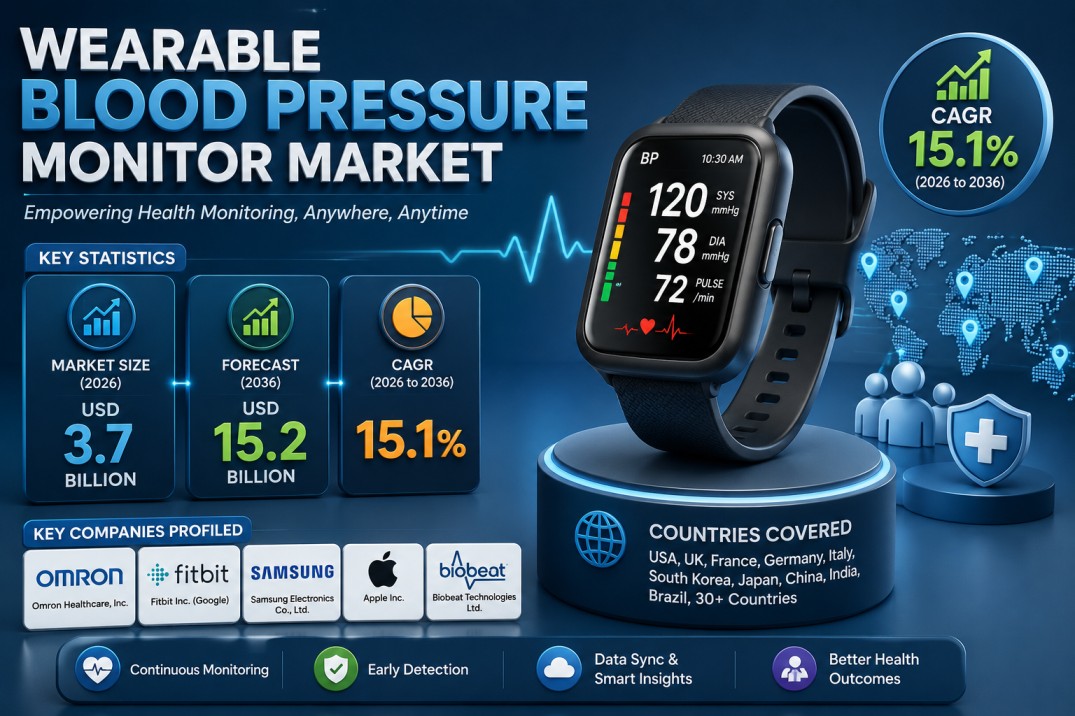
| Estimated Market Size (2026) | USD 3.7 Billion |
| Projected Market Value (2036) | USD 15.2 Billion |
| CAGR (2026 to 2036) | 15.1% |
Market Summary
The global Wearable Blood Pressure Monitor Market is projected to grow from USD 3.7 billion in 2026 to USD 15.2 billion by 2036, reflecting strong demand for continuous monitoring, remote patient management, and value-based care solutions.
Segment highlights include:
- Wrist-Based Monitors — 55.0% market share in 2026
• Hypertension Monitoring — 60.0% application share
• Oscillometric Technology — 70.0% technology share
• Key growth regions — North America, Europe, and Asia-Pacific
• High-growth countries — China, India, Germany, Brazil, and USA
Country-wise Growth Outlook
| Country | CAGR |
| China | 20.39% |
| India | 18.88% |
| Germany | 17.37% |
| Brazil | 15.86% |
| USA | 14.35% |
| UK | 12.84% |
| Japan | 11.33% |
Top Key Players
- Omron Healthcare
• Samsung Electronics
• Apple
• Fitbit (Google)
• Withings
Explore More Related Studies Published by FMI Research
- The blood pressure monitor market is projected to grow steadily from USD 2.40 billion in 2025 to USD 4.36 billion by 2035, registering a CAGR of 6.1%, driven by the rising prevalence of hypertension, increasing cardiovascular health awareness, and advancements in digital health monitoring.
- The wearable healthcare devices market is anticipated to expand from USD 22.57 billion in 2026 to USD 50.99 billion by 2036, registering a CAGR of 8.5% during the forecast period.
- The wearable medical device market was valued at USD 41.7 billion in 2025 and is projected to be valued at USD 91.6 billion by 2035. The market is expected to register a 8.2% CAGR during the forecast period.
Contact Us
Future Market Insights Inc.
Christiana Corporate, 200 Continental Drive,
Suite 401, Newark, Delaware – 19713, USA
T: +1-347-918-3531
Why FMI: Future Market Insights – Why FMI
For Sales Enquiries: sales@futuremarketinsights.com
Website: Future Market Insights