

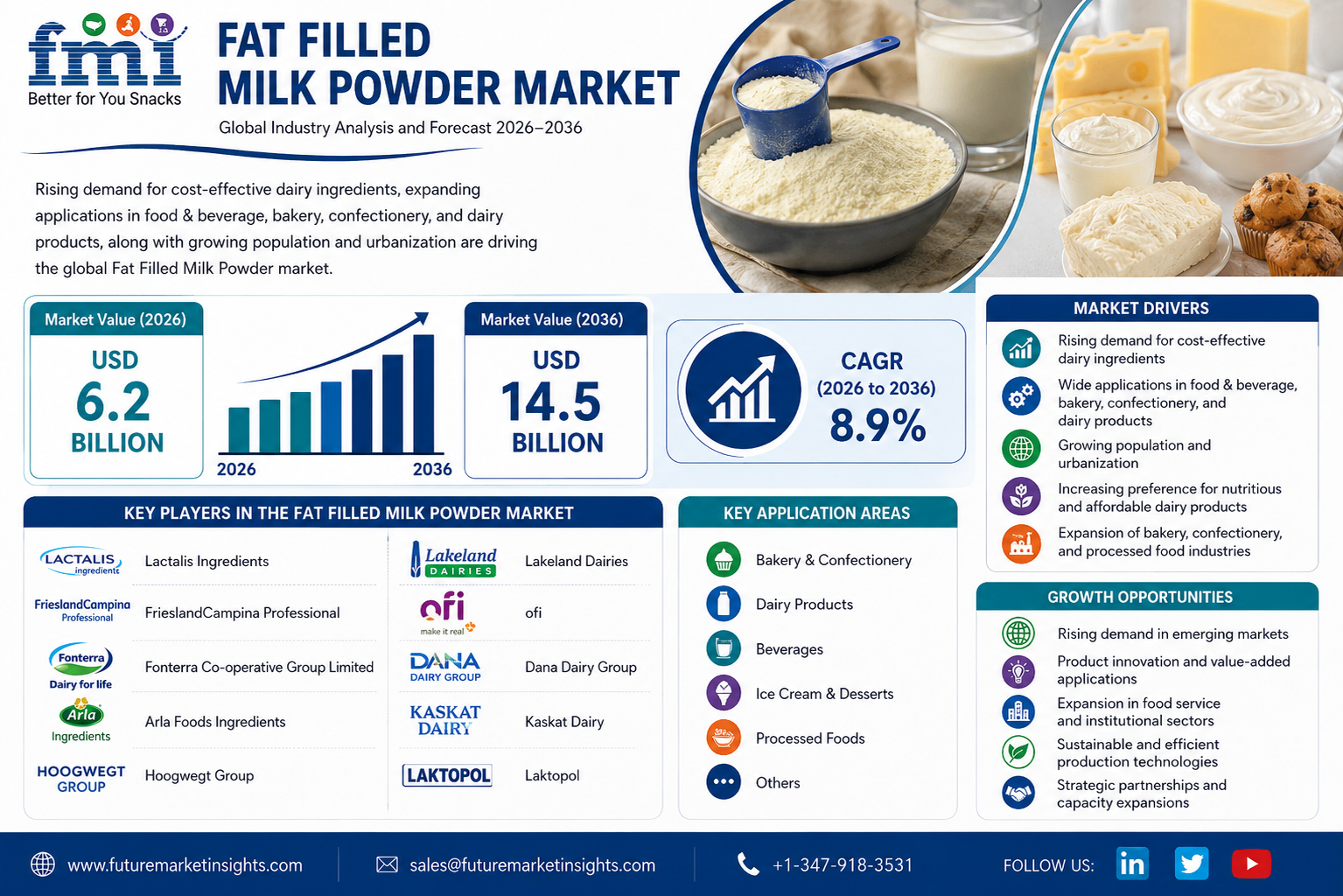
According to the latest insights by Future Market Insights, the global Fat Filled Milk Powder market is experiencing significant transformation as food manufacturers increasingly focus on cost optimisation, formulation flexibility, supply security, and application-specific ingredient performance. In 2026, rising dairy fat costs, shifting vegetable oil economics, and growing demand for affordable dairy-based ingredients are accelerating Fat Filled Milk Powder adoption across bakery, confectionery, beverages, and processed food applications.
Industry analysts highlight that consumption patterns are no longer influenced only by dairy availability but are increasingly shaped by ingredient economics, regional milk production structures, regulatory frameworks, and manufacturers’ ability to balance functionality with cost efficiency. Markets with limited domestic dairy production and high price sensitivity are emerging as major growth centres for Fat Filled Milk Powder consumption.
Cost Optimisation Drives Fat Filled Milk Powder Adoption
Fat Filled Milk Powder has become an important cost optimisation solution for food manufacturers seeking alternatives to whole milk powder. The ingredient combines skim milk powder with vegetable fats to deliver comparable functional properties while reducing dependence on expensive dairy fat.
Unlike whole milk powder, which contains a high proportion of milk fat, Fat Filled Milk Powder replaces part of the dairy fat component with vegetable-based alternatives such as palm oil and coconut oil. This substitution provides manufacturers with significant raw material savings while maintaining essential product characteristics.
Manufacturers are increasingly adopting Fat Filled Milk Powder to achieve:
- Reduced formulation costs
• Improved ingredient flexibility
• Stable supply availability
• Consistent processing performance
• Better production economics
For high-volume food categories, even moderate reductions in ingredient costs create significant commercial advantages, making Fat Filled Milk Powder an attractive solution in price-sensitive markets.
Dairy Fat Substitution Becomes a Key Market Differentiator
Dairy fat substitution continues to influence global Fat Filled Milk Powder consumption as manufacturers seek alternatives to volatile dairy commodity pricing.
Vegetable fats provide a commercially attractive option due to their lower cost and functional adaptability. Palm oil offers cost efficiency, neutral flavour, and oxidative stability, while coconut-based fats provide specific melting and texture characteristics suitable for confectionery applications.
Advanced formulation strategies allow processors to customise fat profiles according to application requirements, supporting:
- Improved texture control
• Enhanced shelf stability
• Optimised melting behaviour
• Application-specific performance
• Lower production costs
This flexibility enables manufacturers to create products that meet consumer expectations while maintaining competitive pricing.
Application Economics Shape Consumption Growth
Application requirements play a major role in determining Fat Filled Milk Powder consumption patterns across global food industries.
Bakery products represent one of the largest consumption areas, as manufacturers prioritise functional performance and cost efficiency. Biscuits, cakes, bread, and pastries utilise Fat Filled Milk Powder for protein contribution, moisture retention, colour development, and texture improvement.
Confectionery manufacturers also increasingly incorporate Fat Filled Milk Powder into:
- Chocolate compounds
• Wafer fillings
• Cream-based products
• Value-oriented confectionery products
In these categories, vegetable fat functionality supports processing requirements while reducing dependence on premium dairy fat ingredients.
Recombined dairy beverages represent another important application, particularly in regions where domestic milk production cannot fully meet consumer demand. Fat Filled Milk Powder enables manufacturers to produce affordable dairy beverages while managing raw material costs.
Vegetable Fat Availability Influences Market Dynamics
Vegetable oil pricing and supply conditions significantly impact Fat Filled Milk Powder economics.
Palm oil remains one of the most widely used fat sources due to its availability, affordability, and functional properties. However, fluctuations caused by production changes, trade restrictions, and competing demand can influence substitution decisions.
When vegetable fat prices rise significantly, the cost advantage compared with whole milk powder narrows, affecting manufacturer preferences. As a result, processors increasingly evaluate:
- Long-term supply security
• Alternative fat sources
• Regional sourcing strategies
• Sustainability requirements
Coconut oil and other specialty vegetable fats provide additional formulation options but may experience greater price volatility due to concentrated production regions.
Regional Dairy Supply Structures Accelerate Adoption
Regional dairy production capacity strongly influences Fat Filled Milk Powder consumption trends.
Import-dependent regions across Africa, the Middle East, and parts of Asia are witnessing stronger adoption due to limited domestic milk availability and growing demand for affordable dairy ingredients.
In these markets, Fat Filled Milk Powder helps manufacturers:
- Reduce dependence on expensive whole milk powder imports
• Improve dairy ingredient accessibility
• Support local food production
• Manage supply fluctuations
Countries with developing dairy industries often use Fat Filled Milk Powder as a strategic ingredient solution to bridge the gap between domestic supply and consumer demand.
Meanwhile, dairy surplus regions with strong milk production infrastructure generally demonstrate lower adoption because abundant dairy fat availability reduces the economic incentive for substitution.
Regulatory Standards Influence Consumption Opportunities
Regulations and product classification standards continue shaping where Fat Filled Milk Powder can be commercially applied.
Many markets maintain strict definitions for dairy products requiring specific dairy fat content. These regulations influence usage across categories such as milk, cheese, yoghurt, and premium ice cream.
However, applications including:
- Bakery products
• Compound chocolate
• Processed foods
• Certain beverage formulations
• Frozen dessert categories
often provide greater flexibility for vegetable fat inclusion.
Labelling requirements and consumer transparency expectations also affect adoption, as manufacturers must balance cost advantages with consumer perceptions around dairy authenticity.
Sustainability and Supply Chain Considerations Gain Importance
Sustainability concerns are becoming increasingly relevant in Fat Filled Milk Powder production as manufacturers evaluate vegetable fat sourcing practices.
Demand for responsibly sourced palm oil and improved supply chain transparency is influencing procurement decisions. Companies are increasingly focusing on:
- Sustainable ingredient sourcing
• Traceable supply chains
• Responsible fat procurement
• Resource-efficient production
These considerations are shaping future consumption patterns, particularly in developed markets where sustainability expectations influence purchasing behaviour.
Future Outlook
The future of the Fat Filled Milk Powder industry will be shaped by cost optimisation, dairy supply dynamics, vegetable fat innovation, and evolving food manufacturing strategies.
Manufacturers are expected to continue investing in flexible formulations, improved ingredient sourcing, and application-focused product development to meet changing market requirements.
Growing demand for affordable dairy nutrition, expanding processed food industries, and supply challenges in dairy-deficit regions are expected to support continued market opportunities.
As the industry evolves, price competitiveness, formulation adaptability, and regional supply chain efficiency will remain the defining factors influencing global Fat Filled Milk Powder consumption trends.
Explore More Related Studies Published by FMI Research:
Dairy Ingredients Market is projected to expand through 2036, supported by rising processed food demand, nutritional applications, dairy innovation, and global ingredient trade development.
Food Service Industry: Global Industry Analysis 2015 – 2024 and Opportunity Assessment 2025 – 2035
About Future Market Insights (FMI)
Future Market Insights, Inc. (FMI) is an ESOMAR-certified, ISO 9001:2015 market research and consulting organization, trusted by Fortune 500 clients and global enterprises. With operations in the U.S., UK, India, and Dubai, FMI provides data-backed insights and strategic intelligence across 30+ industries and 1200 markets worldwide.
Contact Us:
Future Market Insights Inc.
Christiana Corporate, 200 Continental Drive,
Suite 401, Newark, Delaware – 19713, USA
T: +1-347-918-3531
Why FMI: https://www.futuremarketinsights.com/why-fmi
For Sales Enquiries: sales@futuremarketinsights.com
Website: https://www.futuremarketinsights.com
LinkedIn| Twitter| Blogs | YouTube