

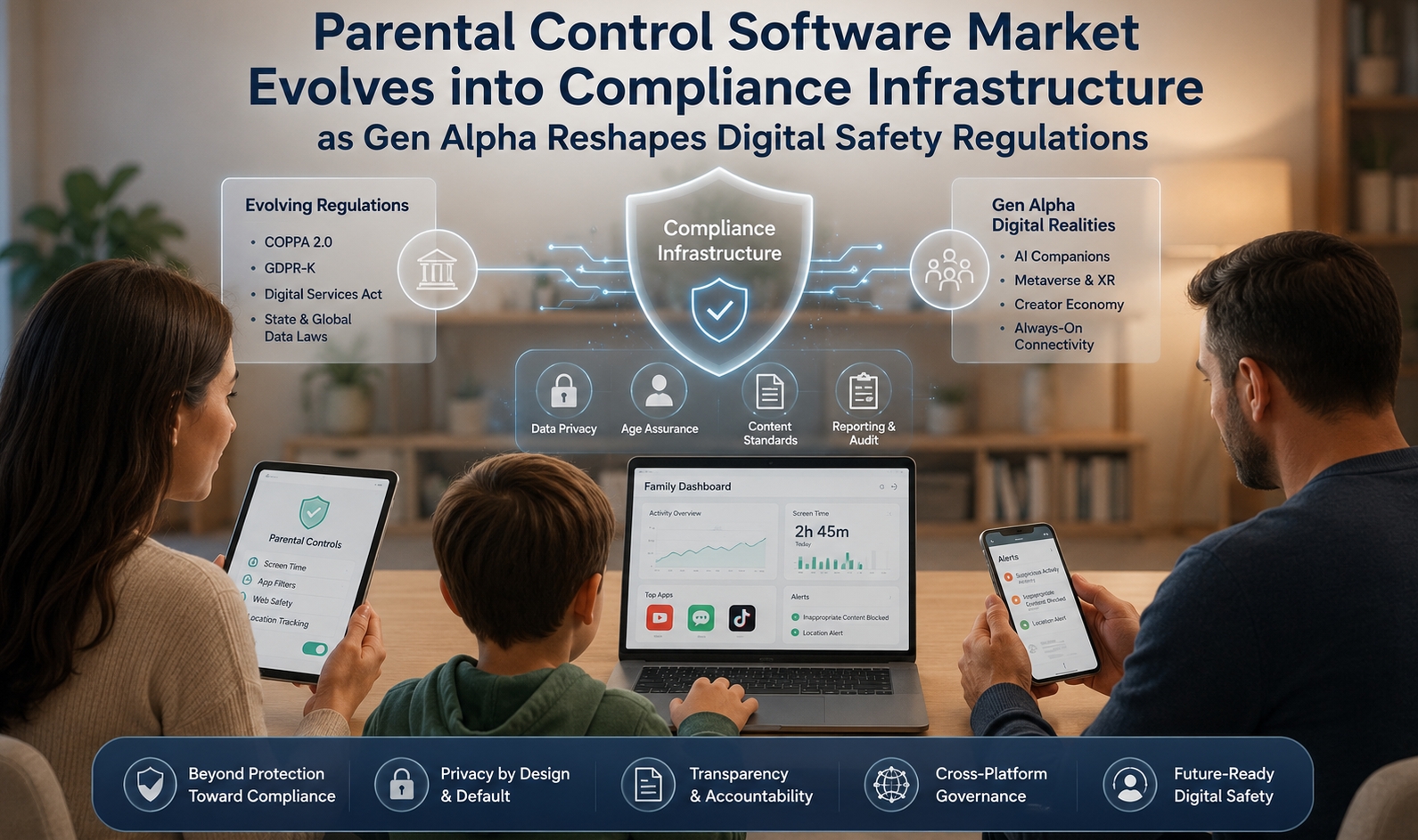
According to the latest analysis by Future Market Insights, the global parental control software market is entering a transformative phase as child safety regulations, data protection mandates, and platform accountability frameworks increasingly redefine how digital protection tools are designed, deployed, and monetized.
The emergence of Gen Alpha—the first generation raised entirely in a connected digital environment—is fundamentally changing regulatory priorities worldwide. With children gaining access to smartphones, tablets, gaming platforms, and social media ecosystems at increasingly younger ages, policymakers are moving beyond traditional parental monitoring models toward mandatory safety-by-design frameworks embedded directly into digital platforms.
As governments strengthen age-appropriate design requirements and privacy protections for minors, parental control software is evolving from an optional household utility into a critical compliance layer supporting platform accountability, child safety, and regulatory adherence.
Quick Market Highlights
- Growing regulatory focus on Gen Alpha digital behavior is accelerating parental control software adoption.
- Child safety laws increasingly mandate default protections rather than optional parental activation.
- Operating systems and platforms are embedding parental controls as core functionality.
- Enterprise and education licensing models are gaining traction over consumer subscriptions.
- Platform partnerships are becoming a major growth channel for software providers.
- Data protection regulations are driving privacy-focused monitoring and compliance solutions.
Gen Alpha Behavior Becomes the Foundation of Modern Child Safety Regulation
Regulators across major economies are increasingly using Gen Alpha digital engagement patterns as a reference point for designing child safety frameworks.
Unlike previous generations, Gen Alpha children are often exposed to connected devices before developing full verbal communication skills. Continuous access to digital platforms through educational tools, entertainment services, gaming ecosystems, and social applications has created unprecedented levels of early-age connectivity.
Evidence collected by academic researchers, child protection organizations, and platform safety teams shows that children frequently engage with connected devices for several hours daily by primary school age. These behavioral trends are prompting regulators to implement more proactive intervention strategies.
Industry analysts note that policymakers increasingly view mandatory platform safeguards as essential because digital exposure intensity now exceeds the monitoring capacity of many parents and guardians.
Child Safety Regulations Create Strong Market Momentum
Regulatory frameworks worldwide are becoming one of the strongest growth catalysts for parental control software providers.
Legislation focused on age-appropriate design, online safety, and child data protection increasingly requires platforms to implement built-in safeguards for younger users. Rather than relying on parents to discover and install third-party monitoring tools, regulators are encouraging default safety settings that automatically protect children based on age profiles.
These regulatory initiatives are driving demand for technologies that support:
- Age verification and identity management
- Content filtering and moderation
- Screen-time management
- Privacy protection controls
- Consent management systems
- Safety monitoring and reporting
As compliance obligations expand, organizations are investing in software solutions that help demonstrate adherence to evolving child protection requirements.
Platform Accountability Accelerates Embedded Control Adoption
One of the most significant industry shifts is the movement from standalone parental control applications toward platform-integrated safety infrastructure.
Technology providers increasingly embed screen-time controls, application restrictions, content filters, and location management features directly within operating systems and app ecosystems. This approach allows platforms to address regulatory expectations while simplifying user adoption.
Operating system providers, device manufacturers, and app marketplaces are integrating child safety functionality into their core ecosystems to reduce compliance risks and improve trust among consumers and regulators.
As a result, parental control capabilities are becoming a standard feature rather than a premium add-on, fundamentally changing competitive dynamics across the market.
Privacy Regulations Drive Technology Innovation
The market is also benefiting from increasing investments in privacy-preserving technologies designed specifically for child safety environments.
Data protection regulations limit the amount of information platforms can collect, retain, and monetize from younger users. This is encouraging software developers to redesign monitoring architectures around privacy-first principles.
Key technology priorities include:
- On-device processing capabilities
- Privacy-preserving monitoring systems
- Advanced age verification technologies
- AI-powered content analysis
- Cross-platform synchronization tools
- Automated compliance reporting
Software providers are increasingly focusing on solutions that balance effective parental oversight with strict privacy and data minimization requirements.
Compliance Management and Documentation Remain Critical
While regulatory demand continues to support market expansion, compliance implementation remains a significant challenge for both software vendors and platform operators.
Organizations must demonstrate that safety controls function effectively, consent processes are properly documented, and age-appropriate protections are consistently enforced across user environments.
Industry experts emphasize that successful deployment requires more than feature development alone. Vendors must also provide:
- Compliance documentation
- Regulatory reporting capabilities
- Audit support services
- Data governance frameworks
- Ongoing policy updates
As regulations become more complex across multiple jurisdictions, buyers increasingly evaluate compliance expertise alongside software functionality.
Competitive Landscape Focuses on Ecosystem Integration
Competition within the parental control software market is intensifying as vendors seek to align with platform operators, educational institutions, telecom providers, and device manufacturers.
Leading companies are expanding investments in:
- Platform integration partnerships
- Education sector deployments
- Enterprise compliance solutions
- AI-driven monitoring capabilities
- Regulatory reporting infrastructure
- Multi-device management systems
Market participants capable of combining technical innovation with regulatory expertise are expected to strengthen their competitive positioning throughout the forecast period.
Partnerships with operating system providers, internet service providers, and educational technology ecosystems are becoming increasingly important as compliance responsibilities extend across the digital value chain.
Outlook: Parental Control Software Becomes Core Digital Compliance Infrastructure
Looking ahead to 2036, parental control software is expected to evolve far beyond its traditional role as a household monitoring tool.
As governments continue strengthening child protection regulations and platform accountability standards, digital safety controls will increasingly function as foundational compliance infrastructure embedded within operating systems, educational environments, telecommunications networks, and online platforms.
The next decade will likely favor providers that can deliver privacy-focused innovation, regulatory expertise, platform interoperability, and scalable compliance management capabilities. As Gen Alpha continues to shape digital policy discussions worldwide, parental control technologies are positioned to become a cornerstone of responsible digital ecosystem governance.
Related Reports
- Recycling & Traceability Platforms Market – https://www.futuremarketinsights.com/reports/recycling-traceability-platforms-market
- Event Management Software Market – https://www.futuremarketinsights.com/reports/event-management-software-market
- Visitor Management System Market – https://www.futuremarketinsights.com/reports/visitor-management-system-market
Have Specific Requirements or Budget Constraints?
Contact our team for customized insights, pricing assistance, or tailored research solutions.
About Future Market Insights (FMI)
Future Market Insights, Inc. (FMI) is an ESOMAR-certified, ISO 9001:2015 market research and consulting organization trusted by Fortune 500 companies and global enterprises. With operations across the U.S., UK, India, and Dubai, FMI delivers data-driven intelligence and strategic insights across 30+ industries and more than 1200 markets worldwide.
Contact Us
Future Market Insights Inc.
Christiana Corporate, 200 Continental Drive,
Suite 401, Newark, Delaware – 19713, USA
T: +1-347-918-3531
Why FMI: https://www.futuremarketinsights.com/why-fmi
For Sales Enquiries: sales@futuremarketinsights.com
Website: https://www.futuremarketinsights.com
LinkedIn | Twitter | Blogs | YouTube