

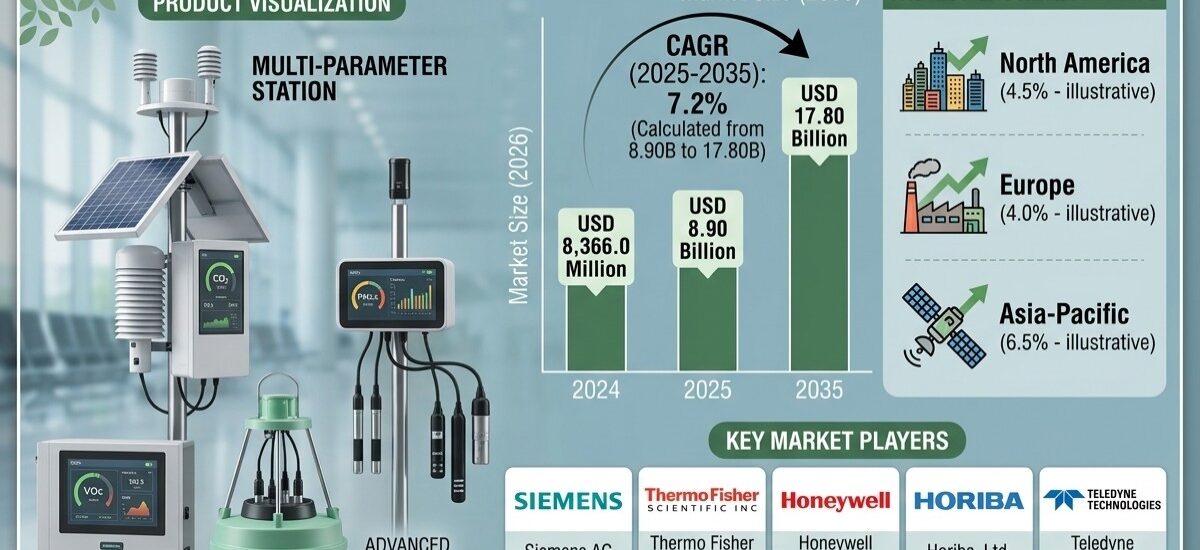
The global pollution monitoring equipment market is entering a sustained growth phase as governments and industries intensify efforts to track and reduce environmental pollutants. According to the latest analysis, the market is valued at USD 8.90 billion in 2025 and is projected to reach USD 17.80 billion by 2035, expanding at a CAGR of 7.2%. The sector is expected to generate an incremental opportunity of USD 8.90 billion over the forecast period.
This growth reflects a structural shift toward data-driven environmental governance, where real-time monitoring systems are becoming essential for regulatory compliance, industrial safety, and public health protection across air, water, and soil ecosystems.
Get detailed market forecasts, competitive benchmarking, and pricing trends:
https://www.futuremarketinsights.com/reports/sample/rep-gb-5531
Featured Snippet: Key Market Answer
Q: What is driving the growth of the pollution monitoring equipment market?
A: Growth is driven by stringent environmental regulations, rising public health concerns related to pollution, and the adoption of IoT- and AI-enabled monitoring systems that provide real-time, high-accuracy environmental data.
Quick Stats
- Market Size (2024): USD 8,366.0 million
- Market Size (2025): USD 8.90 billion
- Forecast (2035): USD 17.80 billion
- CAGR (2025–2035): 7.2%
- Incremental Opportunity: USD 8.90 billion
- Leading End-Use Segment: Power Generation (36.9%)
- Fastest Growing Sampling Method: Continuous Monitoring
Market Overview: Shift Toward Real-Time Environmental Intelligence
The pollution monitoring equipment market encompasses advanced instruments such as sensors, analyzers, and integrated systems used to measure environmental contaminants with high precision. These systems are increasingly embedded with IoT, AI, and cloud-based analytics, enabling continuous monitoring, predictive insights, and automated alerts.
Three structural forces are reshaping the market:
- Tightening global emission and pollution regulations
- Growing demand for real-time environmental data
- Technological advancements in smart monitoring systems
As a result, pollution monitoring is evolving from periodic compliance checks to continuous, intelligent environmental surveillance.
Key Growth Drivers
- Stringent Environmental Regulations
Governments worldwide are enforcing strict emission standards targeting pollutants such as NOₓ, SO₂, particulate matter, and greenhouse gases. Regulatory frameworks mandate continuous monitoring and reporting, pushing industries to adopt advanced systems like CEMS and PEMS.
- Rising Public Health Awareness
Increasing awareness of pollution-related health risks—such as respiratory diseases and cardiovascular conditions—is accelerating demand for monitoring solutions. Global concerns, including millions of premature deaths linked to air pollution annually, are driving investments across public and private sectors.
- Adoption of IoT and AI Technologies
Modern pollution monitoring systems leverage:
- IoT sensors for real-time data collection
- AI algorithms for predictive analytics
- Cloud platforms for remote monitoring and reporting
These technologies enhance accuracy, automation, and decision-making capabilities.
- Corporate Sustainability & ESG Initiatives
Industries such as oil & gas, manufacturing, and energy are deploying monitoring systems to meet ESG goals and carbon reduction targets. Pollution tracking is now a core component of corporate sustainability strategies.
Speak to Analyst: Customize insights for your business strategy:
https://www.futuremarketinsights.com/customization-available/rep-gb-5531
Market Trends Shaping the Industry
- Rise of Smart Monitoring Networks: Integration of IoT-enabled sensor networks across cities and industries
- Shift to Continuous Monitoring: Real-time systems replacing manual and intermittent sampling
- Growth of Smart Cities: Urban infrastructure increasingly adopting environmental monitoring systems
- Hyperlocal Data Analytics: Advanced systems providing location-specific pollution insights
- Automation & Early Warning Systems: Real-time alerts for proactive pollution control
Segment Insights
Sampling Method Leadership: Continuous Monitoring
Continuous monitoring is the fastest-growing segment due to its ability to:
- Provide real-time pollution data
- Enable immediate corrective action
- Support regulatory compliance
CAGR (2025–2035): 45%
End-Use Leadership: Power Generation (36.9%)
Power plants dominate demand due to high emission levels from fossil fuel combustion. Monitoring systems help:
- Ensure regulatory compliance
- Optimize emission control systems
- Minimize environmental impact
Regional Insights
Top Growth Markets (CAGR 2025–2035)
- India: 10.2% – Driven by urbanization and government initiatives
- China: 9.3% – Supported by strict environmental policies and smart city projects
- South Korea: 8.0% – Technology-driven monitoring adoption
- United States: 7.6% – Strong regulatory enforcement
- Germany: 7.4% – Advanced industrial compliance systems
Emerging Markets Outlook
- Asia-Pacific leads in demand growth due to rapid industrialization
- India & China offer strong long-term potential driven by environmental reforms
- Increasing investments in smart infrastructure are accelerating adoption
Competitive Landscape
The market is moderately consolidated, with competition shifting toward technology innovation and data capabilities rather than pricing alone.
Key Players
- Siemens AG
- Thermo Fisher Scientific Inc.
- Honeywell International Inc.
- Horiba, Ltd.
- Teledyne Technologies
- ABB Ltd.
- Emerson Electric Co.
- SICK AG
- Ametek, Inc.
- Endress+Hauser AG
Competitive Differentiation Factors
- Real-time monitoring capabilities
- AI and IoT integration
- Regulatory compliance expertise
- Data analytics and cloud platforms
- Scalability and customization
Recent Developments
- Launch of real-time air monitoring systems with rapid detection capabilities
- Introduction of compact, industrial-grade smart monitoring devices
- Large-scale urban air quality monitoring deployments across cities
- Expansion of IoT-based environmental sensor networks
Expert Insight
The pollution monitoring equipment market is transitioning into a critical infrastructure layer for environmental governance. As regulations tighten and climate concerns intensify, demand will shift toward intelligent, connected systems capable of delivering real-time insights and predictive analytics.
Companies investing in AI-driven monitoring, scalable sensor networks, and compliance-ready solutions will gain a significant competitive advantage in this evolving landscape.
FAQs
- What is the future outlook for the pollution monitoring equipment market?
The market is expected to reach USD 17.80 billion by 2035, growing at a CAGR of 7.2%, driven by regulatory enforcement and technological advancements.
- Which segment dominates the market?
The power generation segment leads with a 36.9% share due to high emissions monitoring requirements.
- Why is continuous monitoring gaining traction?
It provides real-time data, improves compliance, and enables faster decision-making compared to manual methods.
- What are the key challenges in the market?
- Complex data analysis and interpretation
- High implementation costs
- Technical expertise requirements
- Calibration and certification compliance
- Which regions offer the highest growth potential?
India and China lead growth due to urbanization, regulatory reforms, and increasing environmental investments.
Unlock 360° insights for strategic decision making and investment planning:
https://www.futuremarketinsights.com/reports/pollution-monitoring-equipment-market
Conclusion
The pollution monitoring equipment market sits at the intersection of environmental regulation, technological innovation, and public health priorities. As industries and governments move toward stricter compliance and real-time environmental intelligence, monitoring systems are becoming indispensable.
With strong growth momentum across developed and emerging economies, the market is set to play a pivotal role in shaping a data-driven, sustainable future where pollution control is proactive, precise, and globally standardized.




