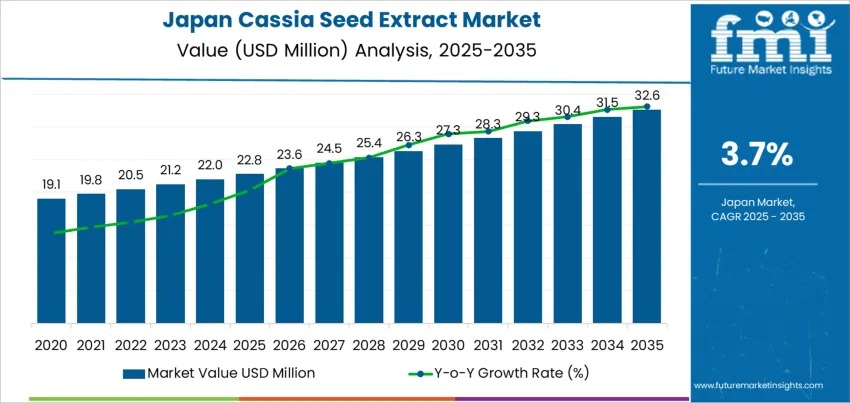
The demand for cassia seed extract in Japan is rising consistently, increasing from USD 22.8 million in 2025 to an expected USD 32.6 million by 2035—marking a steady CAGR of 3.7%. Consumer preference for natural, plant-based health solutions continues to shape market momentum, driving adoption across nutraceuticals, herbal teas, functional foods, and wellness product applications.
Growing awareness of digestive health, detoxification, and weight management—combined with Japan’s evolving clean-label movement—continues to elevate cassia seed extract’s appeal. Its extensive use in herbal medicine traditions and rising demand across food, beverage, and wellness industries further reinforce long-term market expansion.
Explore trends before investing – request a sample report today! https://www.futuremarketinsights.com/reports/sample/rep-gb-29321
Consistent Year-on-Year Growth Through 2035
Japan’s cassia seed extract market is forecast to record stable, incremental gains throughout the next decade. Demand is expected to rise from USD 22.8 million in 2025 to USD 23.6 million in 2026, and to USD 24.5 million in 2027, supported by strong interest in natural remedies. By 2029, demand will reach USD 26.3 million, with growth continuing through the early 2030s before surpassing USD 32.6 million in 2035.
Quick Stats: Japan Cassia Seed Extract Market
- Market Value 2025: USD 22.8 million
- Forecast Value 2035: USD 32.6 million
- CAGR (2025–2035): 3.7%
- Leading Distribution Channel: Wholesale (64%)
- Top Growth Regions: Kyushu & Okinawa, Kanto, Kinki, Chubu, Tohoku
- Key Players: Shaanxi Yongyuan Bio-Tech, Xi’an Green Spring Technology, Changsha Wanrun Bio-Technology, Botaniex Biotech, Shaoxing Marina Biotechnology
Why Demand Is Rising: Natural Wellness Meets Clean-Label Preferences
As Japanese consumers increasingly shift toward natural, minimally processed, plant-derived ingredients, cassia seed extract has gained traction across multiple industries. Derived from Cassia obtusifolia and Cassia tora, the extract is valued for:
- Digestive support and mild laxative effects
- Antioxidant and anti-inflammatory properties
- Vision support and general wellness benefits
Its adoption is particularly strong in herbal teas, detox and weight-management formulations, functional beverages, and dietary supplements. Japan’s booming e-commerce channels and specialty wellness stores further strengthen access and visibility of cassia seed–based products.
Application Analysis: Nutraceuticals Lead with 42% Share
Nutraceuticals remain the dominant application area, accounting for 42% of Japan’s cassia seed extract demand. Rapid consumer adoption of dietary supplements, preventive health routines, and functional foods has bolstered this category.
Japan’s aging population and rising interest in digestive care, liver support, and detoxification are fueling the growth of cassia seed extract in:
- Herbal teas
- Weight management supplements
- Liver and digestion-support formulations
- Wellness and cleansing blends
The extract’s positioning as a traditional remedy with modern applications is strengthening its relevance in Japan’s health-focused market.
Distribution Channel Insights: Wholesale Dominates With 64% Share
Wholesale channels command 64% of total demand, supporting the needs of large manufacturers in nutraceutical, pharmaceutical, and food and beverage sectors. Bulk sourcing requirements, strict quality consistency, and demand for standardized herbal extracts make wholesale the preferred route for commercial buyers.
Manufacturers prioritize suppliers offering:
- High-purity extracts
- Standardized active compounds
- Strong batch consistency
- Regulatory-compliant documentation
Regional Outlook: Kyushu & Okinawa Lead at 4.6% CAGR
Regional growth rates vary across Japan, driven by differences in consumer adoption, industrial strength, and wellness-product penetration.
CAGR Forecast by Region (2025–2035)
- Kyushu & Okinawa: 4.6%
- Kanto: 4.2%
- Kinki: 3.7%
- Chubu: 3.3%
- Tohoku: 2.8%
- Rest of Japan: 2.7%
Kyushu & Okinawa benefit from strong cultural ties to herbal remedies. Kanto, home to Tokyo, leads in demand for functional foods, supplements, and clean-label beauty products. Meanwhile, Kinki and Chubu show steady momentum due to growing interest in natural beverages and wellness formulations.
Competitive Landscape: Quality, Standardization, and Supply Reliability Drive Market Positioning
Japan’s cassia seed extract market is served primarily by international botanical extract suppliers. Major players include Shaanxi Yongyuan Bio-Tech (approx. 39% share among top producers), Xi’an Green Spring Technology, Changsha Wanrun Bio-Technology, Botaniex Biotech, and Shaoxing Marina Biotechnology.
Competition centers on:
- Extract purity and consistent active content
- Standardization for nutraceutical and cosmetic applications
- Supply reliability and global sourcing networks
- Versatility across teas, capsules, beverages, and skincare formulations
Suppliers offering high-quality, standardized extracts aligned with Japan’s regulatory expectations are best positioned for long-term success.