

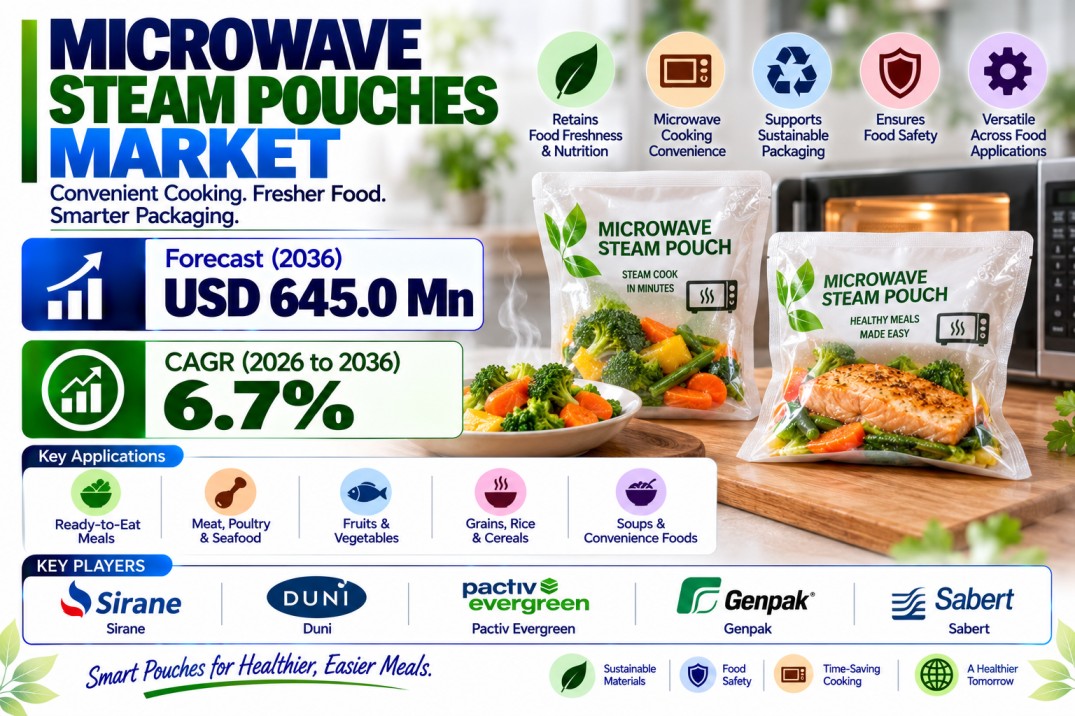
The global microwave steam pouches market is projected to reach USD 645.0 million by 2036, up from USD 337.2 million in 2026, registering a 6.7% CAGR over the forecast period, according to Future Market Insights (FMI). The market was valued at USD 316.0 million in 2025 and is expected to generate an incremental opportunity of USD 307.8 million between 2026 and 2036.
Packaging regulations are accelerating material reviews
The European Union’s Packaging and Packaging Waste Regulation (PPWR), Regulation (EU) 2025/40, entered into force on February 11, 2025, and generally began applying on August 12, 2026. FMI identifies the regulation’s packaging requirements, including restrictions on PFAS in food-contact packaging, as a reason buyers are reviewing pouch materials and structures.
For foodservice operators and converters, a change in material must still meet heat-performance, seal-integrity and food-contact requirements. Fiber-led and mono-material designs offer alternatives, but each structure needs appropriate testing before commercial adoption.
>> Access detailed market insights: https://www.futuremarketinsights.com/reports/brochure/rep-gb-35734
Where growth is fastest
- Saudi Arabia — 8.3% CAGR: Food-contact standards favor documented suppliers and support demand for qualified pouch formats.
- United Arab Emirates — 8.0% CAGR: Single-use product rules are encouraging buyers to consider lower-plastic packaging.
- South Korea — 7.7% CAGR: Recyclability grading and packaging-material requirements are influencing design and material choices.
- United States — 7.4% CAGR: Frozen-meal consumption and food-contact authorization requirements are shaping supplier demand.
- United Kingdom — 7.1% CAGR: Producer-responsibility fees linked to recyclability are increasing interest in alternative pouch structures.
- Germany — 6.8% CAGR: High frozen-food consumption and packaging-design requirements support demand for microwave-ready packs.
- France — 6.5% CAGR: Restaurant-packaging producer-responsibility obligations are influencing material selection.
- Japan — 6.2% CAGR: Material-reduction efforts are supporting trials of packaging that uses less material without changing the pack’s function.
What leads the market
- Standard formats — 38% share in 2026: Familiar dimensions and established production settings support repeat orders across foodservice programs.
- Paperboard — 30% share: Fiber-based structures are attracting attention as buyers assess packaging recovery and material requirements.
- Standard meal packs — 41% share in 2026: Single-meal formats suit products that are filled, sold and heated as one portion.
- Delivery platforms — 27% share in 2026: Food delivery operators need packaging that can travel and perform during home heating.
- Broadline foodservice distributors — 41% share in 2026: Distributors supply pouches alongside other routine foodservice consumables, serving buyers with different order volumes.
The hurdle
Qualification remains the main barrier to switching pouch structures. Microwave steam pouches operate under heat and pressure while contacting food, so new designs require appropriate checks for migration, sealing and cooking performance. Recyclability claims alone do not establish that a pack will work consistently across recipes and production conditions.
This can lengthen approval timelines and delay commercial orders. Converters must demonstrate that changes in films, coatings or fiber-based structures maintain the required performance before food manufacturers commit to a new specification.
Recent developments
Supplier activity shows how manufacturers are developing microwave-ready and fiber-based alternatives:
- June 2025: Duni launched its Vista take-away series, with recyclable polypropylene, adjustable steam vents and microwave-safe bases. The series became available from July 1, 2025.
- August 2025: Graphic Packaging introduced PaperSeal Pressed, a pressed paperboard tray with a high-barrier liner designed to run on existing form-fill-seal equipment.
- May 2026: Sabert announced a multi-substrate food packaging showcase for IDDBA 2026, covering paper, molded fiber and resin options.
FMI profiles Sirane, Dart Container, Duni, Novolex, Pactiv Evergreen, Genpak, Sabert, Berry Global, Graphic Packaging and Detmold Group across steam-ready, fiber-led and scaled foodservice packaging.
>> Request For Sample Report | Customize Report | Purchase Full Report – https://www.futuremarketinsights.com/reports/sample/rep-gb-35734
Analyst quote
“The figure I watch most closely in this market is per capita frozen and prepared meal consumption, because every extra meal heated at home is a possible steam pouch. Saudi Arabia and the UAE, at 8.3% and 8% CAGR through 2036, will add volume fastest, and standard meal packs, with 41% of demand in 2026, will carry most of that new volume.”
— Nikhil Kaitwade, Principal Consultant, Future Market Insights
What this means for food manufacturers, converters and procurement teams
- Validate the complete pouch before changing materials. Assess sealing, venting, cooking performance and food-contact documentation together. A new structure should be tested under the intended production and use conditions before it is approved for repeat orders.
- Compare material alternatives against actual operating needs. Paperboard, molded fiber, recycled polymers and other structures serve different applications. Buyers should compare performance, processing compatibility and end-of-life requirements rather than select a material based on a single sustainability attribute.
- Include qualification time in sourcing plans. Build testing and approval milestones into supplier transitions, especially where regulatory or recyclability requirements may change an existing specification. Coordinate converters, foodservice operators and material suppliers early to reduce avoidable delays.
Contact Us:
Future Market Insights Inc.
Christiana Corporate, 200 Continental Drive,
Suite 401, Newark, Delaware – 19713, USA
T: +1-347-918-3531
For Sales Enquiries: sales@futuremarketinsights.com
About Future Market Insights
Future Market Insights (FMI) is a leading provider of market research and consulting services, offering syndicated and customized research across industries including Packaging, Consumer Product, and Food & Beverage.