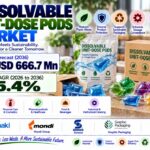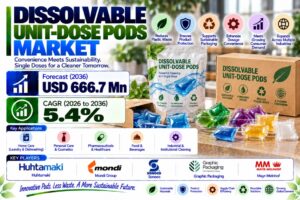


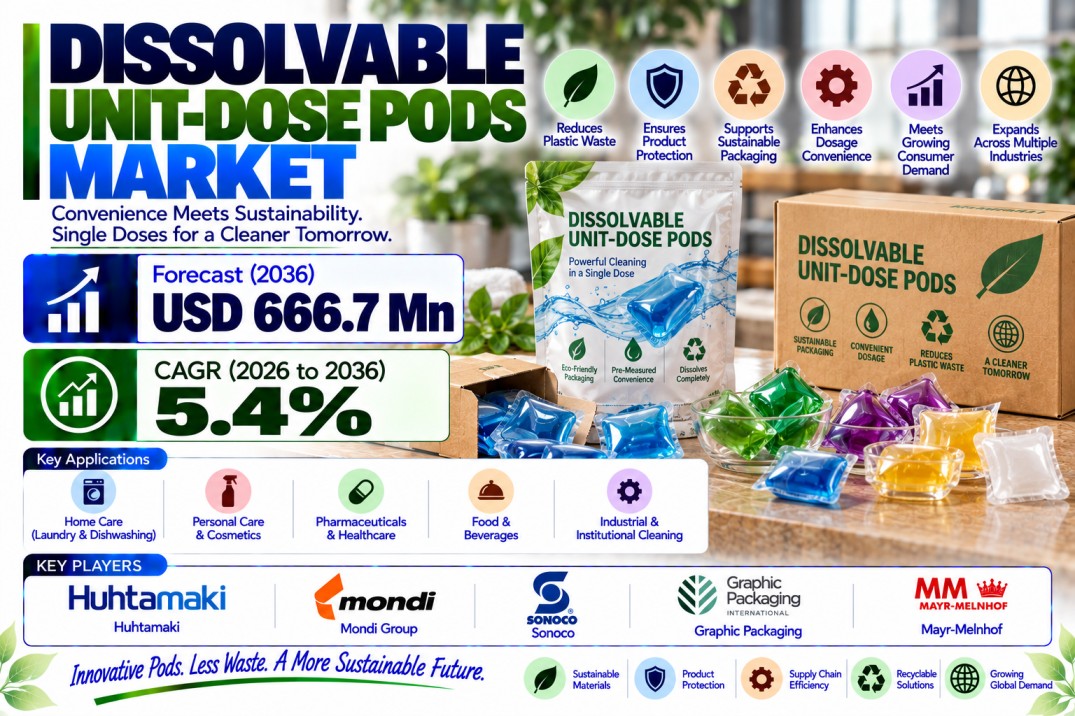
The global dissolvable unit-dose pods market is projected to grow from USD 394.0 million in 2026 to USD 666.7 million by 2036, registering a 5.4% CAGR, according to Future Market Insights (FMI). The market was valued at USD 373.8 million in 2025. FMI estimates an incremental opportunity of USD 272.7 million after 2026.
New EU rules set a deadline for detergent pod films
Regulation (EU) 2026/405 of the European Parliament and of the Council on detergents and surfactants entered into force on March 22, 2026, replacing Regulation (EC) No 648/2004. FMI reports that the revised rules require the films around 70% of detergent tablets and capsules to become biodegradable within six years. This creates a defined timetable for brands to qualify alternative film grades, beginning with high-volume laundry pod formats.
The qualification process is not limited to biodegradability. Films must withstand humidity during filling and storage while dissolving as intended in use. Outer packs also need suitable barrier performance, seals and closures. These requirements can slow supplier changes, even as the regulatory deadline creates opportunities for tested film and fiber-pack combinations.
>> Request For Sample Report | Customize Report | Purchase Full Report – https://www.futuremarketinsights.com/reports/sample/rep-gb-35734
Where growth is fastest
- United Arab Emirates — 6.8% CAGR: Single-use plastic restrictions are encouraging brands to consider fiber-based outer packs, provided barrier and food-contact documentation is available.
- Saudi Arabia — 6.5% CAGR: The Vision 2030 Annual Report 2025, published in 2026, recorded 145 recycling facilities and 18% waste diversion from landfills in 2025, supporting the report’s outlook for fiber-pack recovery routes.
- South Korea — 6.2% CAGR: Packaging extended producer responsibility and recyclability evaluations are increasing the importance of clear material declarations.
- United States — 5.9% CAGR: Closure and pack-performance checks influence supplier selection for large retail laundry programs.
- Germany — 5.6% CAGR: EU packaging design rules and the detergent-film transition are expected to reshape laundry-pack qualification.
- United Kingdom — 5.3% CAGR: Material-based producer-responsibility fees are encouraging brands to compare paper and composite outer-pack formats.
- France — 4.9% CAGR: National plastic-reduction and recycling targets are influencing packaging design decisions.
- Japan — 4.5% CAGR: The market is expected to grow more slowly as brands favor measured material changes and carefully tested formats.
What leads the market
- Laundry pods film — 37% share in 2026: Large retail laundry programs use established film specifications across multiple pack sizes, making this the largest product category.
- Virgin kraft and solid bleached sulfate (SBS) board — 37% share: Stiffness and print quality support its use in cartons and sleeves around moisture-sensitive pods.
- Standard retail packs — 42% share: Tubs and pouches containing several weeks of household doses account for the largest format category.
- Food and foodservice — 35% share: FMI identifies this as the largest end-use group, citing demand for pre-portioned ingredients and measured cleaning doses.
- Direct brand contracts — 46% share: Joint qualification of film, board and packing-line settings supports direct agreements between brands and packaging suppliers.
Qualification time is a key restraint. A new film must resist moisture during filling and storage, maintain suitable sealing performance and dissolve as intended. Brands often repeat testing for each new film and pack combination, which can delay supplier changes and increase the time required to secure repeat orders.
For outer packs, closure performance, barrier properties and recyclability also influence approval. Suppliers that can provide dissolution data, seal testing and closure trials together may be better placed to shorten qualification cycles, according to FMI.
Recent developments
Developments in paperboard and barrier materials are relevant to suppliers evaluating alternative pod-pack structures:
- August 2025: Mondi Group ramped up production of FunctionalBarrier Paper Ultimate at its Solec plant in Poland following a EUR 16 million investment. The company lists pod overwraps among the material’s applications.
- September 2025: Stora Enso introduced Ensovelvet, a premium uncoated solid bleached sulfate paperboard for consumer packaging.
- July 2026: Graphic Packaging launched PaceSetter Ridgeline, an uncoated recycled paperboard for folding cartons, laminations, tubes, cores and specialty applications.
FMI profiles Huhtamaki, Mayr-Melnhof, Metsa Group, International Paper, Mondi Group, Smurfit Westrock, Sonoco, Ranpak, Graphic Packaging and Stora Enso across converted consumer packs, board materials, transit packaging and automation-related formats.
Analyst quote
“Brand owners selling pods in Europe should prepare film test files now, since Regulation (EU) 2026/405 gives detergent capsules six years to move to biodegradable film. Laundry pods film holds 37% of demand by product type in 2026, and brands requalifying laundry film first will protect shelf space through 2036.”
— Nikhil Kaitwade, Principal Consultant, Future Market Insights
What this means for brand owners and packaging procurement teams
- Start film qualification ahead of the regulatory deadline. Map current laundry and dish pod volumes, identify which film grades need review, and schedule tests early enough to avoid a last-minute change across established retail programs.
- Evaluate the film and outer pack as one system. Review moisture resistance, dissolution, sealing, closure performance and recyclability together. A material change that meets one requirement may still need further validation at the filling line or in the intended pack.
- Ask suppliers for evidence before committing volumes. Request documented test results, material declarations and application-specific performance data. Direct brand contracts can support joint trials, but the approval process should be built into procurement timelines and contingency plans.
Contact Us:
Future Market Insights Inc.
Christiana Corporate, 200 Continental Drive,
Suite 401, Newark, Delaware – 19713, USA
T: +1-347-918-3531
For Sales Enquiries: sales@futuremarketinsights.com
About Future Market Insights
Future Market Insights (FMI) is a leading provider of market research and consulting services, offering syndicated and customized research across industries including Packaging, Consumer Product, and Food & Beverage.