

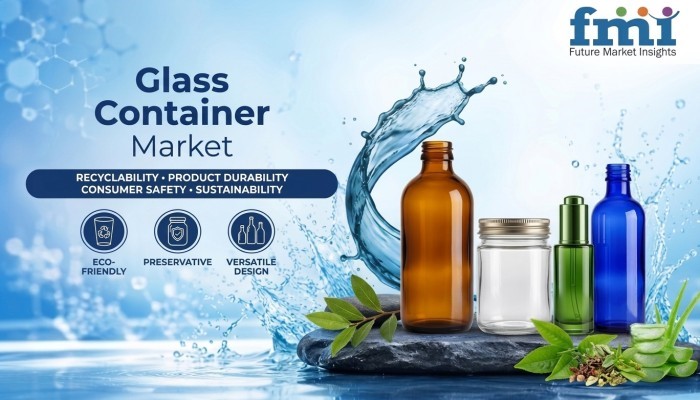
The global glass container market is projected to grow from USD 67.4 billion in 2026 to USD 94.2 billion by 2036, registering a Compound Annual Growth Rate (CAGR) of 3.4% over the forecast period. The market was valued at USD 65.2 billion in 2025, with the latest analysis from Future Market Insights, Inc. (FMI) identifying demand for inert packaging materials, beverage containers and pharmaceutical-grade glass as central contributors to industry revenue.
The market is expected to generate an additional USD 26.8 billion between 2026 and 2036. Soda lime glass will remain the leading material, accounting for 68.0% of market share in 2026. Bottles represent 52.0% of product-type demand, while beverages account for 45.0% of end-use demand. Pharmaceutical applications hold a 48.0% share, reflecting the importance of chemical stability and dimensional consistency in regulated packaging.
Get detailed market forecasts, competitive benchmarking, and pricing trends:
https://www.futuremarketinsights.com/reports/sample/rep-gb-935
KEY MARKET TAKEAWAYS
- Market Valuation: USD 67.4 billion in 2026, projected to reach USD 94.2 billion by 2036.
- Growth Rate: The market is forecast to expand at a 3.4% CAGR from 2026 to 2036.
- Leading Material: Soda lime glass accounts for 68.0% of the market in 2026.
- Leading Product Type: Bottles hold a 52.0% share, supported by established filling and closure systems.
- Fastest-Growing Country: India leads the evaluated markets with a projected 6.0% CAGR.
- Core Growth Driver: Demand for recyclable packaging and chemically stable containers across beverage and pharmaceutical applications.
INDUSTRY SHIFTS & MARKET DYNAMICS
Glass containers continue to serve applications where product protection, material stability and packaging recovery matter. Beverage producers use glass to preserve flavor and aroma in beer, spirits, wine and mineral water. Pharmaceutical manufacturers rely on its chemical resistance and dimensional consistency for injectable biologics, liquid medicines and ophthalmic products. Packaging waste requirements are also encouraging brand owners to assess recyclable materials and increase the use of recycled glass, or cullet, in manufacturing.
Production economics remain a defining factor in supplier selection. Glass furnaces operate through long production campaigns, making frequent shutdowns and specification changes expensive. Energy-price volatility, furnace rebuild costs and the availability of clean, color-sorted cullet can affect manufacturing margins. Buyers are increasingly examining furnace condition, backup production capacity and verified carbon-reduction performance before signing longer-term supply agreements.
Technology investment is creating opportunities for producers able to reduce emissions while maintaining output quality. In April 2026, Verallia inaugurated its first hybrid industrial furnace in Zaragoza, Spain. The furnace uses 70% renewable electrical energy and 30% natural gas, with a stated daily production capacity of 1.3 million containers. The project illustrates how hybrid melting systems may support lower-emission production, although installation costs and industrial electricity tariffs remain barriers for smaller manufacturers.
Lightweighting is another important area of development. The technology accounts for 42.0% of market demand in 2026, as producers seek to reduce container weight and freight emissions without losing the appearance and protective properties associated with glass. However, thinner walls require careful impact testing and surface protection to prevent breakage during filling, capping and transportation.
REGIONAL MARKET SUMMARY
Country growth rates vary according to pharmaceutical demand, beverage production, recycling infrastructure and local manufacturing capacity.
- India: 6.0% CAGR, supported by pharmaceutical packaging and expanding beverage-filling capacity.
- China: 5.3% CAGR, driven by large beverage manufacturing clusters and faster mold turnaround.
- Canada: 2.9% CAGR, supported by deposit-return systems and circular bottle programs.
- United States: 2.5% CAGR, with demand from craft beverages and pharmaceutical replacement packaging.
- Germany: 2.0% CAGR, supported by established return systems and cullet availability.
Spain is projected to grow at 1.8%, while the United Kingdom records a 1.6% CAGR. These mature markets are focused increasingly on production efficiency, premium formats and lower-emission manufacturing rather than broad-based volume expansion.
ANALYST INSIGHTS
“Glass suppliers must balance furnace economics with packaging proof that brand owners can defend under new waste rules. Producers controlling clean cullet and lightweight design will secure the most durable beverage and pharmaceutical programs,” stated Nandini Roy Choudhury, Principal Consultant at Future Market Insights. Her assessment highlights the commercial importance of recycled-material access, production efficiency and packaging specifications as buyers evaluate long-term supply arrangements.
ABOUT THE REPORT
The FMI report examines the global glass container market from 2026 to 2036, covering product type, material, end use, application, technology and neck type.
Its geographic assessment includes North America, Latin America, Europe, East Asia, South Asia and Pacific, and the Middle East and Africa.
The competitive analysis covers O-I Glass, Ardagh Glass Packaging, Verallia, Vitro Glass Containers, BA Glass, Vidrala and PGP Glass.
The study uses primary and secondary research, market-sizing approaches and data triangulation to assess demand and forecast industry development.
For more information on the full report, visit: https://www.futuremarketinsights.com/reports/container-glass-market
Explore More Related Reports Links:
https://www.openpr.com/news/4694995/top-players-in-the-nutraceutical-packaging-market-fmi
https://www.openpr.com/news/4694998/top-players-in-the-office-starter-kit-packaging-market-fmi
https://www.openpr.com/news/4695011/top-players-in-the-faith-based-product-packaging-market-fmi
FMI Custom Research: Strategic Intelligence for Confident Decision-Making
In today’s rapidly evolving business environment, leadership teams need more than market data—they need clear, actionable intelligence tailored to their strategic objectives. FMI’s Custom Research solutions are designed around the specific business questions organizations need answered, enabling executives to evaluate growth opportunities, validate investments, assess competitive dynamics, and reduce uncertainty before making critical decisions. By combining deep industry expertise, primary research, and proprietary market intelligence, FMI delivers insights that help organizations move from assumptions to evidence-based strategies with greater speed and confidence.
Business Impact
FMI helps organizations transform market complexity into strategic clarity, enabling leadership teams to identify growth opportunities faster, optimize resource allocation, strengthen competitive positioning, and make high-stakes business decisions with confidence.
To explore how FMI Custom Research can support your strategic priorities, please connect with our team at – sales@futuremarketinsights.com
About Future Market Insights (FMI)
Future Market Insights, Inc. (FMI) is an ESOMAR-certified, ISO 9001:2015 market research and consulting organization, trusted by Fortune 500 clients and global enterprises. With operations in the U.S., UK, India, and Dubai, FMI provides data-backed insights and strategic intelligence across 30+ industries and 1200 markets worldwide.
Contact Us:
Future Market Insights Inc.
Christiana Corporate, 200 Continental Drive,
Suite 401, Newark, Delaware – 19713, USA
T: +1-347-918-3531
For Sales Enquiries: sales@futuremarketinsights.com
Website: https://www.futuremarketinsights.com
LinkedIn| Twitter| Blogs | YouTube