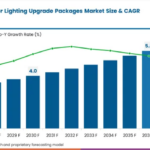
The global direct-to-garment (DTG) printing market is projected to increase from USD 3.2 billion in 2025 to USD 3.6 billion in 2026 and USD 10.1 billion by 2036. According to the latest market report published by Future Market Insights, the industry is anticipated to expand at a Compound Annual Growth Rate (CAGR) of 11.0% from 2026 to 2036, adding USD 6.5 billion in revenue over the forecast period.
The shift from stocked apparel designs to made-after-sale production is changing how clothing brands and independent decorators manage inventory. DTG systems allow businesses to print individual garments after receiving orders, reducing dependence on screen preparation and large production batches. This approach supports personalized apparel, creator merchandise and online storefronts that frequently introduce new designs.
Get detailed market forecasts, competitive benchmarking, and pricing trends:
https://www.futuremarketinsights.com/reports/sample/rep-gb-11367
KEY MARKET TAKEAWAYS
- Market Valuation: USD 3.6 billion in 2026, projected to reach USD 10.1 billion by 2036.
- Growth Rate: Expanding at an 11.0% CAGR from 2026 to 2036.
- Leading Segment: Digital textile printers are projected to account for 58.0% of printer-type demand in 2026.
- Leading Application: Apparel is forecast to represent 67.0% of the market in 2026.
- Fastest-Growing Country: China is projected to record the highest evaluated country CAGR at 12.5%.
- Core Growth Driver: Rising demand for customized apparel and short-run production without screen setup or fixed minimum quantities.
INDUSTRY SHIFTS & MARKET DYNAMICS
DTG printing is gaining commercial relevance as apparel sellers seek ways to offer more designs without holding finished-garment inventory. A paid order can be converted directly into a production instruction, allowing print shops to handle small quantities and frequent artwork changes. Digital textile printers are projected to hold 58.0% of printer-type demand in 2026, reflecting their suitability for repeatable output across customized orders. Apparel remains the largest end-use application, supported by personalized t-shirts, hoodies and merchandise programs.
Equipment suppliers are also working to simplify adoption. Epson introduced its SureColor F1070 Business Edition package in September 2025, combining the printer with ink and maintenance supplies for smaller apparel businesses. Hybrid systems are extending the range of jobs that a shop can handle. Brother launched the GTX300 in July 2026 with DTG and direct-to-film capabilities for cotton, polyester and blended apparel.
Operational consistency remains a key challenge. White-ink circulation, nozzle maintenance, garment pretreatment and curing conditions can affect output quality and machine uptime. Uneven pretreatment can lead to inconsistent color and adhesion, while pigment settling during idle periods can cause nozzle problems. Smaller decorators may also struggle to maintain equipment utilization when order volumes fluctuate. These factors increase the importance of operator training, consumable reliability, service coverage and workflow automation.
REGIONAL MARKET SUMMARY
China is expected to lead the evaluated countries, supported by its apparel manufacturing base and demand for customized order fulfillment. Other markets are advancing through print-on-demand platforms, independent fashion labels and demand for precision garment decoration.
- China: 12.5% CAGR, 2026–2036.
- United States: 10.8% CAGR, supported by creator merchandise and online storefronts.
- Germany: 10.2% CAGR, with demand shaped by output consistency and workflow automation.
- United Kingdom: 9.9% CAGR, supported by independent brands and short-run fashion production.
- Japan: 9.4% CAGR, with precision and compact equipment supporting adoption.
ANALYST INSIGHTS
“DTG investment is shifting from isolated print quality toward complete workflow economics. Suppliers that reduce pretreatment variation and operator intervention will support profitable short-run apparel production,” stated Nandini Roy Choudhury, Principal Consultant at Future Market Insights.
The assessment points to a change in purchasing priorities. Print quality remains necessary, but buyers increasingly evaluate equipment through uptime, maintenance requirements, ink performance and the ability to process varied artwork without disrupting production. Suppliers that simplify daily operation and support consistent output across small batches are better positioned to serve apparel decorators and growing print-on-demand businesses.
COMPETITIVE OUTLOOK AND COMMERCIAL OPPORTUNITIES
The market includes industrial production platforms, commercial systems and specialist equipment providers. Notable companies include Brother Industries, Seiko Epson, Kornit Digital, Ricoh, Mimaki Engineering, ROQ International, M&R Companies, Aeoon Technologies and ColDesi.
Industrial suppliers are addressing higher-volume requirements and automated workflows, while commercial equipment providers serve decorators with varied production scales. Specialist suppliers compete through application flexibility and focused customer support. Across these categories, buyers assess equipment beyond its stated print resolution. Maintenance effort, software integration, local technical support and access to inks and replacement parts also influence purchasing decisions.
Hybrid production represents an important commercial opportunity. DTG systems are suited to direct printing on cotton, while transfer-based workflows can help shops handle polyester, blended fabrics and products with different decoration requirements. Combining these capabilities can improve equipment utilization across changing order mixes and reduce the need for businesses to purchase separate systems for every application.
Consumables and services also contribute to supplier value. Ink supply, maintenance parts, software and operator training can support recurring commercial relationships after the initial equipment sale. For smaller businesses, packaged systems and accessible technical support may be particularly relevant because limited operator experience can affect pretreatment, curing and maintenance consistency.
ABOUT THE REPORT
The Direct-to-Garment Printing Market report by Future Market Insights examines market performance from 2026 to 2036. It evaluates demand by printer type, ink type, fabric type and end-use application, alongside regional and country-level growth patterns. The study also reviews competitive positioning, market drivers, operational restraints and commercial opportunities. Its research approach combines primary and secondary research with market sizing, forecasting and data triangulation.
For more information, visit the Direct-to-Garment Printing Market report: https://www.futuremarketinsights.com/reports/direct-to-garment-printing-market
Explore More Related Reports Links:
https://www.openpr.com/news/4690533/top-players-in-the-corrugated-board-market-fmi-forecasts-usd
https://www.openpr.com/news/4690542/top-players-in-the-packing-boxes-market-fmi-forecasts-usd-75-3
https://www.openpr.com/news/4690543/top-players-in-the-food-tray-market-fmi-forecasts-usd-15-6
FMI Custom Research: Strategic Intelligence for Confident Decision-Making
In today’s rapidly evolving business environment, leadership teams need more than market data—they need clear, actionable intelligence tailored to their strategic objectives. FMI’s Custom Research solutions are designed around the specific business questions organizations need answered, enabling executives to evaluate growth opportunities, validate investments, assess competitive dynamics, and reduce uncertainty before making critical decisions. By combining deep industry expertise, primary research, and proprietary market intelligence, FMI delivers insights that help organizations move from assumptions to evidence-based strategies with greater speed and confidence.
Business Impact
FMI helps organizations transform market complexity into strategic clarity, enabling leadership teams to identify growth opportunities faster, optimize resource allocation, strengthen competitive positioning, and make high-stakes business decisions with confidence.
To explore how FMI Custom Research can support your strategic priorities, please connect with our team at – sales@futuremarketinsights.com
About Future Market Insights (FMI)
Future Market Insights, Inc. (FMI) is an ESOMAR-certified, ISO 9001:2015 market research and consulting organization, trusted by Fortune 500 clients and global enterprises. With operations in the U.S., UK, India, and Dubai, FMI provides data-backed insights and strategic intelligence across 30+ industries and 1200 markets worldwide.
Contact Us:
Future Market Insights Inc.
Christiana Corporate, 200 Continental Drive,
Suite 401, Newark, Delaware – 19713, USA
T: +1-347-918-3531
For Sales Enquiries: sales@futuremarketinsights.com
Website: https://www.futuremarketinsights.com
LinkedIn| Twitter| Blogs | YouTube