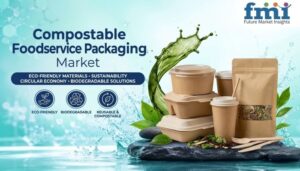


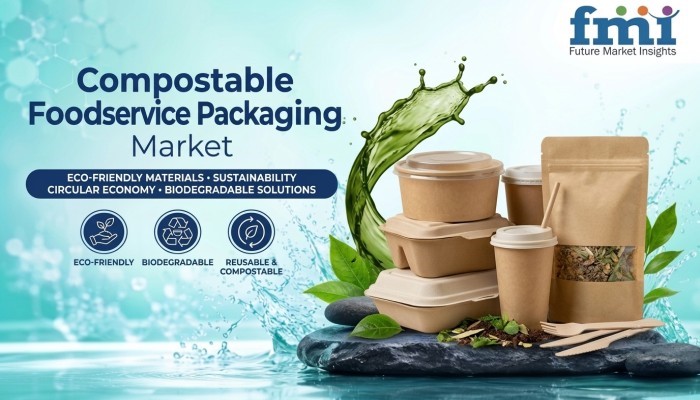
The global compostable foodservice packaging market is expanding as restaurant chains, food delivery businesses and institutional caterers reassess the materials used in takeaway and disposable serviceware. Market revenue is projected to rise from USD 4.6 billion in 2026 to USD 10.6 billion by 2036, up from USD 4.2 billion in 2025. According to the latest analysis by Future Market Insights (FMI), the industry is anticipated to register a Compound Annual Growth Rate (CAGR) of 8.8% over the 2026 to 2036 forecast period.
Demand is increasingly tied to a practical procurement question: can compostable packaging protect food during service and reach an appropriate end-of-life facility after use? Fiber-based formats, including bagasse and molded pulp, are gaining attention because they can serve trays, bowls and clamshell applications that require stiffness and grease resistance. However, certification alone does not guarantee that a local waste collection system will accept the packaging.
Get detailed market forecasts, competitive benchmarking, and pricing trends:
https://www.futuremarketinsights.com/reports/sample/rep-gb-3210
KEY MARKET TAKEAWAYS
- Market Valuation: The market is projected to increase from USD 4.6 billion in 2026 to USD 10.6 billion by 2036, compared with USD 4.2 billion in 2025.
- Growth Rate: Sales are expected to expand at an 8.8% CAGR between 2026 and 2036.
- Leading Segment: Fiber-based products are estimated to hold 51.0% of material demand in 2026.
- Leading End Use: Quick-service restaurants are projected to account for 42.0% of end-use demand in 2026.
- Fastest-Growing Evaluated Country: The Netherlands is forecast to record the highest country CAGR at 9.7% through 2036.
- Core Growth Driver: Foodservice plastic restrictions, corporate waste targets and demand for certified alternatives are encouraging packaging conversions.
INDUSTRY SHIFTS & MARKET DYNAMICS
Compostable packaging is moving from limited sustainability initiatives into broader foodservice procurement programs. Quick-service restaurants, which account for 42.0% of end-use demand in 2026, require consistent packaging across high-volume takeaway operations. Cups, lids, plates, bowls and clamshell containers must withstand heat, grease, condensation and transport without disrupting filling, stacking or delivery. Fiber-based products are estimated to represent 51.0% of material demand, supported by molded-pulp and bagasse formats that can serve several foodservice applications.
Regulatory requirements are also influencing purchasing decisions. The European Union’s Packaging and Packaging Waste Regulation began applying from August 12, 2026, with restrictions on PFAS above specified limits in food-contact packaging. This is increasing attention on material declarations, barrier chemistry and supplier documentation. Buyers are also assessing whether certified packaging is accepted by the waste collection and composting systems available to their outlets.
Infrastructure remains a central restraint. A compostable container may still enter residual waste if local collection contractors do not accept it. Price premiums, inconsistent municipal requirements and the technical challenge of maintaining grease resistance without unsuitable barrier materials can slow adoption. Suppliers that coordinate product certification, performance testing and local waste-management arrangements may be better positioned to secure repeat orders from restaurant groups.
REGIONAL MARKET SUMMARY
FMI’s country-level forecasts indicate varied growth across the evaluated markets:
- Netherlands: 9.7% CAGR, supported by organics collection and circular procurement.
- France: 9.5% CAGR, driven by single-use restrictions and foodservice packaging conversion.
- United States: 9.2% CAGR, supported by state-level rules and quick-service restaurant procurement.
- Canada: 9.0% CAGR, reflecting federal restrictions and municipal organics programs.
- Germany: 8.9% CAGR, supported by packaging compliance requirements and composting capabilities.
- United Kingdom: 8.6% CAGR, influenced by packaging tax pressure and chain-level adoption.
- China: 8.3% CAGR, supported by food delivery volumes and fiber converting capacity.
The Netherlands leads the evaluated countries, while China’s growth reflects the scale of its food delivery market and domestic molded-pulp converting base. Across regions, actual adoption will depend on whether packaging performance, purchasing economics and waste infrastructure align.
ANALYST INSIGHTS
“Foodservice converters must prove end-of-life acceptance without sacrificing grease resistance or hot-fill integrity. Suppliers that connect certification with local collection systems will secure longer restaurant supply agreements,” stated Nandini Roy Choudhury, Principal Consultant at Future Market Insights.
COMPETITIVE LANDSCAPE
Competition includes established foodservice packaging manufacturers and specialists focused on certified plant-based products. Buyers assess fiber product breadth, barrier performance, certification coverage, distributor access and supply reliability. Manufacturers with broad production capabilities can serve large restaurant networks, while compostable packaging specialists compete through certified product ranges and waste-program support.
Key companies profiled in the market include Huhtamaki Oyj, Dart Container Corporation, Vegware Ltd, BioPak, Eco-Products, World Centric, Pactiv Evergreen, Genpak, Sabert Corporation and Fabri-Kal Corporation.
Product development is increasingly focused on combining compostability credentials with practical foodservice performance. In October 2024, Huhtamaki commenced smooth molded fiber production at its Lurgan facility in Northern Ireland. In 2025, BioPak expanded its certified home-compostable packaging portfolio and commercial organics collection service across Australasia. These developments illustrate the importance of manufacturing capacity and end-of-life support in the competitive environment.
ABOUT THE REPORT
The FMI report examines the global compostable foodservice packaging market from 2026 to 2036, covering material type, product type, end use, capacity, certification type and distribution channel. It evaluates fiber-based products, bio-based plastics and other materials across major regional markets. The study also assesses country-level growth, competitive positioning, regulatory influences and factors shaping foodservice packaging procurement. Market estimates draw on primary and secondary research, market sizing and data triangulation.
For more information on the full report: https://www.futuremarketinsights.com/reports/compostable-foodservice-packaging-market
Explore More Related Reports Links:
https://www.openpr.com/news/4690533/top-players-in-the-corrugated-board-market-fmi-forecasts-usd
https://www.openpr.com/news/4690542/top-players-in-the-packing-boxes-market-fmi-forecasts-usd-75-3
https://www.openpr.com/news/4690543/top-players-in-the-food-tray-market-fmi-forecasts-usd-15-6
FMI Custom Research: Strategic Intelligence for Confident Decision-Making
In today’s rapidly evolving business environment, leadership teams need more than market data—they need clear, actionable intelligence tailored to their strategic objectives. FMI’s Custom Research solutions are designed around the specific business questions organizations need answered, enabling executives to evaluate growth opportunities, validate investments, assess competitive dynamics, and reduce uncertainty before making critical decisions. By combining deep industry expertise, primary research, and proprietary market intelligence, FMI delivers insights that help organizations move from assumptions to evidence-based strategies with greater speed and confidence.
Business Impact
FMI helps organizations transform market complexity into strategic clarity, enabling leadership teams to identify growth opportunities faster, optimize resource allocation, strengthen competitive positioning, and make high-stakes business decisions with confidence.
To explore how FMI Custom Research can support your strategic priorities, please connect with our team at – sales@futuremarketinsights.com
About Future Market Insights (FMI)
Future Market Insights, Inc. (FMI) is an ESOMAR-certified, ISO 9001:2015 market research and consulting organization, trusted by Fortune 500 clients and global enterprises. With operations in the U.S., UK, India, and Dubai, FMI provides data-backed insights and strategic intelligence across 30+ industries and 1200 markets worldwide.
Contact Us:
Future Market Insights Inc.
Christiana Corporate, 200 Continental Drive,
Suite 401, Newark, Delaware – 19713, USA
T: +1-347-918-3531
For Sales Enquiries: sales@futuremarketinsights.com
Website: https://www.futuremarketinsights.com
LinkedIn| Twitter| Blogs | YouTube