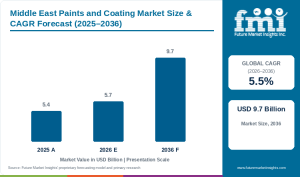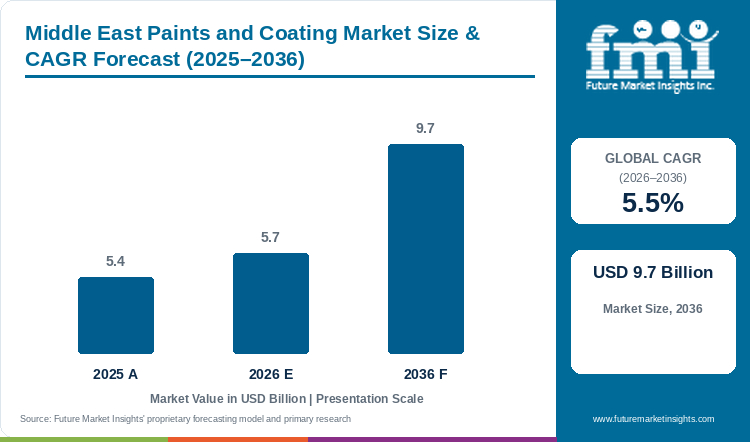
NEWARK, Del., November 12, 2026 – The Middle East paints and coating market is witnessing steady expansion as large-scale infrastructure investments, residential construction projects, industrial development, and rising demand for sustainable coating technologies reshape the regional chemicals and materials industry. According to the latest market intelligence report published by Future Market Insights (FMI), the Middle East paints and coating market is estimated to reach USD 5.7 billion in 2026, increasing from USD 5.4 billion in 2025. The market is projected to reach USD 9.7 billion by 2036, registering a compound annual growth rate (CAGR) of 5.5% between 2026 and 2036.
The market is expected to generate an incremental revenue opportunity of USD 4.0 billion during the forecast period. Growth is supported by expanding residential and commercial construction, oil and gas infrastructure development, offshore maintenance activities, and increasing adoption of water-borne, low-VOC, and high-performance protective coatings across Gulf Cooperation Council (GCC) economies.
Water-borne emulsion paints based on acrylic and vinyl binders are projected to account for 58.0% of technology type demand in 2026. Meanwhile, architectural and decorative interior and exterior wall paints are anticipated to represent 52.0% of product formulation demand, reflecting continued construction activity and increasing requirements for durable decorative coatings.
Get Detailed Market Forecasts, Competitive Benchmarking & Industry Insights: Request a Sample Report: https://www.futuremarketinsights.com/reports/sample/rep-gb-15681
Market Size & Growth Forecasts
The Middle East paints and coating market is transitioning toward advanced coating formulations designed to withstand extreme temperatures, ultraviolet radiation, humidity, and corrosive industrial environments. Construction contractors, infrastructure developers, and industrial operators are increasingly prioritizing coating solutions that deliver durability, environmental compliance, and long-term asset protection.
The residential villa and high-rise construction segment is expected to account for 44.0% of end-use sector demand in 2026. Government-backed housing programs, urban development initiatives, and large-scale residential projects across Saudi Arabia and the United Arab Emirates are supporting demand for interior and exterior architectural coatings.
By resin chemistry, acrylic and polyurethane copolymers are projected to capture 46.0% of demand in 2026, supported by their ultraviolet resistance, durability, and suitability for exterior and industrial applications. Roller brush and airless spray systems are anticipated to account for 51.0% of application method demand as contractors increasingly adopt efficient coating application technologies.
The growing emphasis on green-building standards, low-VOC formulations, solar-reflective coatings, and passive fire protection systems is creating additional opportunities for coating manufacturers across the Middle East.
Key Market Takeaways
Market Valuation: The Middle East paints and coating market is estimated at USD 5.7 billion in 2026.
Future Market Value: The market is projected to reach USD 9.7 billion by 2036.
Growth Rate: The industry is forecast to expand at a CAGR of 5.5% between 2026 and 2036.
Incremental Opportunity: The market is expected to generate USD 4.0 billion in additional revenue during the forecast period.
Leading Technology Segment: Water-borne emulsion paints based on acrylic and vinyl are projected to account for 58.0% of technology demand in 2026.
Leading Product Formulation: Architectural and decorative interior and exterior wall paints are anticipated to capture 52.0% of product formulation demand.
Leading End-Use Sector: Residential villa and high-rise construction is expected to represent 44.0% of end-use demand.
Fastest-Growing Country: Saudi Arabia is projected to lead national market expansion with a CAGR of 6.8% through 2036.
Core Growth Drivers: GCC construction investments, Vision 2030 infrastructure projects, industrial expansion, offshore maintenance, and increasing demand for sustainable coating technologies.
Construction Investments and Infrastructure Development Strengthen Market Demand
Large-scale construction and infrastructure development across the Middle East are creating sustained opportunities for architectural and industrial coating manufacturers. Saudi Arabia’s Vision 2030 initiatives, residential housing developments, commercial megaprojects, and industrial city expansions are increasing demand for high-performance paints and protective coating systems.
The growing construction pipeline across Dubai, Abu Dhabi, Riyadh, Doha, and other regional urban centers is supporting demand for decorative wall paints, exterior facade coatings, waterproofing systems, and specialized protective formulations.
Industrial applications are also becoming increasingly important. Oil and gas facilities, petrochemical plants, offshore platforms, storage terminals, and marine infrastructure require advanced epoxy, polyurethane, and corrosion-resistant coatings to protect assets against harsh environmental conditions.
Manufacturers are responding by expanding regional production capabilities, strengthening distribution networks, and developing formulations suited to extreme heat, coastal humidity, and high ultraviolet exposure.
Water-Borne and Low-VOC Technologies Create New Growth Opportunities
Environmental regulations and green-building requirements are accelerating the adoption of water-borne coatings across the Middle East. Water-borne emulsion paints based on acrylic and vinyl binders are projected to hold a 58.0% share of technology demand in 2026.
Increasing awareness of indoor air quality, environmental performance, and volatile organic compound (VOC) emissions is encouraging construction companies and property developers to prioritize low-VOC coating formulations.
Water-borne technologies offer advantages in residential and commercial applications through lower solvent emissions, easier application, and compatibility with modern architectural requirements. These formulations are particularly relevant for high-rise residential buildings, hospitality developments, hospitals, and commercial properties.
Demand is also expanding for solar-reflective exterior paints, cool-roof coatings, antimicrobial interior formulations, and water-borne passive fire protection systems. Such innovations are creating opportunities for manufacturers to differentiate their portfolios through improved performance and environmental compliance.
Industrial Protective Coatings and Advanced Resin Chemistry Drive Innovation
The growing importance of industrial infrastructure protection is strengthening demand for advanced resin technologies across the region. Acrylic and polyurethane copolymers are expected to account for 46.0% of resin chemistry demand in 2026.
These materials provide resistance to ultraviolet degradation, weathering, abrasion, and chemical exposure, making them suitable for architectural facades, industrial structures, and specialized protective applications.
Epoxy and phenolic epoxy binders are also important in oil and gas infrastructure, offshore platforms, petrochemical facilities, and industrial storage environments. Their corrosion resistance and protective properties make them valuable for applications requiring long-term asset protection.
Manufacturers are increasingly investing in high-solids coatings, powder coatings, fluoropolymer systems, silicone-modified binders, and advanced polyurethane formulations to address evolving industrial requirements.
However, fluctuations in titanium dioxide prices, petrochemical monomer costs, and international shipping expenses continue to create margin pressures for regional coating manufacturers.
Saudi Arabia Leads the Middle East Paints and Coating Market Growth Outlook
Saudi Arabia is projected to register the fastest growth among the evaluated national markets, expanding at a CAGR of 6.8% between 2026 and 2036. Vision 2030 infrastructure investments, residential developments, petrochemical industrial expansion, and large-scale commercial projects are supporting demand for architectural and protective coatings.
Qatar is forecast to grow at a CAGR of 6.4%, supported by North Field LNG expansion, infrastructure development, and protective coating requirements for industrial facilities.
The United Arab Emirates is anticipated to register a CAGR of 6.2%, driven by luxury residential construction, commercial real estate development, hospitality investments, and green-building regulations.
Kuwait is projected to expand at 5.7%, while Bahrain is expected to record a CAGR of 5.5%. Oman is forecast to grow at 5.2%, supported by industrial development in the Duqm Special Economic Zone and urban construction projects.
Egypt is anticipated to register a CAGR of 4.9%, driven by urban development and infrastructure investments, while Türkiye is projected to expand at 4.6%, supported by residential reconstruction and automotive and appliance manufacturing.
Competitive Landscape and Key Companies
The Middle East paints and coating market features a combination of regional manufacturers, multinational coating companies, industrial resin suppliers, and specialized marine and protective coating producers. Competition is increasingly shaped by regional manufacturing capabilities, product innovation, distribution networks, environmental compliance, and technical performance.
Key companies operating in the Middle East paints and coating market include:
- Jotun Group (Jotun Middle East)
- National Paints Factories Co. Ltd.
- Akzo Nobel N.V. (Dulux and International)
- Hempel A/S
- Berger Paints Emirates Limited
- The Sherwin-Williams Company
- Al Jazeera Paints
- PPG Industries, Inc.
- Sika AG
- BASF SE
These companies are focusing on strengthening regional manufacturing footprints, expanding architectural and decorative coating portfolios, developing advanced corrosion protection systems, and improving access to industrial and construction customers.
Regional manufacturers are also investing in localized production, automated tinting centers, and specialized coating technologies to address growing procurement requirements across GCC infrastructure and construction projects.
Recent Developments in the Middle East Paints and Coating Industry
- Sika AG: In October 2026, the company acquired Dubai-based waterproofing and building protection manufacturer Duproof to strengthen its regional construction chemicals and protective coatings presence.
- Akzo Nobel and Axalta Coating Systems: On October 15, 2026, the companies announced that their intended combined global coatings company would be named Axanzo, bringing together their global coatings businesses.
- Hempel A/S: In July 2026, the company launched its water-borne Hempafire Optima 515 passive fire protection coating in the Middle East, featuring 75% volume solids and up to 150 minutes of structural steel fire protection under specified application conditions.
Analyst Perspective
According to Nikhil Kaitwade, Principal Consultant at Future Market Insights:
“Middle East engineering consultants and property developers no longer procure architectural emulsions or industrial epoxies purely on per-liter can price; they buy certified solar reflectance, 150-minute structural fire ratings, and local In-Country Value compliance. Formulators that pair domestic GCC resin blending with automated dealer tinting networks will secure the highest-margin giga-project and offshore maintenance specifications through 2036.”
Future Outlook for the Middle East Paints and Coating Market
The outlook for the Middle East paints and coating market remains positive as construction investments, industrial diversification, and infrastructure modernization continue to support regional demand.
The expansion of residential developments, commercial real estate, oil and gas facilities, offshore infrastructure, and transportation networks is expected to create opportunities across decorative, industrial, marine, and protective coating categories.
At the same time, the transition toward low-VOC technologies, water-borne formulations, advanced resin chemistry, and environmentally compliant products is expected to influence future product development and competitive strategies.
Companies investing in regional manufacturing, sustainable formulations, advanced protective technologies, and localized distribution capabilities are likely to strengthen their market positioning through 2036.
For detailed market insights, competitive benchmarking, regional analysis, and future growth opportunities, access the full report: https://www.futuremarketinsights.com/reports/middle-east-paints-and-coating-market
About Future Market Insights (FMI)
Future Market Insights (FMI) is a market research and consulting firm providing actionable intelligence, strategic analysis, and industry forecasts to businesses across global markets. FMI delivers data-driven insights covering market size, competitive landscapes, emerging trends, growth opportunities, and regional industry developments to support informed business decisions.
Media Contact
For Press & Corporate Inquiries
Rahul Singh
AVP – Marketing and Growth Strategy
Phone: +91 8600020075
For Sales: sales@futuremarketinsights.com
For Media: Rahul.singh@futuremarketinsights.com
Website: https://www.futuremarketinsights.com