

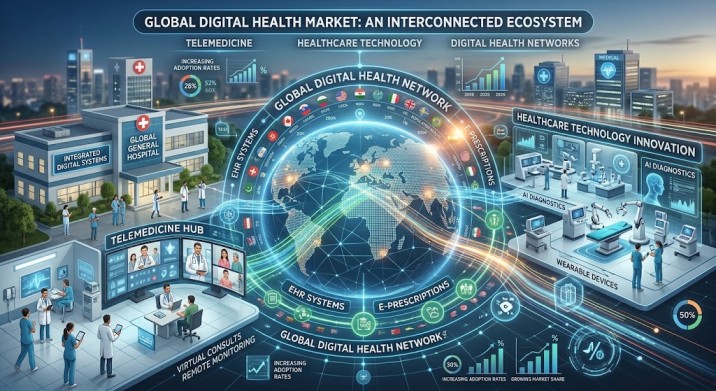
The global digital health market is entering a period of significant expansion as healthcare providers accelerate the adoption of telemedicine, electronic health records (EHRs), remote patient monitoring, and cloud-based clinical platforms. Growing pressure to improve healthcare access, manage chronic diseases, and streamline clinical workflows is encouraging hospitals, insurers, and healthcare networks to invest in connected digital solutions.
According to Future Market Insights (FMI), the global digital health market is estimated to reach USD 420.2 billion in 2026, up from USD 347.4 billion in 2025. The market is projected to expand to USD 2,294.3 billion by 2036, registering a compound annual growth rate (CAGR) of 18.5% during the 2026–2036 forecast period. This represents an estimated incremental market valuation of USD 1,874.1 billion over the decade.
Digital Health Market: Key Growth Highlights
- The global digital health market is forecast to reach USD 2.29 trillion by 2036.
- The market is projected to expand at an 18.5% CAGR between 2026 and 2036.
- Software platforms, mHealth apps, telehealth, and EHR portals are expected to account for 59.4% of solution component demand in 2026.
- Cloud-native SaaS deployment is projected to represent 64.7% of deployment architecture demand.
- Telemedicine and virtual care consultations are expected to account for 39.7% of clinical workflow demand.
- Hospitals and integrated health systems are projected to represent 48.9% of end-user demand.
Request a sample report: https://www.futuremarketinsights.com/reports/sample/rep-gb-505
Integrated Digital Platforms Support Market Expansion
Healthcare providers are increasingly moving away from disconnected digital tools toward integrated platforms that connect patient records, clinical communication, appointment management, and virtual consultations. These systems can help healthcare organizations coordinate services across departments and improve access to patient information.
The growing burden of chronic diseases is another important market driver. Patients with diabetes, cardiovascular conditions, and respiratory disorders often require continuous monitoring and regular follow-up. Remote patient monitoring solutions enable healthcare teams to collect patient data outside conventional clinical settings and support ongoing care management.
Digital platforms are also helping healthcare providers manage administrative workloads. Integrated patient portals, automated documentation tools, and connected clinical systems can reduce fragmented workflows and support more coordinated healthcare delivery.
Software Platforms Lead the Solution Component Segment
Software platforms covering mHealth apps, telehealth, and EHR portals are projected to capture 59.4% of solution component demand in 2026. Healthcare organizations are increasingly prioritizing unified systems that allow patients and clinicians to access appointments, consultations, medical records, and follow-up services through connected interfaces.
Connected diagnostic and remote patient monitoring hardware gateways complement these platforms by transmitting health measurements from home-based devices to clinical systems. Implementation and tele-monitoring services further support deployment and ongoing use.
The shift toward integrated platforms is creating opportunities for software providers that can deliver interoperability, data security, and practical integration with existing hospital infrastructure.
Cloud-Native SaaS Gains Adoption
Cloud-native software-as-a-service (SaaS) is expected to account for 64.7% of deployment architecture demand in 2026. Healthcare organizations are increasingly considering cloud-based platforms to support multi-site operations, scalable data management, and remote access to clinical applications.
Cloud deployment can reduce dependence on locally maintained server infrastructure and support software updates across distributed healthcare networks. However, providers must address data privacy, cybersecurity, regulatory compliance, and interoperability requirements when selecting cloud-based systems.
Hybrid and on-premise architectures will continue to serve organizations with specific data-sovereignty, infrastructure, or operational requirements.
Telemedicine and Virtual Care Reshape Clinical Workflows
Telemedicine and virtual care consultations are projected to account for 39.7% of clinical workflow demand in 2026. Virtual consultations allow patients to connect with healthcare professionals without always requiring an in-person visit, supporting access to primary care, behavioral health, and follow-up services.
Remote chronic disease management is another important application. Connected devices can transmit measurements such as blood pressure and glucose levels to healthcare teams, supporting monitoring between scheduled appointments.
Prescription digital therapeutics and software-based clinical interventions are also creating opportunities for digital health providers. As regulatory and reimbursement frameworks develop, clinically validated applications may become more integrated into treatment pathways.
Hospitals and Integrated Health Systems Drive Procurement
Hospitals and integrated health systems are expected to represent 48.9% of end-user demand in 2026. These organizations invest in digital health platforms to connect clinical departments, manage patient information, and coordinate inpatient and outpatient services.
Institutional procurement is also significant because large healthcare networks often require customized software integration, staff training, technical support, and multi-year service agreements.
Healthcare payers, self-insured employers, patients, and home care agencies represent additional demand sources as digital health services expand beyond traditional hospital environments.
Regional Growth Outlook: South Korea and Brazil Lead Country Expansion
FMI identifies strong growth opportunities across several national markets during the 2026–2036 period. South Korea and Brazil are projected to record the highest country-level growth rates among the markets highlighted.
- South Korea – 8.8% CAGR: Smart-hospital cloud EHR adoption and expanded outpatient telemedicine initiatives are supporting digital healthcare investment.
- Brazil – 8.4% CAGR: Digital primary care and teleconsultation programs are expanding access to healthcare services.
- United States – 7.0% CAGR: Remote patient monitoring reimbursement and value-based healthcare arrangements are supporting adoption.
- Germany – 6.9% CAGR: Digital health application reimbursement and electronic patient record initiatives are encouraging investment.
- United Kingdom – 6.8% CAGR: NHS virtual ward expansion and digital patient record programs are supporting market development.
- Japan – 6.6% CAGR: Online medical care and remote chronic disease monitoring are contributing to demand.
- Canada – 6.4% CAGR: Provincial virtual care programs and remote monitoring networks are supporting adoption.
- France – 6.2% CAGR: National health portal integration and tele-expertise reimbursement are contributing to digital health expansion.
Competitive Landscape: Key Companies in the Digital Health Market
The digital health market includes enterprise healthcare software providers, virtual care platforms, and connected medical technology companies. Competition is shaped by platform interoperability, clinical integration, data security, user experience, and the ability to support large healthcare networks.
Key companies profiled by FMI include:
- Teladoc Health, Inc.
- Koninklijke Philips N.V.
- Oracle Health
- Epic Systems Corporation
- Amwell
- Doximity, Inc.
- Veradigm Inc.
- athenahealth, Inc.
These companies participate in different areas of the digital health ecosystem. Enterprise EHR providers support clinical records and patient portals, while virtual care companies deliver teleconsultation and remote care services. Connected healthcare technology providers contribute monitoring systems and diagnostic platforms.
Analyst Perspective
Anurag Sharma, Principal Consultant at Future Market Insights, observes:
“Health systems have stopped buying standalone telehealth apps that force doctors to toggle between separate browser windows and manual billing sheets. Vendors that integrate cloud-native FHIR patient portals, cellular remote monitoring gateways, and automated CPT coding directly into core hospital EHR workflows will capture multi-year enterprise renewals.”
Outlook for the Global Digital Health Market
The global digital health market is expected to experience substantial growth through 2036 as healthcare providers expand virtual care, remote monitoring, and integrated clinical software. Cloud-native platforms, connected diagnostic technologies, and digital therapeutics are creating opportunities for technology providers and healthcare organizations.
Companies that prioritize interoperability, data protection, clinical usability, and measurable improvements in care coordination are likely to strengthen their position as healthcare systems continue their digital transformation.
Related Reports:
- Hair Restoration Market – https://www.futuremarketinsights.com/reports/hair-restoration-market
- Softgel Capsules Market – https://www.futuremarketinsights.com/reports/softgel-capsules-market
- Mobile Cardiac Telemetry System Market – https://www.futuremarketinsights.com/reports/mobile-cardiac-telemetry-systems-market
About Future Market Insights (FMI)
Future Market Insights (FMI) is a global market intelligence and consulting firm providing comprehensive market research, competitive intelligence, and strategic business insights across industries. The firm delivers detailed forecasts, technology analysis, and data-driven recommendations that support informed decision-making for manufacturers, investors, distributors, and policymakers worldwide.
For Press & Corporate Inquiries
Rahul Singh
AVP – Marketing and Growth Strategy
Future Market Insights, Inc.
+91 8600020075