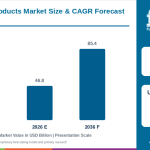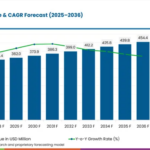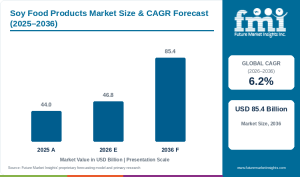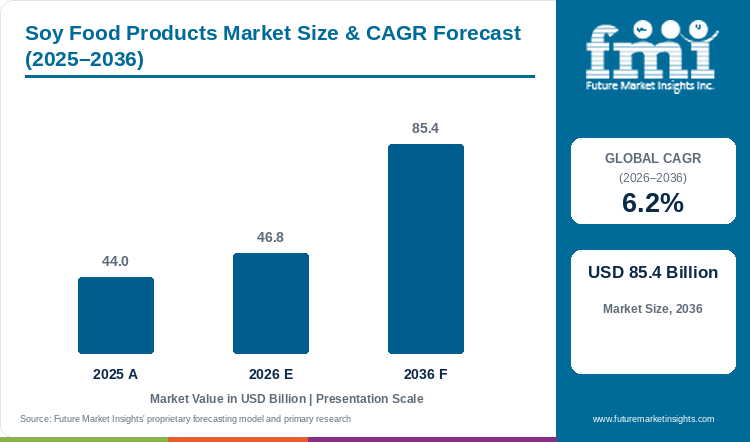
NEWARK, Del., November 12, 2026 — The global soy food products market is witnessing steady expansion as consumers increasingly prioritize plant-based protein, clean-label nutrition, fermented foods, and dairy-free beverage alternatives. According to the latest market intelligence report published by Future Market Insights (FMI), the global soy food products market is estimated to reach USD 46.8 billion in 2026, increasing from USD 44.0 billion in 2025. The market is projected to reach USD 85.4 billion by 2036, registering a compound annual growth rate (CAGR) of 6.2% during the 2026–2036 forecast period. This growth represents an incremental revenue opportunity of approximately USD 38.6 billion.
The growing acceptance of plant-based diets and rising demand for complete protein sources are transforming the global soy food industry. Soy milk, tofu, soy sauce, miso, tempeh, natto, edamame, and textured soy protein are gaining importance across household consumption, foodservice operations, and industrial food manufacturing. Soy-based products offer complete amino acid profiles, versatile processing characteristics, and applications across beverages, meat alternatives, fermented condiments, and convenience foods.
Get Detailed Market Forecasts, Competitive Benchmarking & Industry Insights: Request a Sample Report: https://www.futuremarketinsights.com/reports/sample/rep-gb-105
Manufacturers are increasingly investing in whole-bean processing, fermentation technologies, non-GMO sourcing, and shelf-stable packaging to address changing consumer preferences. The expansion of retail plant-based beverage categories and demand for naturally fermented ingredients are expected to create new opportunities for soy food producers throughout the forecast period.
Market Size & Growth Forecasts
The global soy food products market is expected to maintain consistent growth between 2026 and 2036, supported by increasing consumption of plant-based beverages, fermented soy foods, and protein-rich food alternatives.
Soy Milk and Ready Drinks are projected to account for 39.0% of the product category segment in 2026, supported by demand for complete plant protein, dairy alternatives, and barista-compatible beverages. Fermented Soy Foods are anticipated to capture 64.0% of the processing type segment as naturally brewed soy sauce, miso, tempeh, and natto remain important components of global food consumption.
Non-GMO Certified Organic Soybeans are expected to represent 72.0% of the source certification segment in 2026, reflecting the growing importance of ingredient traceability, identity preservation, and clean-label sourcing. Retail Supermarkets and Asian Specialty Grocers are projected to account for 56.0% of distribution channel demand, while Aseptic Cartons and Vacuum Pouches are expected to capture 52.0% of packaging format sales.
These developments highlight the increasing importance of product differentiation, processing efficiency, ingredient transparency, and packaging innovation across the global soy food value chain.
Key Market Takeaways
Market Valuation: The global soy food products market is estimated at USD 46.8 billion in 2026.
Historical Market Size: The market was valued at USD 44.0 billion in 2025.
Future Market Forecast: The industry is projected to reach USD 85.4 billion by 2036.
Growth Rate: The market is expected to expand at a CAGR of 6.2% between 2026 and 2036.
Incremental Opportunity: The market is forecast to generate approximately USD 38.6 billion in additional revenue.
Leading Product Category: Soy Milk and Ready Drinks are projected to account for 39.0% of the product category segment in 2026.
Leading Processing Type: Fermented Soy Foods are anticipated to capture 64.0% of the processing type segment.
Leading Source Certification: Non-GMO Certified Organic Soybeans are expected to account for 72.0% of the source certification segment.
Leading Distribution Channel: Retail Supermarkets and Asian Specialty Grocers are projected to represent 56.0% of distribution channel demand.
Leading Packaging Format: Aseptic Cartons and Vacuum Pouches are forecast to capture 52.0% of packaging format sales.
Fastest-Growing Country: Mexico is projected to register the highest country-level CAGR of 7.4% through 2036.
Plant-Based Protein Consumption and Fermented Food Innovation Drive Demand
The increasing demand for plant-based protein is one of the primary factors supporting the global soy food products market. Consumers are exploring alternatives to conventional dairy and animal-based protein sources, creating opportunities for soy milk, tofu, edamame, textured soy protein, and other whole-bean products.
Soy milk and ready-to-drink beverages are particularly benefiting from growing demand for convenient nutritional products. Their complete protein composition and compatibility with coffee, smoothies, and breakfast applications make them attractive to consumers and commercial beverage operators. Food manufacturers are also investing in processing technologies that improve taste, reduce beany off-notes, and maintain nutritional characteristics.
Fermented soy foods represent another important growth opportunity. Naturally brewed soy sauce, miso, tempeh, and natto are gaining attention as manufacturers and consumers increasingly value traditional fermentation methods, distinctive umami profiles, and versatile culinary applications.
Technological improvements in microbial fermentation and ingredient processing are helping producers develop differentiated products with improved consistency, flavor, and functional properties. These developments are supporting the expansion of fermented soy foods across Asian and Western markets.
Non-GMO Sourcing and Sustainable Processing Reshape the Industry
Ingredient traceability and certification are becoming increasingly important across the soy food products value chain. Food manufacturers and retail buyers are placing greater emphasis on non-GMO soybean sourcing, organic certification, and identity-preserved supply chains.
Non-GMO Certified Organic Soybeans are projected to account for 72.0% of the source certification segment in 2026. This reflects growing procurement requirements across major food markets, particularly in Europe, Japan, and North America.
Manufacturers are increasingly establishing direct relationships with soybean suppliers to secure consistent food-grade raw materials and improve supply chain transparency. Identity-preserved sourcing also enables producers to differentiate premium soy beverages, tofu, and fermented food products.
Processing efficiency remains another important industry priority. Commercial tofu and soy beverage manufacturers are exploring improved whole-bean grinding, coagulation techniques, and byproduct utilization. The conversion of okara, a soybean pulp generated during processing, into high-fiber snacks and value-added food ingredients represents an emerging commercial opportunity.
However, manufacturers continue to face challenges related to soy allergen labeling, raw material price fluctuations, non-GMO sourcing premiums, and production efficiency. Companies that improve processing economics while maintaining ingredient quality and regulatory compliance are expected to strengthen their competitive positions.
Regional Market Outlook: Mexico and Brazil Lead Growth
Regional demand for soy food products is expanding across North America, Latin America, Europe, and Asia Pacific as plant-based food consumption and value-added soybean processing gain momentum.
Mexico is projected to register the fastest growth, with the soy food products market expected to expand at a CAGR of 7.4% between 2026 and 2036. Increasing incorporation of textured soy protein into meat extensions, affordable protein formulations, and lactose-free soy beverages is supporting market development.
Brazil is anticipated to record a CAGR of 6.7% through 2036, driven by domestic soybean processing capabilities and expanding production of aseptic soy beverages, textured soy protein, and tofu.
The United States soy food products market is projected to grow at a CAGR of 6.5%, supported by investments in tofu manufacturing facilities, demand for plant-based beverages, and expanding consumption of brewed soy sauce and edamame.
Canada is forecast to register a CAGR of 6.3%, supported by food-grade soybean availability, non-GMO sourcing, and domestic soy beverage and tofu production.
China is expected to expand at a CAGR of 6.1%, driven by food-grade soybean cultivation, packaged tofu modernization, and naturally brewed soy sauce production. Japan is projected to grow at 5.9%, supported by established consumption of natto, silken tofu, miso, and functional soy milk.
The United Kingdom soy food products market is anticipated to record a CAGR of 5.7%, while Spain is forecast to expand at 5.5% through 2036. Demand for smoked tofu, marinated soy products, and ambient shelf-stable soy beverages is expected to support European market development.
Get Detailed Market Forecasts, Competitive Benchmarking & Industry Insights Full Report https://www.futuremarketinsights.com/reports/global-soy-food-products-market
Competitive Landscape and Key Companies
The global soy food products market features multinational food and beverage manufacturers, specialized soy processors, fermented condiment producers, and plant-based nutrition companies. Market participants are focusing on product innovation, international distribution, fermentation capabilities, non-GMO sourcing, and manufacturing expansion to strengthen their competitive positioning.
Key companies operating in the global soy food products market include:
- Kikkoman Corporation
- Danone SA
- The Hain Celestial Group Inc.
- House Foods Group Inc.
- Vitasoy International Holdings Ltd.
- The Nisshin OilliO Group Ltd.
- Eden Foods Inc.
- Pulmuone Co., Ltd.
- Archer Daniels Midland Company
- Morinaga Milk Industry Co., Ltd.
These companies participate across different areas of the soy food value chain, including plant-based beverages, tofu, fermented sauces, soy protein ingredients, and specialty food products.
Competitive strategies increasingly emphasize product diversification, manufacturing capacity expansion, vegan certification, clean-label formulations, and regional distribution partnerships. Companies that combine reliable food-grade soybean sourcing with differentiated products and efficient processing capabilities are expected to benefit from evolving global demand.
Future Outlook: Innovation in Plant-Based Beverages and Fermented Soy Foods
Over the forecast period, the soy food products market is expected to benefit from continued innovation in plant-based beverages, high-protein food formulations, fermented products, and convenient packaged foods.
Soy milk manufacturers are likely to focus on improved sensory characteristics, barista-compatible formulations, and shelf-stable packaging. Tofu producers may increasingly invest in advanced coagulation technologies and automated production systems to improve consistency and manufacturing efficiency.
The development of value-added fermented products, including premium soy sauces, miso, and tempeh, is also expected to create opportunities for established food brands and emerging manufacturers.
Additionally, the utilization of soybean processing byproducts and expansion of non-GMO certified sourcing networks may help manufacturers improve sustainability and product differentiation.
Related Food & Beverage Industry Reports Explore additional market intelligence and industry research from Future Market Insights:
Frozen Desserts Market https://www.futuremarketinsights.com/reports/frozen-desserts-market
Organic Foods Market https://www.futuremarketinsights.com/reports/organic-foods-market
Fortified Foods Market https://www.futuremarketinsights.com/reports/fortified-food-market
Gluten-free Food Market https://www.futuremarketinsights.com/reports/gluten-free-food-market
About Future Market Insights (FMI)
Future Market Insights (FMI) is a global market research and consulting organization providing actionable market intelligence, industry analysis, and strategic insights across diverse industry verticals. FMI helps businesses, investors, and decision-makers identify emerging opportunities, understand competitive landscapes, evaluate market dynamics, and develop informed growth strategies through comprehensive research and data-driven insights.
Media Contact
For Press & Corporate Inquiries
Rahul Singh
AVP – Marketing and Growth Strategy
Phone: +91 8600020075
For Sales: sales@futuremarketinsights.com
For Media: Rahul.singh@futuremarketinsights.com
Website: https://www.futuremarketinsights.com