

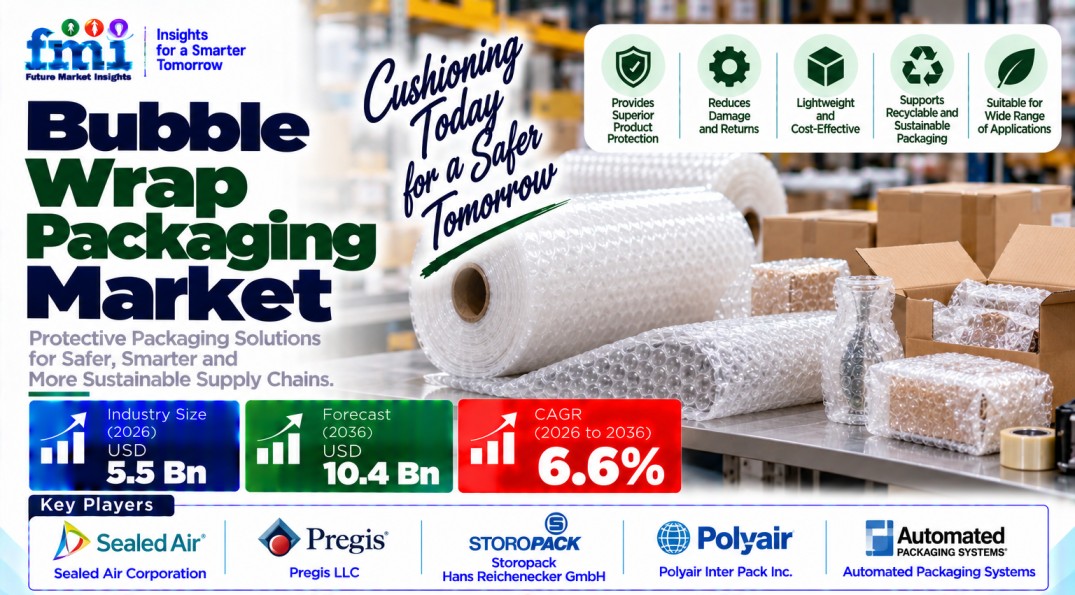
According to the latest market intelligence report published by Future Market Insights (FMI), the global bubble wrap packaging market is estimated to reach USD 5.5 billion in 2026 and is projected to grow to USD 10.4 billion by 2036, registering a compound annual growth rate (CAGR) of 6.6% from 2026 to 2036. Market expansion is supported by increasing e-commerce shipments, growing logistics activity and the need to protect fragile products during storage and transportation.
Bubble wrap remains an important protective packaging material for electronics, household appliances, pharmaceuticals, consumer goods and industrial components. FMI identifies cushioning performance, resistance to compression, compatibility with automated packing systems and material efficiency as important considerations shaping purchasing decisions across fulfillment and manufacturing operations.
Market Size & Growth Forecasts
- 2026 Estimated Market Size: USD 5.5 billion
- 2036 Projected Market Value: USD 10.4 billion
- Forecast CAGR: 6.6% from 2026 to 2036
- Leading Material: Polyethylene bubble wrap, with approximately 68% share
- Leading Application: E-commerce and retail, with approximately 42% share
- 2026–2036 Market Expansion: USD 4.9 billion, based on the published market values
The report examines bubble wrap by material type, application, bubble size, thickness, end-use industry and region. The published page does not specify a 2025 baseline market value.
>> Get Detailed Market Forecasts, Competitive Benchmarking, and Pricing Trends: https://www.futuremarketinsights.com/reports/sample/rep-gb-5612
Key Market Segments
By Material Type
Polyethylene (PE) bubble wrap accounts for approximately 68% of the market. Its flexibility, lightweight construction and cushioning properties make it suitable for high-volume parcel shipments and varied handling conditions. PE bubble wrap is also compatible with automated wrapping and dispensing equipment, supporting its use in logistics and industrial packaging.
Other material categories identified in the report include polyurethane and other materials. Material selection depends on the protective performance required, product characteristics and shipping conditions.
By Application
E-commerce and retail represent approximately 42% of market demand, making this the leading application segment. Online retailers and fulfillment centers use bubble wrap to protect fragile goods, including electronics, cosmetics and household products, while maintaining efficient packing operations.
Additional applications include electronics and electrical products, consumer goods, automotive and industrial components, and food and beverage packaging. These uses reflect the need for adaptable cushioning across different product sizes, shipment distances and handling conditions.
By Bubble Size and Thickness
The market includes small bubbles measuring 6–10 mm, medium bubbles measuring 10–25 mm, and large bubbles above 25 mm. Smaller bubbles are commonly suited to lightweight and fragile items, while larger bubbles can provide additional cushioning for heavier products.
Thickness categories include standard films of 50–100 microns, heavy-duty films of 100–150 microns, and extra-heavy-duty films above 150 microns. These options allow buyers to match packaging specifications to product weight and anticipated handling intensity.
By Country / Region
FMI projects the following country-level CAGRs for 2026–2036:
- India: 9.1%, supported by expanding e-commerce, fulfillment infrastructure and manufacturing activity.
- China: 8.0%, reflecting high parcel volumes, domestic online retail and export-oriented shipping.
- Brazil: 7.6%, supported by growing online retail and logistics investment.
- United States: 6.3%, driven by established fulfillment networks and demand for damage prevention.
- France: 6.2%, supported by retail, cosmetics and specialty-product shipments.
- Germany: 5.9%, reflecting industrial exports and structured logistics operations.
- Japan: 5.4%, supported by electronics shipments and demand for consistent packaging quality.
Asia Pacific is identified as the fastest-growing region, while North America remains a major consumption hub. Europe also contributes to demand through manufacturing, retail and logistics applications.
Major Market Trends & Drivers
Growth in e-commerce fulfillment: Rising parcel volumes increase demand for lightweight protective materials that can help reduce transit damage and associated product returns.
Packaging automation: Warehouses increasingly require bubble wrap formats compatible with automated and semi-automated dispensing, cutting and packing systems. Consistent bubble formation and film performance help support operational efficiency.
Sustainability and material optimization: Plastic-waste concerns and resin-price fluctuations are encouraging manufacturers to explore downgauged films, recycled-content integration and alternative protective packaging formats. Balancing environmental considerations with cushioning performance remains a key industry challenge.
>> Access Detailed Market Insights: https://www.futuremarketinsights.com/reports/bubble-wrap-packaging-market
Competitive Landscape
Competition includes global protective-packaging manufacturers and regional suppliers serving logistics, industrial and retail customers. Companies differentiate through cushioning performance, material consistency, product customization, supply availability and compatibility with automated packaging operations.
Key Companies Profiled Include: Sealed Air Corporation, Pregis LLC, Storopack Hans Reichenecker GmbH, Polyair Inter Pack Inc., Automated Packaging Systems, Jiffy Packaging Co., Smurfit Kappa Group, Barton Jones Packaging Ltd and Airplus Packaging Solutions.
Analyst Perspective / Insight
Editorial synthesis based on FMI’s published findings—not a verbatim analyst quotation:
“As parcel volumes and fulfillment requirements increase, bubble wrap suppliers must balance reliable product protection with packing efficiency and material use. Manufacturers that can deliver consistent cushioning, automation-compatible formats and practical material optimization will be better positioned to address changing customer requirements.”