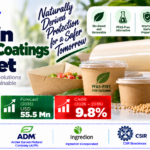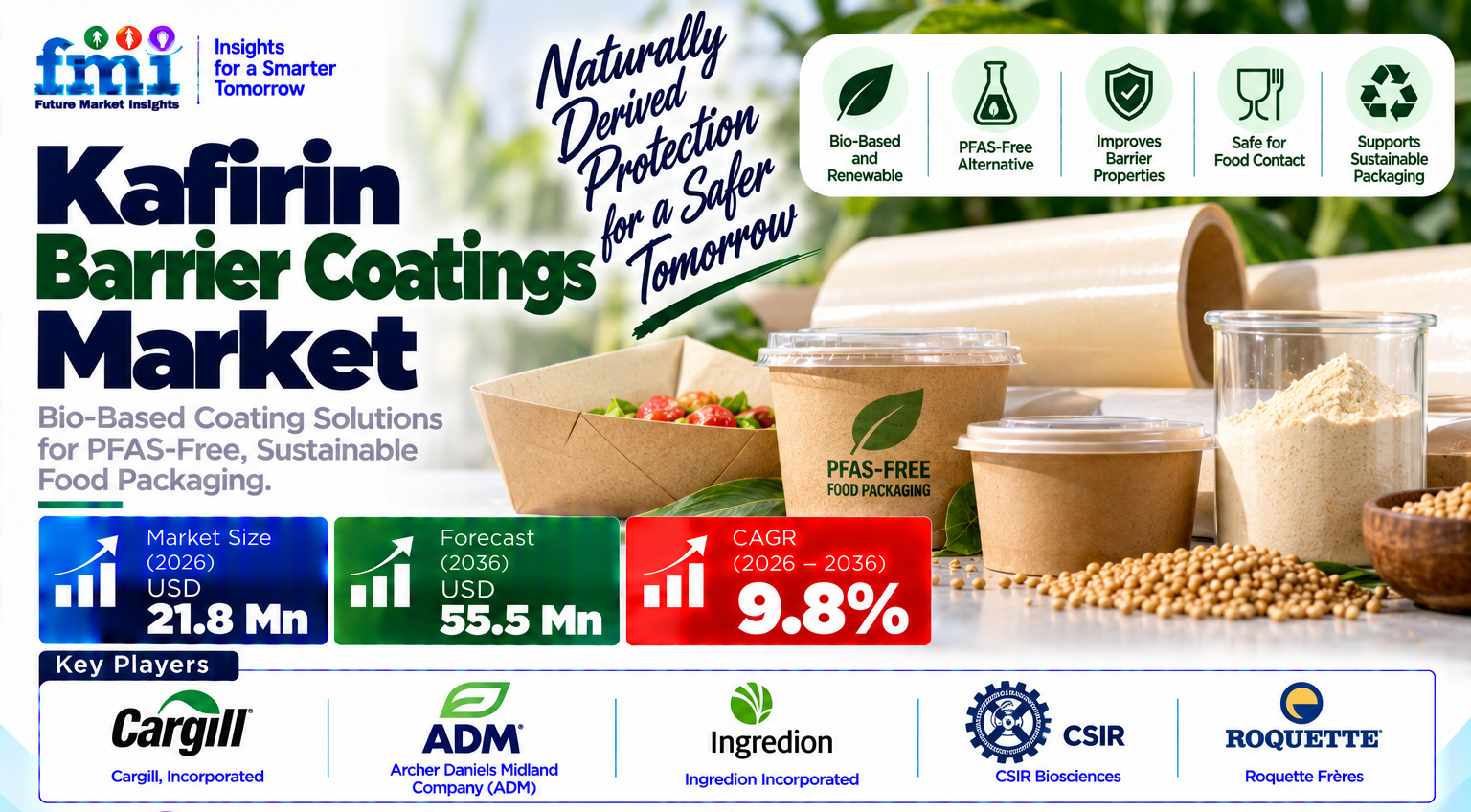
According to the latest market intelligence report published by Future Market Insights (FMI), the global kafirin barrier coatings market is valued at USD 21.8 million in 2026, up from USD 19.8 million in 2025. The market is projected to reach USD 55.5 million by 2036, registering a compound annual growth rate (CAGR) of 9.8% from 2026 to 2036. Demand for bio-based grease and moisture barriers, regulatory pressure to reduce fluorochemical use in food packaging, and growing interest in valorizing sorghum-processing by-products are creating new opportunities for plant-protein coating technologies.
Market Size & Growth Forecasts
FMI’s analysis examines kafirin, a sorghum-derived prolamin protein used to develop barrier coatings for paperboard, molded fiber, flexible bio-based films, and selected food surfaces.
- 2025 Baseline Market Value: USD 19.8 million
- 2026 Estimated Market Size: USD 21.8 million
- 2036 Projected Market Value: USD 55.5 million
- Forecast CAGR: 9.8% (2026–2036)
- Incremental Growth Opportunity: USD 33.7 million between 2026 and 2036
Kafirin’s hydrophobic properties and potential to form crosslinked protein networks make it relevant to packaging applications requiring resistance to grease and moisture. Commercial expansion will depend on extraction efficiency, coating consistency, food-contact compliance, and the economics of converting existing production lines.
>> Get Detailed Market Forecasts, Competitive Benchmarking, and Pricing Trends: https://www.futuremarketinsights.com/reports/sample/rep-gb-35871
Key Market Segments
By Feedstock and Prolamin Fraction
- White Tan-Plant Sorghum Distillers Dried Grains (DDGS): Projected to capture 58.6% of feedstock demand in 2026, supported by protein-rich distillery co-products and reduced risk of dark pigment staining on light-colored packaging.
- Alpha-Kafirin and Gamma-Kafirin Disulfide-Crosslinked Blends: Expected to represent 52.4% of prolamin fraction demand in 2026, with crosslinking supporting barrier performance under humid conditions.
By Coating Process and Packaging Application
- Aqueous Ethanol Roll-to-Roll Rod and Curtain Coating: Forecast to account for 49.0% of coating-process demand in 2026, offering a route to apply coatings on continuous production lines.
- Molded Fiber and Kraft Paperboard Trays: Projected to capture 54.8% of coated packaging substrate demand in 2026, supported by interest in alternatives to conventional plastic and fluorochemical barriers.
- High-Moisture Chilled Meat and Bakery Paperboard: Expected to account for 43.5% of end-use food-sector demand in 2026, reflecting the need to limit grease penetration and moisture-related deterioration.
- Standard Confectionery Grade, 2.5–3.5 gsm: Forecast to represent 57.2% of coat-weight specification demand in 2026.
By Country / Region
FMI projects strong growth across sorghum-processing markets and established packaging economies, with South Africa recording the fastest expansion among the profiled countries.
- South Africa: Expected to grow at an 11.3% CAGR through 2036, supported by kafirin extraction commercialization and coatings for exported citrus and avocados.
- Brazil: Projected to expand at an 11.0% CAGR, supported by sorghum bioethanol production and opportunities to utilize DDGS co-products.
- Mexico: Forecast to grow at a 10.7% CAGR, with sorghum processing and export-oriented food packaging supporting demand.
- United States: Expected to register a 9.4% CAGR, as demand for alternatives to fluorochemical food-packaging barriers creates opportunities for coated trays.
- Australia: Projected to grow at a 9.1% CAGR, supported by sorghum supply and interest in alternatives to conventional foodservice packaging.
- France: Forecast to expand at an 8.8% CAGR, reflecting demand for compliant food-contact packaging and bio-based barrier materials.
Major Market Trends & Drivers
- PFAS-Free Packaging Transition: Restrictions on certain fluorinated substances in food packaging are encouraging converters to assess alternative grease-resistant coatings.
- Sorghum By-Product Valorization: Protein-rich DDGS provides a potential feedstock for higher-value coating ingredients rather than being used exclusively in conventional applications.
- Barrier Performance and Paper Recovery: Kafirin formulations are being investigated for grease and moisture resistance while retaining compatibility with paper-based packaging systems.
- Extraction and Processing Challenges: Aqueous-ethanol recovery, protein denaturation, and coating-line integration remain important technical and capital considerations for commercial adoption.
>> Access Detailed Market Insights: https://www.futuremarketinsights.com/reports/kafirin-barrier-coatings-market
Competitive Landscape
Competition spans agricultural processors, plant-protein specialists, coating formulators, and intellectual-property licensors. Suppliers are positioned across the value chain, from sorghum feedstock and protein extraction to crosslinked formulations and food-grade barrier coatings.
Key companies profiled include:
- Cargill, Incorporated
- Archer Daniels Midland Company (ADM)
- Ingredion Incorporated
- CSIR Biosciences
- Roquette Frères
- Mantrose-Haeuser Co., Inc. (RPM International)
- Tate & Lyle PLC
- Kerry Group plc
Analyst Perspective
“Disulfide-crosslinked kafirin dispersions give molded fiber and kraft paperboard converters an industrial-compostable grease and water-vapor barrier.”